
Why the authors of Software as a Medical Device sought to 'embed AI into every chapter’

Software as a medical device sits at one of healthcare’s fastest-evolving frontiers: the intersection of software, regulation, and artificial intelligence.
Software as a Medical Device, Second Edition aligns the regulatory community with the current state-of-the-art understanding of SaMD, with essential reading on SaMD fundamentals (including for IVDs), software classification, safety and security risk management for software, clinical evaluation of software, and so much more, all written by regulatory experts.
We spoke to Gert Bos and Koen Cobbaert, the book’s lead editors, for a conversation about the advances that necessitated this new book, how they find expert authors, and more.
Why publish a new and updated version of this book?
Koen Cobbaert: We wanted to explore what is going on around the world by looking at guidance, by talking to experts in the different jurisdictions, and then to ultimately bring readers the context that they need to go beyond the dry legal text and understand what it means to implement these legislations and guidances.
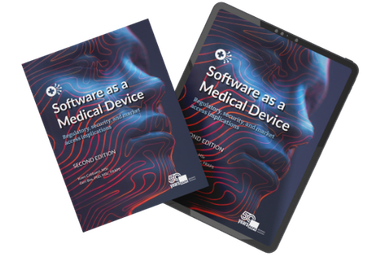
Navigate the quickly evolving world of SaMD
With this updated book written by regulatory experts.
How did advances in artificial intelligence inform this book?
Gert Bos: When we started the process of rewriting the book with original authors and new authors, we sought to embed AI into every chapter. This meant a lot of the guidance globally was updated as we were writing. This was a challenge and made for an iterative process, but it ultimately helped us produce the most up-to-date resource available.
What else is new in this second edition?
Bos: When we published the first edition, there was no book in the world on SaMD. When we got started, we were focused on creating a book that explains what everyone needs to know about software if you are developing or supervising a product, if you are a health authority, and so on. We were focused on the essential parts of the validation and in doing the clinical evaluation.
For the second edition, we had the opportunity to update these chapters with new information, but also to add new topics. The chapter on health technology assessment was completely rewritten. As you can imagine, with all the advances in artificial intelligence, our chapter on AI has been substantially changed. We added a chapter on economic operators that goes into what it means to place software on the market. This chapter examines how it works if you have configurable software, if you sell licenses, if your software is cloud-based, or if it is deployed to a specific customer and continues to change in that customer setting. And it goes into the implications in terms of market authorization and market access for those issues.
If a chapter made it into this book, it was reviewed three times over, by Koen, by myself, and by an editor. There is a lot of rigor in the process. There is so much fine-tuning to ensure everything is fit for you to read.
One crucial new chapter is on data management. It's a complex field, and the role of data is becoming more prominent day by day. There are hardly any software medical devices that aren't created either using data, validated using data, or just processing data while they're actually being used in practice. And from the whole development up to the whole decommissioning of the device, the whole lifecycle is actually very much intertwined with the use and availability of data and how that data is being gathered. The regulations around it are tightening fast, and the number of regulations and standards is increasing. It's a fascinating field.
Where do the expert authors in this book come from?
Cobbaert: After we published the first edition, we came together and received commitments from various authors from the first edition of the book that they were willing to come back for the second edition.
Then we sought out new experts to make sure this book is as up to date as possible. One example: after market authorization, you still need to get your software into clinical pathways. For that, you need to have technology assessments. That is a landscape that is diversifying across the world.
Go deeper: read a free chapter of Software as a Medical Device, Second Edition in RAPS Library, our searchable e-book platform. Start reading.
In my role at Philips, it is my job to understand and monitor what's happening across the world in terms of existing guidance, laws, and standards. That gives me the opportunity to participate in a lot of forums and get access to a lot of information sources that others may not have. That’s where you quickly recognize who the true subject matter experts are. Then it was a matter of us going out, asking these experts if they wanted to contribute, and finding the chapters and topics in the book that matched their expertise.
What makes this book different from other resources on SaMD?
Bos: The expertise and commitment that goes into each page. It was not just, well, someone writes a chapter and then RAPS prints it. If a chapter made it into this book, it was reviewed three times over, by Koen, by myself, and by an editor. There is a lot of rigor in the process. There is so much fine-tuning to ensure everything is fit for you to read.
Explore the world of SaMD
With the new guide to one of healthcare’s fastest-evolving frontiers.