
Strategic regulatory intelligence on pricing and reimbursement models for cell and gene therapies
Abstract This is the second of two articles on cell and gene therapies (CGTs). CGTs are among the most transformative and commercially complex therapeutics with their curative potential and one-time administration model. However, their extremely high research, development, and manufacturing costs create a unique set of regulatory and market access challenges not adequately addressed by the existing frameworks. The article synthesizes comparative regulatory intelligence across five major jurisdictions and discusses the corresponding health technology assessments (HTA), payer expectations, and reimbursement landscapes governing commercial access for approved CGT products. The first article focuses on the role of strategic regulatory intelligence in shaping CGT strategy across the development lifecycle.
Keywords – cell and gene therapy, health technology assessment, outcome-based agreement, regulatory intelligence, risk-sharing agreement
Introduction
CGTs, a therapeutic category that includes cell, gene, and tissue-engineered therapies, differ from all other drug classes for which existing policies were originally intended.1 These differences present unique challenges for regulatory science, HTA frameworks, and payer infrastructure across major global markets. The prospect of a single administration with potentially curative benefit, combined with high manufacturing costs and reliance on single-arm clinical studies in rare or refractory populations, represents a set of trade-offs that regulators have been willing to accept for CGTs. In contrast, these characteristics are often viewed as insufficient by HTA bodies and payers when recommending reimbursement.2
In this context, regulatory intelligence on regulatory agency expectations, HTA body methodologies, and payer decision frameworks across leading markets is an essential strategic requirement for improved patient access to these much-needed therapies. The regulatory intelligence challenge is further compounded by globally divergent and distinct policies. The US Food and Drug Administration (FDA) has established orphan disease, breakthrough therapy designation, and accelerated approval pathways that facilitate early authorization based on surrogate endpoints.3 However, the absence of a formal national HTA process means that pricing and access decisions are fragmented across payers. These decisions are also subject to external review by organizations such as the Institute for Clinical and Economic Review (ICER), whose cost-effectiveness assessments carry no regulatory authority but might have substantial commercial impact.4
The European Medicines Agency (EMA) grants centralized marketing authorization for CGTs classified as advanced therapy medicinal products (ATMPs) and offers conditional approval and priority medicine pathways.5 Since January 2025, the European Joint Clinical Assessment (JCA) under Regulation EU 2021/2282 superimposes a harmonized comparative clinical evidence evaluation across 27 member states.6 However, member countries apply their own HTA methodology, comparator selection logic, pricing negotiation, and reimbursement process.
Japan’s Pharmaceuticals and Medical Devices Agency (PMDA) processes CGT applications through what is called an expedited Sakigake designation pathway7 and mandates National Health Insurance (NHI) listing within 60 to 90 days following approval. However, the Ministry of Health, Labor and Welfare (MHLW) subjects listed products to biennial price revisions, which can materially erode commercial value over time.8
China’s National Medical Products Administration has increasingly accepted multi-regional clinical trial data for CGT approvals, but reimbursement through the National Reimbursement Drug List (NRDL) requires separate annual negotiations with the National Healthcare Security Administration (NHSA). These negotiations are benchmarked against domestically approved CGTs priced at a fraction of global wholesale acquisition cost (WAC), a dynamic that has effectively excluded every major innovator CGT from public reimbursement.9
In South Korea, the Ministry of Food and Drug Safety links marketing approval to a structured HTA conducted by the Health Insurance Review and Assessment Service (HIRA), which applies formal cost-effectiveness thresholds prior to National Health Insurance System (NHIS) coverage decisions. A risk-sharing agreement (RSA) pathway for CGTs has enabled South Korea to become the first Asian market to formally reimburse multiple chimeric antigen receptor T-cell (CAR-T) products through public insurance.10
Across these five global markets, several recurring challenges occur. First, the evidentiary standard for regulatory approval and reimbursement decisions for CGTs frequently diverges. Regulators may accept single-arm trials with surrogate endpoints as sufficient evidence for conditional or accelerated approvals, whereas HTA assessments require comparative evidence against the standard of care, which is often complex for CGT trials.11 Consequently, having an effective clinical development strategy for regulatory approval does not guarantee successful HTA assessment, contributing to systematic reimbursement failures across markets, regardless of the strength of the regulatory package.
Additionally, timelines from regulatory approval to pricing and reimbursement decisions differ substantially across major global markets. Outcome-based agreements (OBAs) and RSA are among the major payer expectations for CGT coverage decisions, yet the supporting operational infrastructure to execute these agreements, including patient registries, outcome tracking systems, rebate administration, and data governance frameworks, is inadequate or fragmented in most markets.12
This article consolidates current regulatory intelligence on CGT approval, HTA, and reimbursement frameworks across the US, EU, Japan, China, and South Korea, and discusses the strategic regulatory intelligence implications for CGT sponsors navigating development, approval, and market access decisions across these markets simultaneously.
HTA and pricing policies
HTA and pricing pathways for CGTs/ATMPs diverge substantially across regions, reflecting differences in geopolitical policies, healthcare financing, and budget constraints. In the US, patient access to drugs has been shaped predominantly by payer-led value assessments and volume-based rebates, with the gradual adoption of OBA and RSA frameworks in the absence of a centralized HTA framework. European markets rely on nationally administered comparative cost-effectiveness evaluations, now partially harmonized through mandatory JCA, with managed entry access, OBA, and RSA widely deployed to address evidentiary uncertainty and budgetary impact. Across major Asia-Pacific markets, cost-effectiveness analysis, RSA, and pricing discounts are increasingly used as price-adjustment mechanisms for high-cost ATMPs to enable patient access. These aspects have been described in detail in the subsequent sections.
United States
ICER, an independent, nonprofit organization, has emerged as a leading authority in the US for the clinical and economic evaluation of drugs to inform pricing and payer coverage decisions.4 ICER develops recommendations for manufacturers, insurers, and providers prior to FDA approval, analyzing a drug’s potential role in therapy, key patient subpopulations, pricing parameters, and payment schemes. For novel therapeutics such as CGTs with limited clinical evidence, ICER recommends that manufacturers and payers consider either a lower launch price with the potential for upward adjustment as evidence matures, or a higher launch price with OBA and RSA-based rebates that will reimburse payers if outcomes fall short of projections.4,12 ICER also recommends the development of patient registries and planned long-term follow-ups for all patients treated with CAR-T therapies as part of postapproval commitments.
CGT sponsors are encouraged to engage with ICER proactively across scoping, evidence submission, draft reporting, follow-up data submission, and design of OBA structures. This early engagement can facilitate favorable price modeling and potentially achieve better commercial outcomes compared to a reactive response to postapproval ICER review.
European Union
Under the EU’s HTA regulation, the European Commission coordinates a JCA, a single harmonized evaluation of the clinical evidence for an ATMP that can be utilized across all member states to produce a common relative effectiveness assessment.5,6 The JCA evaluation of the comparative clinical effectiveness and safety of ATMPs against an appropriate comparator can therefore be used as the evidentiary foundation for national HTA and regional pricing decisions. For example, when the JCA’s conclusion for a product is found to be insufficient in comparative evidence, the evaluation itself does not preclude national reimbursement, but it does substantially weaken the manufacturer’s negotiating position across member states. Pricing frameworks in EU5 markets (Germany, France, Italy, the UK, and Spain) follow three broad HTA models as shown in the accompanying Table.
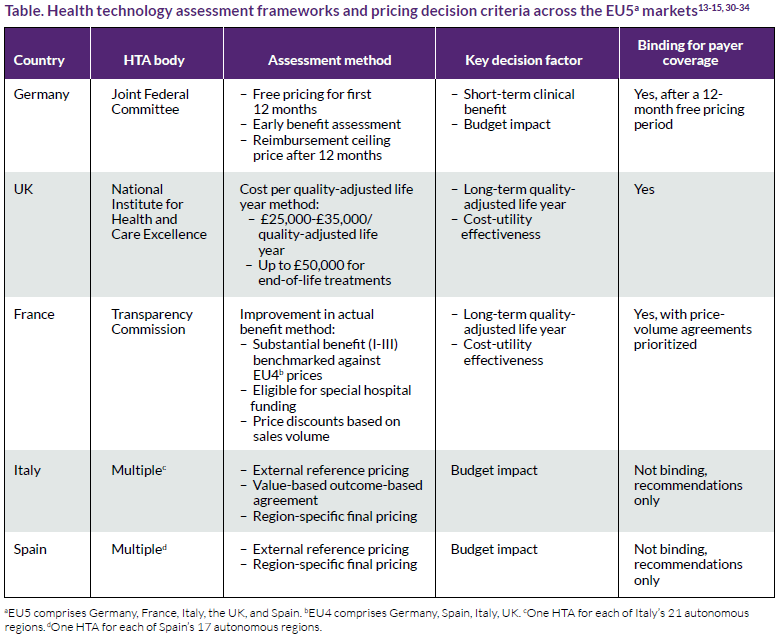
Germany. In Germany, manufacturer-set free pricing is applied for the first 12 months after launch. Manufacturer-set free pricing refers to the provision under which pharmaceutical manufacturers may unilaterally determine the launch price of a novel medicinal product for the initial 12 months following marketing authorization, with statutory payers obligated to reimburse at the manufacturer’s stated price. The Federal Joint Committee then conducts a benefit assessment relative to a comparator therapy, rating the benefit as major, considerable, minor, nonquantifiable, or no added benefit. In situations where an ATMP is evaluated to have no added benefit, its long-term reimbursed price is capped at the cost of the reference or comparator therapy.13 Following the 12-month free-pricing period, the National Association of Statutory Health Insurance Funds negotiates the final rebate price with the manufacturer. Germany primarily manages postlaunch evidence uncertainty through outcome-conditioned HTA reassessment, rather than formal outcome-based rebate schemes.
United Kingdom. In the UK, the National Institute for Health and Care Excellence conducts HTA based on full cost-per-quality-adjusted life year (QALY) appraisals, with a standard willingness-to-pay threshold of £25,000-£35,000 per QALY.14 For most ATMPs, however, this threshold is extended to up to £100,000 per QALY.15 ATMPs approved through conditional pathways also enter structured managed access coverage at a discounted price, commit to mandatory long-term outcome data collection, and undergo subsequent price negotiations at predefined review timelines.
France. France’s HTA framework assigns an improvement in actual benefit (ASMR) rating of I-V, reflecting the degree of clinical improvement relative to existing therapies. The Economic Committee for Health Products then negotiates the list price with the manufacturer: ASMR I-III supports premium pricing, whereas ASMR IV-V aligns pricing with existing comparators. France also benchmarks drug prices using EU4 (i.e., Germany, Spain, Italy, UK) reference pricing.
Italy. The Italian Medicines Agency requires that every patient receiving a reimbursed CGT be enrolled in a national outcome registry. Furthermore, it uses this registry data to administer outcomes-based, payment-at-results, and cost-sharing agreements at the individual patient level, with manufacturers providing rebates when predefined clinical outcomes are not achieved at specified measurement points. Italy’s framework represents one of the most operationally mature OBA frameworks for CGTs globally.
Spain. The Spanish Agency of Medicines and Medical Devices issues a therapeutic positioning report evaluating comparative clinical effectiveness. This is followed by pricing and reimbursement negotiations between the manufacturer and the General Directorate of the Basic Portfolio of Services of the National Health System and Pharmacy, leading to decisions on inclusion in the public National Health System’s funding list, followed by final pricing decisions made by the Inter-ministerial Commission on Drug Prices (CIPM). However, for products associated with high budgetary impacts, access is frequently subject to agreements with regional authorities or individual hospitals, creating a de facto third access tier beyond the national commission decision.
Japan
Although the PMDA conducts marketing authorization review, pricing decisions in Japan are managed by the MHLW working through the country’s HTA body, the Central Social Insurance Medical Council (Chuikyo). Upon PMDA approval, all products receive NHI listing within 60-90 days, making Japan one of the fastest formal national reimbursement market in the world for CGTs.7,8 Accelerated Sakigake-designated products receive coverage within approximately three months of approval; for example, Kymriah (tisagenlecleucel) and Yescarta (axicabtagene ciloleucell) were NHI-listed within 60 days of PMDA approval.
Under comparator-based pricing, NHI sets prices relative to the most comparable listed drug, with premiums or discounts applied based on the assessed degree of improvement. Products demonstrating significant clinical improvement over existing therapies may receive premiums of up to 100% over comparable drugs. For most CGTs without close comparators, a cost-based pricing method is applied using a bottom-up cost calculation that incorporates manufacturing costs, distribution expenses, and a regulated profit margin.
Japan’s biennial price revision involves MHLW revision of prices for all NHI-listed drugs every two years, based on actual market volumes, volume-price relationships, market share dynamics, and generic availability.8 For high-cost CGTs with projected annual sales above approximately $100 million, a supplementary cost-effectiveness evaluation by the Committee on Drug Price Revision based on effectiveness is conducted mandatorily.
China
Following marketing approval by the National Medical Products Administration, the NHSA conducts a separate price negotiation process in which manufacturers submit dossiers and engage in direct price negotiation, after which products are listed in NRDL.9 NHSA benchmarks proposed prices for foreign-manufactured products against domestically approved products, effectively using local CGT prices as ceiling thresholds in NRDL negotiations with foreign manufacturers.
South Korea
The Ministry of Food and Drug Safety approval is closely linked to a structured HTA process conducted by the HIRA, which evaluates all newly approved drugs for NHIS listing. HIRA applies formal cost-effectiveness criteria before pricing negotiations begin, using cost-per-QALY thresholds that are relatively low compared with global CGT launch prices. Products addressing high unmet need, severe disease, or lacking therapeutic alternatives are evaluated under more flexible criteria and are subjected to RSA.
The HIRA assessment requires manufacturers to submit a full health economic dossier, including a systematic literature review of clinical evidence, indirect treatment comparisons or meta-analyses of real-world evidence when no comparators exist, a full cost-utility model, a budget impact analysis, and a proposed RSA structure with defined outcome measures and rebate mechanisms.
Payer expectations and access barriers
Regulatory intelligence allows CGT sponsors to navigate the gap between regulators’ expectations for marketing authorizations and the requirements of HTA bodies and payers prospectively, rather than reactively. A sponsor that designs its pivotal program solely to meet approval criteria, without anticipating region-specific HTA and payer expectations, will deliver a regulatory package that secures approval but fails to achieve reimbursement and commercial viability; this is highlighted by 29% (9 of 31) of EMA-approved ATMPs that have been withdrawn or not renewed due to commercialization failure driven by steep pricing (e.g., Provenge, ChondroCelect, Glybera, MACI), reimbursement negotiation deadlocks (e.g., Skysona and Zynteglo), and unfavorable postapproval confirmatory clinical results (e.g., Zalmoxis).16 Proactive regulatory intelligence is critically important to continuously monitor shifts in pricing policies and reimbursement models that would facilitate drug development in alignment with payer expectations, prior to the product launch, rather than renegotiating under commercial viability pressure after approval.
United States
FDA approval of a CGT does not guarantee payer coverage or formulary listing in the US. The US operates under a fragmented, mixed-payer system in which public payers (e.g., Medicare, Medicaid, and the Department of Veterans Affairs) coexist with employer-sponsored and commercial private insurance, which together cover the majority of working-age patients. Each payer applies distinct pricing and coverage rules, and manufacturers set list prices freely at WAC, with no mandatory national price negotiation at launch.
Inpatient CAR-T infusions are reimbursed under Medicare Part A via a fixed inpatient CAR-T hospital payment category, with a base rate of approximately $48,000-$60,000, far below CAR-T WACs of $400,000-$475,000.17 The Centers for Medicare and Medicaid Services’ (CMS) New Technology Add-on Payment program partially bridges this gap by covering 65% of costs exceeding the diagnosis-related group (DRG) threshold, but the eligibility is time-limited to two to three years postapproval and restricted to innovative products demonstrating substantial clinical improvement over existing treatment.18
Furthermore, Medicaid’s DRG outlier payment covers approximately 80% of costs above a fixed multiplier of the base DRG rate; however, reimbursement is calculated using hospital-reported costs rather than drug WAC. Together, these mechanisms incompletely compensate institutions, particularly for community hospitals and newly certified advanced treatment centers lacking the administrative infrastructure to manage the reimbursement gap. This incomplete compensation leads many hospitals to decline Medicare CAR-T referrals and concentrate capacity on commercially insured patients.19
Outpatient CAR-T administration is reimbursed under Medicare Part B at the average sales price plus 6%. Under Section 340B of the Public Health Service Act, eligible safety-net hospitals and cancer centers may acquire outpatient drugs at statutory ceiling prices 20–50% below WAC and bill Medicare at the average sales price plus 6%, retaining the margin. As payers increasingly favor the outpatient setting, where co-insurance structures are more favorable than fixed inpatient DRG payments, 340B-covered academic medical centers gain a structural financial advantage over non-340B community advanced treatment centers and rural critical access hospitals. This results in access being concentrated at large urban institutions regardless of patient geography or disease burden.20
Given the high upfront costs and uncertainty surrounding long-term clinical efficacy, contemporary reimbursement models aim to mitigate financial risk by aligning critical patient access needs and payer expectations through linking payments to demonstrated therapy performance while preserving financial sustainability for healthcare systems. Some of these payer schemes are discussed in the following sections.
Inflation Reduction Act. Under the Inflation Reduction Act, CMS is authorized to negotiate a maximum fair price for high expenditure drugs beginning 11 years after FDA approval, with negotiated prices taking effect in year 13.21 The One Big Beautiful Bill Act, enacted 4 July 2025, exempts CGTs approved exclusively for orphan indications from Inflation Reduction Act price negotiations, provided they have not received approval for another non-orphan indication.22 Most of the currently approved CAR-T products (Kymriah, Yescarta, Breyanzi, Carvykti, Abecma, and Tecartus) and gene therapies for rare diseases (Hemgenix, Zolgensma, and Casgevy) have been approved exclusively for orphan indications and qualify for this exemption.
CGT Access Model Program. To address Medicaid access fragmentation, CMS recently launched the CGT Access Model Program, under which it negotiates OBAs with manufacturers on behalf of participating state Medicaid programs. Under this model, states pay upfront drug costs, which are linked to patient outcomes over time, and manufacturers provide rebates if therapies fall below prespecified thresholds.23 The model also standardizes ancillary fertilization preservation service coverages to be covered by manufacturers and reduces state-level administrative burden. Bluebird Bio and Vertex Pharmaceuticals were the first manufacturers to enter agreements under this framework for sickle-cell disease. To date, 33 states, the District of Columbia, and Puerto Rico – representing 84% of Medicaid beneficiaries with sickle-cell disease – have enrolled.23
Value-based pricing models. To expand coverage for high-cost CGTs, payers and manufacturers have recently adopted value-based pricing models, including OBAs and RSAs. Luxturna, the first FDA-approved gene therapy in the US, has set the benchmark for success by implementing outcome-based pricing.24 Similarly, in the case of Zynteglo (for beta thalassemia therapy), the manufacturer implemented a risk-sharing model under which it agreed to reimburse up to 80% of the therapy cost if a patient fails to achieve and maintain transfusion independence for at least two years after treatment.25 However, payer concerns regarding patient portability and member turnover have limited the willingness to extend the OBA beyond two years. In practice, risk-sharing models are primarily negotiated based on drug price-volume, budget, and clinical outcome metrics.
Other risk-sharing models. Some of the other risk-sharing models for high-cost CGTs include: subscription-based healthcare models in which a monthly or annual fixed fee covers unlimited direct primary care services;26 stop-loss agreements in which payers pay part of the high-cost therapy payment on a per member basis, with the remaining amount covered by the employer;27 risk pools stratification based models in which providers adjust payments based on intensity of the care needed based on disease severity levels;28 and capitation payment models wherein payers provide a set per-member per-month fee to cover all care, forcing the employer to manage costs or pay for losses incurred by exceeding the budget.29 These approaches, however, introduce operational and financial risks, including exposure to rare, high‑cost cases (i.e., lightning‑strike events), threshold‑based coverage restrictions (i.e., lasering effects), and disproportionate financial burden on employers or smaller risk pools.30 As a result, the adoption of these alternative models has remained limited.
European Union
All five major EU markets operate through predominantly publicly funded, tax- or social-insurance-funded healthcare systems in which statutory public payers are the primary providers of patient access to high-cost CGTs. Private health insurance exists across the EU5 but plays a peripheral role in CGT coverage; it is most developed in Germany, where approximately 11% of the population holds substitutive private insurance outside of Germany’s statutory health insurance system (GKV), and in Spain and Italy, where voluntary private insurance supplements, but does not substitute for, public coverage. In the UK and France, private insurance is largely complementary (covering co-payments and amenities) and does not independently fund CGT access at list price. As a practical matter, CGT market access in all EU5 markets is determined by the statutory public payer, and a positive public reimbursement decision is a commercial prerequisite for meaningful patient volume.31
Reimbursement across the EU5 is governed by national payer systems that operate independently of centralized EMA marketing authorization. Although the EU JCA produces a shared comparative clinical evidence report, each member state retains full authority over pricing negotiation, reimbursement conditions, and coverage scope.32 Managed entry agreements have become the standard commercial instrument for CGT access in all five markets, enabling conditional coverage in exchange for mandatory real-world outcome data generation and defined price review timelines.33
Germany. In Germany, the GKV covers the majority of the population through competing nonprofit sickness funds, with rebate negotiations conducted centrally by the central federal association following the 12‑month free‑pricing period. Price negotiations are informed by the benefit rating assigned by Germany’s national HTA and coverage authority as part of the early benefit assessment.
United Kingdom. The UK’s National Health Service is a universal, tax-funded single-payer system that provides comprehensive coverage to the entire population with most services at no point-of-care cost. The NHS reimburses ATMPs through several routes: a standard technology appraisal conducted by the National Institute for Health and Care Excellence with a willingness-to-pay £25,000 to £35,000 per QALY; highly specialized technologies scheme for ultra-rare diseases with threshold up to £100,000 per QALY; managed access through the Cancer Drugs Fund and the Innovative Medicines Fund, each with £340 million budget, which provides interim coverage at a confidential patient access scheme price while outcome data accumulate over five years.34 Products that do not meet modeled outcomes at the review point are subject to mandatory price renegotiation or delisting. The National Health Service also requires manufacturers of conditionally approved CGTs to participate in a managed access agreement that specifies data-collection obligations, outcome metrics, and review timelines as conditions for continued reimbursement.
Italy. Representing one of the most operationally mature outcomes-based reimbursement infrastructures for CGTs globally, Italy's National Health Service is a universal tax-funded public system administered through 21 regional health services, each with independent budget authority. The Italian Medicines Agency mandates enrollment of every treated CGT patient into a national outcome registry through which payment-at-results and cost-sharing agreements are executed automatically at the individual patient level.35
France. The French National Health Insurance System is a statutory public health insurance system covering approximately 99% of the population, with complementary mutual insurance covering a substantial portion of co-payments for most beneficiaries but not independently funding high-cost CGTs. The Economic Committee for Health Products negotiates the list price based on the ASMR rating assigned by France’s national HTA authority. ATMPs receiving ASMR I-III rating (moderate improvement) are eligible for coverage and are priced with reference to Germany, Spain, Italy, and the UK.31 Price-volume agreements are the dominant contractual structure, increasingly complemented by OBA and RSA models.
Spain. The National Health System in Spain provides universal public coverage, but effective CGT access is further complicated by regional budget impact thresholds across 17 autonomous regions. As a result, national reimbursement authorization by the Inter-ministerial Commission on Drug Prices does not guarantee uniform formulary adoption across regions.33
China
China operates a mixed public-private insurance architecture in which public statutory insurance is the dominant payer for NRDL-listed drugs, while voluntary commercial supplementary insurance is the realistic near-term pathway for innovator CGTs that are not NRDL-listed. The statutory system comprises two mandatory public schemes: the Urban Employee Basic Medical Insurance, covering formally employed urban workers and their dependents through employer-employee payroll contributions, and the Urban-Rural Resident Basic Medical Insurance, covering the remaining population, including rural residents and the informally employed, through subsidized government premiums.
Together, these two schemes provide nominally universal coverage to approximately 1.4 billion people,36 but reimbursement is limited strictly to drugs listed in the NRDL. Drugs not on the NRDL are not eligible under either statutory scheme, and patients must pay fully out-of-pocket or rely on voluntary supplementary commercial insurance products, including government-sponsored Huimin insurance, city‑level schemes, and conventional commercial health insurance policies.37 Innovative therapies, including several domestic CAR-T therapies, are also covered through the new national Commercial Health Insurance Innovative Drug List (Category C).38
The NHSA's annual NRDL negotiation benchmarks new drug prices against the lowest available comparable therapy price. For CAR-T products specifically, multiple domestically manufactured products (e.g., relmacabtagene autoleucel, equecabtagene autoleucel) and locally manufactured Yescarta have been commercially launched at prices ranging from ~$165,000, significantly below the global WACs of innovator products such as Kymriah (~$475,000) and Yescarta (~$400,000).9 NHSA treats domestic product pricing as an effective ceiling benchmark in NRDL negotiations, rendering inclusion of innovator CGTs at global list prices commercially unviable, although recently, CAR-T therapies have been included in the new national Commercial Health Insurance Innovative Drug List (Category C). As a result, access to these products is limited to self-pay use, concentrated among high-income patients treated at Tier 3 academic medical centers in urban coastal provinces.
China's fixed-rate DRG payment system further compounds access inequities for administered CGTs. Fixed-rate bundle payment reimbursement models typically cover only a fraction of the total episode cost for a CGT infusion, creating net operating losses for treating institutions. This financial disincentive limits institutional willingness to administer self-pay CGTs in the absence of manufacturer-sponsored access programs or supplementary provincial insurance coverage.
South Korea
South Korea's NHIS is a single-payer scheme covering the entire population, with drug prices subject to HIRA evaluation. Products that receive a positive HIRA evaluation enter direct price negotiation with the NHIS, whereas products that fail the HIRA evaluation are covered through out-of-pocket, RSA, and cost-effectiveness evaluation-based payment schemes. High-cost CGTs approved accelerated pathways are priced by implementing RSA.
Korea's RSA framework for CGTs incorporates four structural elements: utilization caps limiting the number of NHIS-reimbursed cases per contract period and expenditure caps, setting total annual expenditure limit for the drugs, with manufacturer/company refunding agreed percentage of amounts exceeding the annual reimbursement budget ceiling; outcome-based rebate obligations requiring manufacturers to refund a defined proportion of the drug cost if patients fail to meet predefined response thresholds within a specified post-infusion window; mandatory annual submission of real-world outcome data, including treatment response rates, progression-free survival, and safety data as a condition of continued listing; and conditional listing renewal, under which HIRA reevaluates the product approximately four years after listing and may require a price reduction or delisting if real-world outcomes do not support the originally modelled value.39 This framework establishes NHIS coverage as a multi-year contract rather than a one-time access decision, with continued listing rights contingent on ongoing product performance.
Japan
Japan's NHI system provides universal, reimbursement for all PMDA-approved drugs within 60 to 90 days of marketing authorization, through a price-setting and listing process administered by the Central Social Insurance Medical Council (Chuikyo) and its drug pricing organization. Unlike any other major market, Japan has no separate coverage decision process, no formulary committee vote, and a rare possibility of outright payer rejection following marketing approval. Upon NHI listing, patient financial exposure is governed by income-stratified co-payment rules (generally 10%-30% of the treatment cost), alongside a high-cost medical expense benefit that caps individual monthly out-of-pocket expenditures. Together, these mechanisms effectively remove price as a barrier to patient access once a CGT achieves NHI listing. Kymriah and Yescarta were NHI-listed within 60 days of PMDA approval, demonstrating Japan's pace of formal access relative to other markets.40
However, the MHLW biennial and recent annual off-cycle drug price adjustments trigger downward price corrections, imposing a direct financial penalty on commercial success and incentivizing conservative volume projections in the initial NHI pricing dossier. CGTs with projected annual sales of approximately $100 million are additionally subject to mandatory cost-effectiveness reevaluation by the Committee on Drug Price Revision based on Effectiveness, which can mandate a price reduction at the subsequent biennial revision if the product is assessed as not cost-effective at its current NHI price. Postmarketing surveillance data, generated as a condition of conversion from conditional approval, are reviewed by payers to determine whether innovation premiums assigned at the initial listing remain justified, directly linking reimbursement sustainability to the quality and robustness of the real‑world evidence program.
Conclusion
The global regulatory and market access landscape for CGTs operates under distinct frameworks of evidentiary standards, reimbursement expectations, and risk-allocation mechanisms. Regulatory approval, while imperative for market entry, is an insufficient parameter for patient access assurance. The gap between regulators’ expectations for marketing authorizations and the expectations of HTA bodies and payers with respect to comparative effectiveness data, long-term follow-ups, and outcomes- and risk sharing-based agreements for pricing and reimbursement remains the central, unresolved challenge in CGT development strategy globally.
Regulatory intelligence trends indicate that payers across all major markets are moving toward evidence-based, outcomes-linked reimbursement schemes for CGT coverage. This shift demands CGT sponsors to design clinical development programs that not only align with the regulatory approval requirements but also with the payer expectations for real-world evidence infrastructure, patient registries, outcome tracking, and long-term follow-up protocols. Integrated regulatory intelligence, spanning global approval pathways alongside reimbursement frameworks, is therefore not a postapproval commercial function but a pre-IND strategic requirement. Decisions made during Phase 1/2 development, including comparator selection, registry integration with pivotal protocols, and the architecture of outcomes-based agreements negotiated at product launch, ultimately determine whether a conditionally approved CGT becomes both clinically accessible and commercially viable.
Abbreviations
ATMP, advanced therapy medicinal product; CAR‑T, chimeric antigen receptor T cell; CGT, cell and gene therapy; EMA, European Medicines Agency; FDA, Food and Drug Administration; HTA, health technology assessment; HIRA, Health Insurance Review and Assessment Service; ICER, Institute for Clinical and Economic Review; JCA, joint clinical assessment; MHLW, Ministry of Health, Labour and Welfare; NHI, National Health Insurance; NHIS, National Health Insurance System; NHSA, National Healthcare Security Administration; NRDL, National Reimbursement Drug List; OBA, outcome‑based agreement; PMDA, Pharmaceuticals and Medical Devices Agency; QALY, quality‑adjusted life year; RSA, risk‑sharing agreement; WAC, wholesale acquisition cost.
About the authors
Padma Priya Togarrati, PhD, ASQ-CSSGB, RAC, is a consultant specializing in evaluating AI/ML models for drug development with respect to accuracy, bias, and robustness. She has more than 12 years of experience in industry and academia, with specialization in stem cells, immunology, CGT translational, and CMC development across multiple IND-enabling pipelines and publications. She holds a PhD in cancer genetics from the Sanjay Gandhi Postgraduate Institute of Medical Sciences, India, and completed postdoctoral fellowships at the University of Wisconsin-Madison and the University of California, San Francisco. She previously served as a staff scientist at Vitalant Research Institute. Togarrati is a RAPS member and can be reached at [email protected]
Citation Togarrati PP. Strategic regulatory intelligence on pricing and reimbursement models for cell and gene therapies. RAPS Journal of Regulatory Affairs. 2026;1(3):65-76. Published online 4 May 2026. https://www.raps.org/resource/strategic-regulatory-intelligence-on-pricing-and-reimbursement-models-for-cell-and-gene-therapies.html
References
All references were last checked and verified on 27 April 2026.
- Han Yi, et al. The impacts of pricing and reimbursement policies on access to cell and gene therapies across Europe. J Community Genet. Published 26 January 2026. Accessed 24 March 2026. https://pmc.ncbi.nlm.nih.gov/articles/PMC12832597/
- Abou-El-Enein M, et al. Overcoming challenges facing advanced therapies in the EU market. Cell Stem Cell. Published 1 September 2016. Accessed 24 March 2026. https://pubmed.ncbi.nlm.nih.gov/27588746/
- Food and Drug Administration. Framework for the regulation of regenerative medicine products. Current as of 21 May 2019. Accessed 24 March 2026. https://www.fda.gov/vaccines-blood-biologics/cellular-gene-therapy-products/framework-regulation-regenerative-medicine-products
- Sawhney TG, Thakur N. Drug cost-effectiveness assessments require standards for rigor and inclusion. J Health Econ Outcomes Res. Published 23 February 2023. Accessed 24 March 2026. https://pmc.ncbi.nlm.nih.gov/articles/PMC9960981/
- European Medicines Agency. Guideline on the scientific application and the practical arrangements necessary to implement Regulation (EC) No 507/2006 on the conditional marketing authorisation for medicinal products for human use falling within the scope of Regulation (EC) No 726/2004. Dated 25 February 2016. Accessed 5 April 2026. https://www.ema.europa.eu/en/documents/scientific-guideline/guideline-scientific-application-and-practical-arrangements-necessary-implement-commission-regulation-ec-no-5072006-conditional-marketing-authorisation-medicinal-products-human-use-falling_en.pdf
- Regulation (EU) 2021/2282 of the European Parliament and of the Council of 15 December 2021 on health technology assessment and amending Directive 2011/24/EU. Accessed 24 March 2026. https://eur-lex.europa.eu/eli/reg/2021/2282/oj/eng
- Pharmaceuticals and Medical Devices Agency. Strategy of Sakigake. Dated 17 June 2014. Accessed 24 March 2026. https://web.archive.org/web/20170701000000/http://www.mhlw.go.jp/english/policy/health-medical/pharmaceuticals/dl/140729-01-01.pdf
- He J, et al. Pricing, price revision, and clinical value of anticancer drugs in Japan: A retrospective observational study. Front Pharmacol. Published 18 November 2025. Accessed 24 March 2026. https://pmc.ncbi.nlm.nih.gov/articles/PMC12668999/
- Zhu Z, et al. Impacts of national reimbursement drug price negotiation on drug accessibility, utilization, and cost in China: A systematic review. Int J Equity Health. Published 4 February 2025. Accessed 24 March 2026. https://pubmed.ncbi.nlm.nih.gov/39905408/
- Shin EJ, et al. Reimbursement of high priced one-shot treatments in Korea: Kymriah and Zolgensma case study. Not dated. Accessed 24 March 2026. https://www.ispor.org/docs/default-source/euro2023/isporeurpope23shinhpr55poster131420-pdf.pdf?sfvrsn=a69418_0#:~:text=Due%20to%20the%20lack%20of,CONCLUSIONS
- Hitch J, et al. Challenges in value assessment for one-time gene therapies for inherited retinal diseases: Are we turning a blind eye? Value Health. Published January 2025. Accessed 24 March 2026. https://pubmed.ncbi.nlm.nih.gov/39384069/
- Prabhakar V, et al. The promise of outcomes-based agreements for cell & gene therapies. Cell and Gene. Published 20 January 2023. Accessed 24 March 2026. https://www.cellandgene.com/doc/the-promise-of-outcomes-based-agreements-for-cell-gene-therapies-0001
- Gemeinsamer Bundesausschuss. The benefit assessment of medicinal products in accordance with the German Social Code, Book Five (SGB V), section 35a. Not dated. Accessed 24 March 2026. https://www.g-ba.de/english/benefitassessment/
- O’Carroll L, Campbell D. NHS to pay 25% more for innovative drugs after UK–US zero-tariff deal. The Guardian. Published 1 December 2025. Accessed 24 March 2026. https://www.theguardian.com/business/2025/dec/01/uk-us-agree-zero-tariff-pharmaceuticals-deal
- Genetic Alliance UK. Shared learning roundtable on managed access agreements. Published June 2023. Accessed 24 March 2026. https://geneticalliance.org.uk/wp-content/uploads/2024/01/Managed-Access-Agreements-Recommednations-from-a-shared-learning-roundtable.pdf
- European Medicines Agency. Guideline on good pharmacovigilance practices (GVP); Module VIII—Post-authorisation safety studies (Rev 3). Dated 9 October 2017. Accessed 24 March 2026. https://www.ema.europa.eu/en/documents/scientific-guideline/guideline-good-pharmacovigilance-practices-gvp-module-viii-post-authorisation-safety-studies-rev-3_en.pdf
- Centers for Medicare & Medicaid Services. MS-DRG Version 41 Definitions Manual: DRG 016/017 autologous bone marrow transplant. Not dated. Accessed 24 March 2026. https://www.cms.gov/icd10m/FY2024-version41-fullcode-cms/fullcode_cms/P0046.html
- Gooding M, et al. How a new technology add-on payment (NTAP) program works. Avalere Health. Published 23 April 2025. Accessed 26 April 2026. https://advisory.avalerehealth.com/insights/how-a-new-technology-add-on-payment-works
- Snyder S, et al. Travel-related economic burden of chimeric antigen receptor T Cell therapy administration by site of care. Published 18 July 2021. Accessed 24 March 2026. https://pubmed.ncbi.nlm.nih.gov/34279805/
- Conti RM, Bach PB. The 340B drug discount program: Hospitals generate profits by expanding to reach more affluent communities. Health Aff (Millwood). Published 2 October 2015. Accessed 24 March 2026. https://pmc.ncbi.nlm.nih.gov/articles/PMC4591849/
- Inflation Reduction Act, HR 5376. 117th cong. Accessed 24 March 2026. https://www.govinfo.gov/content/pkg/PLAW-117publ169/pdf/PLAW-117publ169.pdf
- Internal Revenue Service. One, big, beautiful bill, provisions. Updated 1 April 2026. Accessed 24 March 2026. https://www.irs.gov/newsroom/one-big-beautiful-bill-provisions
- Centers for Medicare & Medicaid Services. CGT (cell and gene therapy) access model. Updated 11 March 2026. Accessed 24 March 2026. https://www.cms.gov/priorities/innovation/innovation-models/cgt
- GlobalNewswire. Spark Therapeutics announces first-of-their-kind programs to improve patient access to Luxturna (voretigene neparvovec-rzyl), a one-time gene therapy treatment [press release]. Published 3 January 2018. Accessed 26 April 2026. https://www.globenewswire.com/news-release/2018/01/03/1281548/0/en/Spark-Therapeutics-Announces-First-of-their-kind-Programs-to-Improve-Patient-Access-to-LUXTURNA-voretigene-neparvovec-rzyl-a-One-time-Gene-Therapy-Treatment.html
- Business Wire. Bluebird Bio announces U.S. commercial infrastructure to enable patient access to Zynteglo, the first and only FDA-approved gene therapy for people with beta-thalassemia who require red blood cell transfusions. Published 17 August 2022. Accessed 26 April 2026. https://www.businesswire.com/news/home/20220817005677/en/bluebird-bio-Announces-U.S.-Commercial-Infrastructure-to-Enable-Patient-Access-to-ZYNTEGLO-the-First-and-Only-FDA-Approved-Gene-Therapy-for-People-with-Beta-Thalassemia-Who-Require-Regular-Red-Blood-Cell-Transfusions
- Guilford-Blake R. The pros and cons of direct primary care (DPC). Wolters Kluwer website. Updated 26 August 2020. Accessed 26 March 2026. https://www.wolterskluwer.com/en/expert-insights/what-exactly-is-direct-primary-care#:~:text=Each%20patient%20pays%20a%20membership,advantages%20of%20direct%20primary%20care
- New Drug Development Paradigms Initiative. Emerging market solutions for financing and reimbursement of durable cell and gene therapies [white paper]. FoCUS Project. Dated 16 June 2021. Accessed 26 March 2026. https://newdigs.tuftsmedicalcenter.org/wp-content/uploads/2022/06/FoCUS-WP-CGT-Market-Solutions.pdf
- Horstman C, Lewis L. The basics of risk adjustment. Published 11 April 2024. The Commonwealth Fund website. Accessed 26 March 2026. https://www.commonwealthfund.org/publications/explainer/2024/apr/basics-risk-adjustment#:~:text=What%20is%20risk%20adjustment?,existing%20chronic%20conditions%20and%20disabilities.
- Center For Evidence-Based Policy. Payment model primer – Capitated payments [policy brief]. Dated September 2022. Accessed 26 March 2026. https://centerforevidencebasedpolicy.org/CEbP_PaymentModelPrimer_CapitatedPayments.pdf
- Phares S, et al. Managing the challenges of paying for gene therapy: strategies for market action and policy reform in the United States. J Comp Eff Res. Published 14 November 2024. Accessed 26 March 2026. https://pmc.ncbi.nlm.nih.gov/articles/PMC11609966/pdf/cer-13-240118.pdf
- World Health Organization. Can people afford to pay for health care? Evidence on financial protection in 40 countries in Europe: Summary. Published 12 December 2023. Accessed 26 March 2026. https://iris.who.int/items/922d2723-e880-4a82-8acb-b35fd728702d
- Jørgensen J, et al. Outcomes-based reimbursement for gene therapies in practice: The experience of recently launched CAR-T cell therapies in major European countries. J Mark Access Health Policy. Published 15 January 2020. Accessed 26 March 2026. https://pubmed.ncbi.nlm.nih.gov/32082514/
- Dabbous M, et al. Managed entry agreements: Policy analysis from the European perspective. Value in Health. Published April 2020. Accessed 26 March 2026. https://pubmed.ncbi.nlm.nih.gov/32327159/
- National Institute for Health and Care Excellence. NHS commercial framework for new medicines. Updated 31 January 2025. Accessed 27 March 2026. https://www.england.nhs.uk/long-read/nhs-commercial-framework-for-new-medicines/
- Xoxi E, et al. The evolution of registries to support managed entry agreements for orphan medicinal products in Italy. Front Pharmacol. Published 10 August 2021. Accessed 27 March 2026. https://pmc.ncbi.nlm.nih.gov/articles/PMC8386173/
- Meng J, et al. Preferences for public health insurance coverage of new anticancer drugs: A discrete choice experiment among non-small cell lung cancer patients in China. BMC Public Health. Published 15 January 2025. Accessed 27 March 2026. https://pmc.ncbi.nlm.nih.gov/articles/PMC11734541/
- Chen N, et al. Preferences for private health insurance in China: A discrete choice experiment. Front Public Health. Published 6 September 2022. Accessed 27 March 2026. https://pmc.ncbi.nlm.nih.gov/articles/PMC9486459
- Lin C. China releases 2025 NRDL and first commercial insurance drug list [analyst comment]. Pharm Technol. Published 2 January 2026. Accessed 27 March 2026. https://www.pharmaceutical-technology.com/analyst-comment/china-2025-nrdl-first-commercial-insurance-drug-list/?cf-view
- Coulton L, et al. Outcomes-based risk-sharing schemes: Is there a potential role in the Asia-Pacific markets? Health Outcomes Res Med. Published November 2012. Accessed 27 March 2026. https://www.sciencedirect.com/science/article/abs/pii/S1877131912000390
- Kamae I. Value-based approaches to healthcare systems and pharmacoeconomics requirements in Asia: South Korea, Taiwan, Thailand, and Japan. PharmacoEcon Open. Published 2010. Accessed 27 March 2026. https://pubmed.ncbi.nlm.nih.gov/20831290/