

Understanding iterative medical device software development in the US and EU
Abstract This article compares medical device software regulations in the US and EU and analyzes how they facilitate or hinder iterative development. The analysis reveals that there are currently limited expedited regulatory pathways in the US and EU for iterative medical device software development. Manufacturers must analyze regulatory requirements as an indicator of preferred markets while also evaluating their device development more broadly on elements such as reimbursement pathways.
Keywords EU regulations, iterative product development, medical device software, regulatory comparison, US regulations
Introduction
Some manufacturers choose to iteratively develop a medical device to navigate the rapidly changing regulatory landscape in light of the recently implemented EU Medical Devices Regulation (EU MDR) and the increasingly tailored guidance documents from the US Food and Drug Administration (FDA). This approach is particularly relevant to software-based medical devices, which are the focus of this article.
Medical device software (MDSW) and software as a medical device (SaMD) will be examined, while software in a medical device (SiMD) will be excluded. The article will highlight the regulations applicable to these medical devices and assess the associated requirements in the US and EU. It should be noted that in referenced regulations and guidance documents, the terminology typically used in the US is SaMD, whereas in the EU it is MDSW.
MDSW encompasses a diverse range of products: software can be standalone, interact with other medical devices, or be incorporated into a device. It is therefore critical to enhance understanding of MDSW, especially as its application continues to grow. Examples of this growth include the development of “smart” transfusion pumps rather than traditional infusion pumps, and the addition of artificial intelligence (AI) to magnetic resonance imaging and computed tomography scanners.
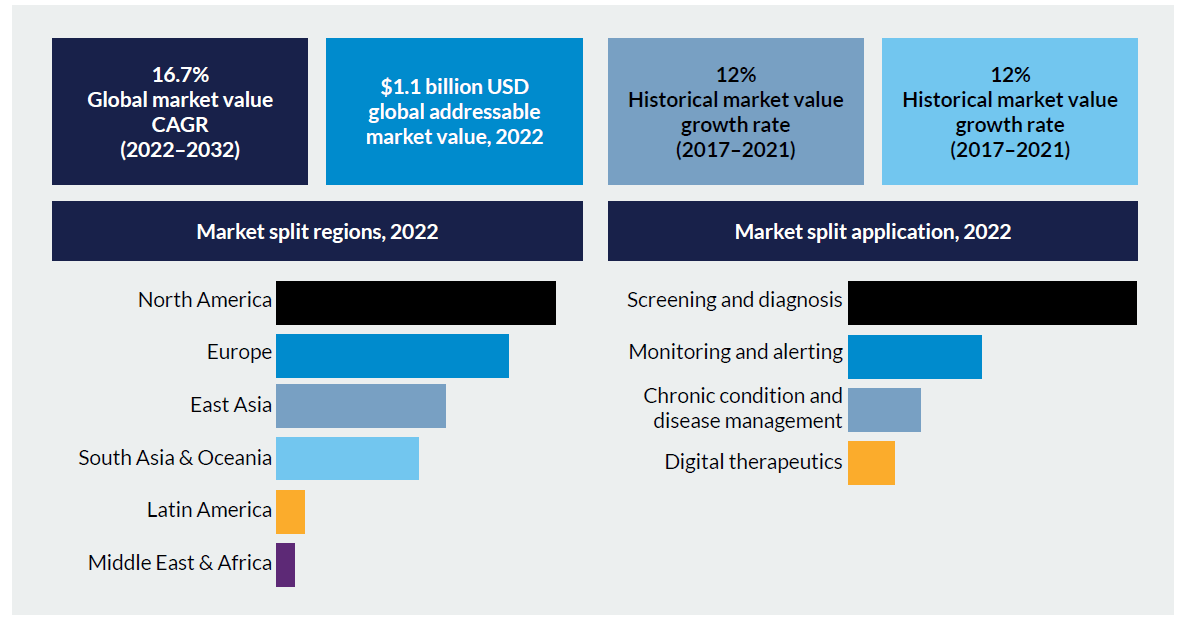
The global MDSW market value is expected to grow at a compound annual growth rate of 16.7%, reaching a total market value of $5.4 billion by 2032 (Figure 1).1 MDSW applications for screening and diagnosis and for monitoring and alerting hold the largest share of this rapidly growing market (4.7% higher compound annual growth rate than in 2017-2021).1 MDSW for screening and diagnosis and for monitoring and alerting may help improve early diagnosis of diseases, increase treatability, and reduce hospitalization by enabling patient self-monitoring, thereby reducing the burden on healthcare systems.
Figure 1. Global MDSW market forecast, 2022-20321
CAGR, compound annual growth rate; MDSW, medical device software.
Source: Fact.MR1
In recent years, MDSW regulations have evolved. In the US, the FDA issued increasingly detailed guidance for digital health medical devices through its Digital Health Innovation Action Plan (DHIAP) in 2017. In the EU, the regulatory requirements for MDSW changed significantly with the EU MDR, which came into effect in May 2021. As MDSW becomes more prevalent, manufacturers are seeking effective regulatory pathways while navigating evolving technologies and rapidly changing regulatory landscapes. One approach is iterative development, whereby a lower-risk device is initially commercialized and subsequently developed for higher-risk applications.
This article is based on research and the accompanying literature review for a master’s thesis in regulatory affairs written by the first author. The purpose of the research was to determine whether the iterative development approach is supported or hampered by regulations in the US and EU. The comparison between the two regions sought to determine whether differences in factors such as governance and regulatory requirements make one market more appealing than the other.
Research objectives and related questions
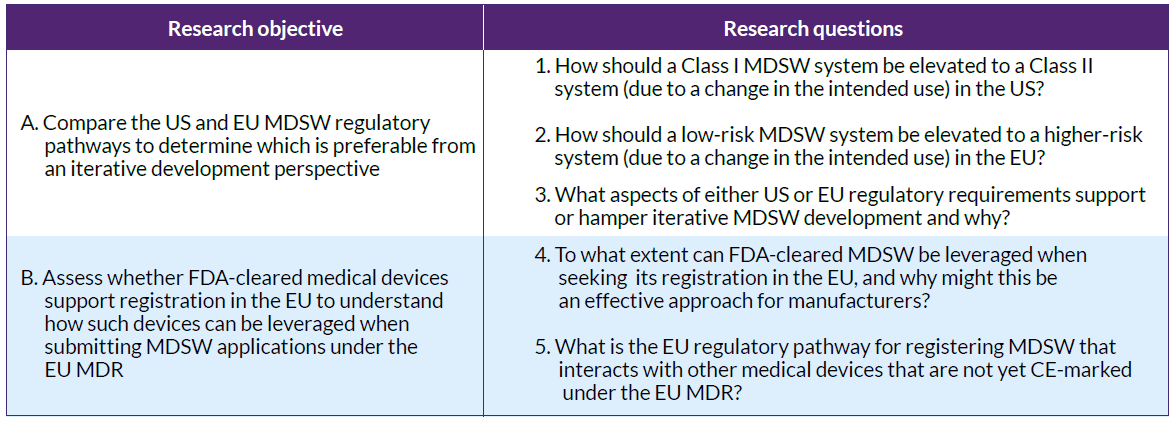
The original research aims to examine and compare regulatory requirements applicable to iterative MDSW development in the US and EU. Two dedicated research objectives (RO) were generated to conduct this examination from multiple perspectives (Table 1). The objectives were to:
- Compare the US and EU regulatory pathways for iterative medical device software development (RO-A in Table 1), and
- Determine whether FDA-cleared medical devices can be leveraged to support a registration of that same device in the EU (RO-B).
Each objective was associated with a set of research questions (Table 1).
Table 1. Overview of research objectives and research questions
CE, conformité Européenne; FDA, Food and Drug Administration [US]; EU MDR, EU Medical Devices Regulation; MDSW, medical device software.
Methodology for literature review
The literature was identified through searches on the following databases: Leiden University online library, University of Hertfordshire online library, PubMed, Web of Science, and Google Scholar. The searches were conducted with the following parameters: language – English; region – the US and EU; and publication period – 2010 to 2025.
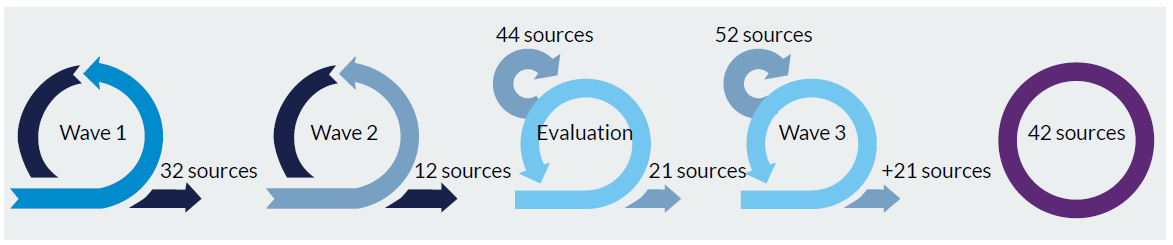
In total, 32 sources were identified during the initial search (Wave 1). An initial high-level review of recurring themes and associated research generated insights for a second search (Wave 2), which identified an additional 12 sources. Of the 44 sources identified, 21 were shortlisted for the research following a preliminary review. A detailed review of these sources triggered a third search (Wave 3) based on the identification of additional studies, industry perspectives, previously conducted research referenced in the shortlisted sources, and applicable regulations and guidance documents. This third search yielded an additional 52 sources, out of which 21 were shortlisted, bringing the total number of selected sources to 42 (Figure 2).
Figure 2. Literature search process
Created by the authors
The shortlisted literature was then categorized by topic according to the associated research objective. During analysis, recurring themes, key opinions, contradictions, and main conclusions were identified, noted, and incorporated into the literature review.
The aim of the literature review was to identify and evaluate sources relevant to answering the defined research questions by assessing applicable regulations, use cases, and opinions. This review section is structured topically, aligning with the research questions, which are grouped by associated research objectives. Each subsection discusses findings from the literature relevant to the associated research questions.
US and EU pathways for iterative MDSW development
The selected literature highlights several recurring themes. The first is that the European regulatory landscape is typified by decentralized governance. This is partly due to the EU’s inherent division into multiple autonomous countries, each with its own national competent authority (NCA). The EU MDR defines several tasks and responsibilities for EU member states, including ensuring medical device safety through market surveillance conducted by their NCAs (EU MDR Article 93).2 Their responsibilities also extend to pricing and reimbursement elements, which may pose a challenge if these need to be negotiated per country. Consequently, the governance is fragmented as localized requirements may diverge.3
EU consultation
While true decision making authority lies with the notified bodies, NCAs are reportedly becoming more open to consultations with medical device manufacturers.4 If NCAs can increase harmonization among themselves, this may eventually turn their collective capacity into a benefit.
Unfortunately, consultation with notified bodies is not permitted under EU MDR Annex VII 1.2.3(d). While this prohibition is often a point of critique, some notified bodies argue that it ensures their independence and that the practice should be maintained.5 Arguably, these organizations may not have the requisite capacities for consultation. Prolonged notified body review timelines, partly due to the ongoing MDD-to-MDR redesignation, can be particularly problematic for MDSW given its frequent incremental updates.4
US governance and reimbursement
Unlike the EU, the US can be characterized as a more centralized governmental landscape. The issuance of regulations, the assessment of medical device filings, and clearance/approval are all performed in conjunction with the FDA. Consequently, while the FDA can be viewed as the go-to entity for most medical device-related activities, manufacturers may turn to the Centers for Medicare & Medicaid Services (CMS) for reimbursement. CMS oversees Medicare (federal health insurance), the implementation of certain Affordable Care Act provisions, national program policies for Medicaid, and the Children’s Health Insurance Program (CHIP); Medicaid and CHIP are joint federal-state programs.
CMS is therefore said to exert influence over the private sector’s coverage and reimbursement decisions, as commercial players often follow Medicare’s lead.6 However, some studies indicate this relationship is more nuanced. It is argued that coverage determinations through these private insurers vary strongly, with roughly 50% of them aligning with Medicare-issued national coverage determinations, another 25% being more restrictive, and the final 25% being less strict.7 This leads to a form of decentralization concerning medical device reimbursement, requiring navigation of both CMS and private insurers.
US consultation
Manufacturers can approach the FDA’s Center for Devices and Radiological Health (CDRH) for advice on their device development. There is a range of Q-submissions8 (part of the broader presubmission programs) to choose from. The agency can speak to almost every aspect of the medical device. Section 513(g), for example, focuses specifically on medical device risk classification and options for obtaining the center’s views on the classification and associated regulatory requirements for a particular device.9 These forms of targeted advice are extremely valuable to manufacturers, as they may alleviate doubts and increase the chance of a successful application.
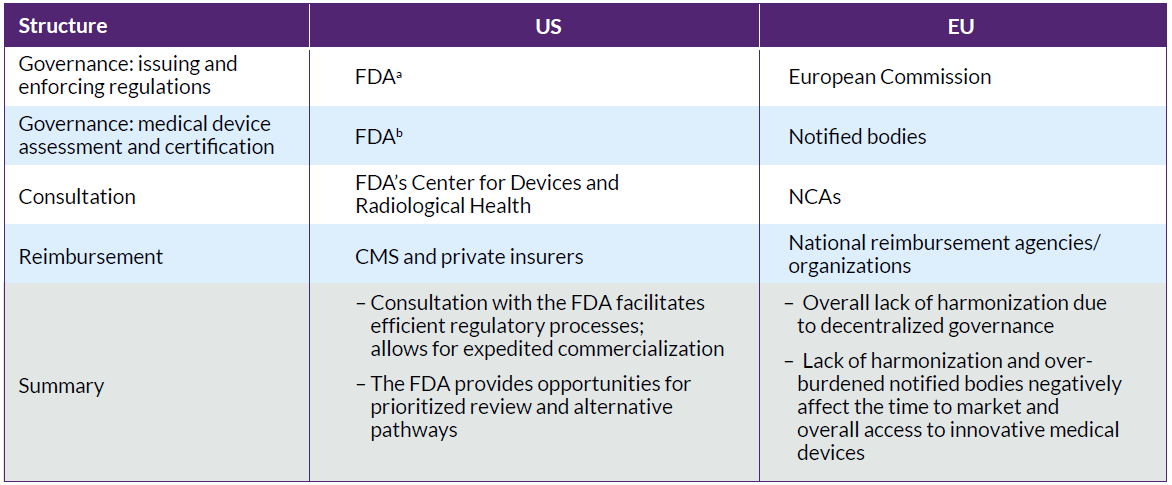
The literature suggests there are unique advantages in the US compared to the EU in obtaining consultation and accessing prioritized review and alternative pathways (Table 2).
Table 2. Structure of regulatory governance organizations in the US and EU
CMS, Centers for Medicare & Medicaid Services; FDA, Food and Drug Administration; NCA, national competent authority
aOther governmental agencies may also issue/enforce regulations, but the scope of this research is limited to, and focuses on, the FDA. bFDA may leverage third-party assessments by an accredited person to support application reviews.
MDSW risk classifications
This subsection will focus on risk classification considerations for MDSW, starting with the EU’s classification Rule 11, followed by risk classifications in the US and the relevance of DHIAP. The purpose for focusing on risk classifications is their relevance in determining the applicable regulatory requirements.
EU MDR Rule 11
The EU MDR is viewed as more stringent than its predecessor, the Medical Devices Directive (MDD). This especially holds true for MDSW, which is now regulated through the EU MDR Rule 11.
The EU MDR classifies devices into four risk classes (I, IIa, IIb, and III, in ascending order of risk), each carrying progressively more stringent regulatory requirements. Notably, most MDSWs are increasingly classified as at least Class IIa under the MDR. Software intended to monitor any vital physiological parameters, for which variations could result in immediate danger to patients, is classified as Class IIb. Lastly, software intended to provide information for diagnostic or therapeutic decision making receives the highest-risk classification (Class III) in cases where the decisions may cause death or an irreversible deterioration of a person’s health.2 This leaves little room for Class I MDSW (limited to software that does not lead to decisions on therapy or diagnosis and does not monitor physiological processes). Consequently, the majority of MDSWs now require notified body involvement to obtain CE certification.
Furthermore, the EU MDR risk classification appears to be determined primarily by severity, placing less emphasis on the likelihood of occurrence.10 At the same time, guidance such as the Medical Device Coordination Group (MDCG) 2019-1111 – referring to the International Medical Device Regulators Forum (IMDRF) risk classification system,12 which is risk-based rather than merely severity-based, attempts to mitigate scenarios where all devices would be classified as Class IIa or higher. This, however, raises the question of which system will be used to assess MDSW risk classifications: EU MDR Rule 11 or IMDRF.
US DHIAP
For software-based devices, the FDA recognized the limitations of existing regulations, which were deemed better suited to hardware medical devices and less well suited to the faster iterative design, development, and validation processes used for software-only medical technologies.13 Thus, the DHIAP was launched to update its regulations, create clarity, and foster innovation. Through the DHIAP, the FDA applied a collaborative mindset to achieve the desired outcome – innovation, knowledge, and alignment with changing regulatory landscapes.
Consequently, the FDA currently facilitates a more granular categorization of software-based medical devices than the EU does. Specific guidance is available for clinical decision support software,14 medical device data systems,15 mobile medical applications,16 and multifunction devices.17 Devices that have a multitude of software features that are lower risk and not considered to have medical device functionality may be exempt from regulations under the Federal Food, Drug, and Cosmetic Act (FDCA). This allows the FDA to focus solely on the regulated features rather than treating the entire software as a regulated entity.
Through these improvements, the FDA is creating clearer pathways towards commercialization. However, manufacturers must exercise greater due diligence to understand the FDA’s stance on their specific type of software-based medical device. This due diligence should not be a significant barrier for MDSW developers due to the availability of programmatic resources such as DHIAP and multiple opportunities for FDA interaction(s).
As previously described, for multifunction devices, not all software described in these guidance documents falls under the FDA’s oversight (Table 3), which could make evaluating the applicable regulatory pathway overly burdensome. The FDA allows regulatory oversight exemptions, such as when the intended user is a healthcare professional, provided the four criteria outlined in the clinical decision support guidance are met.14 In short, though these software still hold liability for clinical decisions, it seems the FDA has chosen to shift responsibility from the MDSW manufacturers to the healthcare providers: perhaps with the intent of making the US more attractive for development.
Refocusing on software risk classification in the US, more avenues for low-risk classifications are available than under the EU framework, in line with the aforementioned approach. Firstly, the FDA’s risk classification aligns better with the IMDRF’s.12 As such, software intended to inform clinical management in either serious or nonserious healthcare settings has an IMDRF Category I risk classification. Furthermore, software intended to drive clinical management in non-serious conditions is also classified as Category I. These Category I devices are considered to have a low risk and thus are either Class I software or even under enforcement discretion by the FDA.18
Table 3. Summary of FDA oversight of clinical decisions support software functions19
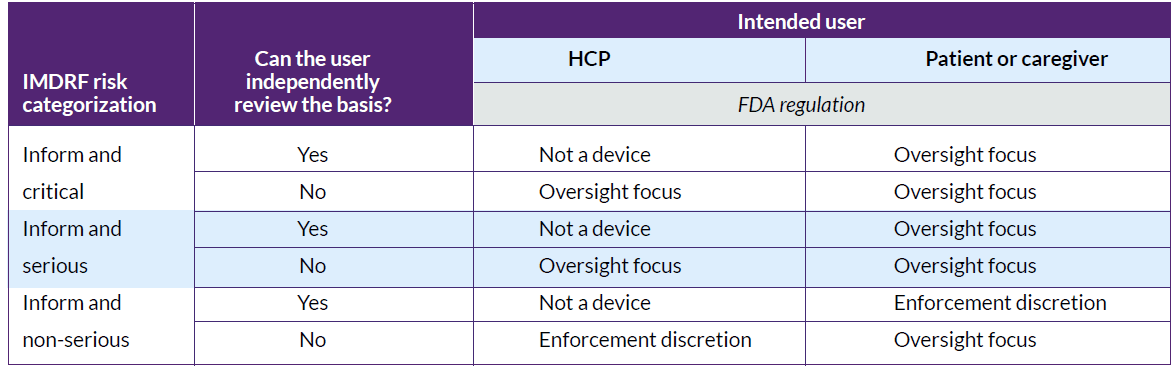
FDA, Food and Drug Administration; HCP, healthcare provider; IMDRF, International Medical Device Regulators Forum.
In comparison to the EU, the FDA has further advanced in its recognition of the different types of software-based medical devices by issuing more granular guidance documents. However, the diversity of FDA guidance documents may prove to be overwhelming and time-consuming when developing a comprehensive regulatory strategy. In contrast, the EU MDR Rule 11 is simple, but may lead to higher-risk classifications and contradictory elements in the MDCG guidance (or vice versa), creating ambiguity.
Changing the intended use of MDSW
This subsection offers a comparison between applicable regulatory pathways and requirements when increasing the risk from low/Class I to moderate/Class II(a/b) due to a change in the intended use/purpose of an associated device, to further evaluate what elements of the US and EU regulatory frameworks either hamper or support iterative software development. It should be noted that the EU MDR refers to “intended purpose” rather than “intended use.” MDCG 2020-620 states that the terms should be interpreted synonymously.
MDD-certified MDSW and significance
For MDSW that is still valid under the EU’s MDD certification, EU MDR Article 120(3)2 applies, stating that significantly changing a device’s intended purpose may no longer allow it to be placed on the market or put into service, requiring recertification under the EU MDR. Although there is ambiguity around the definition of significant, industry stakeholders have defined significant changes as “new or major changes of operating systems, new or modified architecture or database structures, change of algorithms, and new features and new user interfaces that have an impact on the diagnosis or therapy delivered to the patient.”21 This is supported by MDCG 2020-3,22 which has added several reader-friendly charts to navigate the multiple change scenarios.
EU Class II requirements and data reuse
Generally, any change in the intended purpose that results in an increased MDSW risk classification is deemed significant and requires full recertification under the EU MDR. Consequently, some of the requirements from which a Class I device was exempt must now be fulfilled. These include creating Instructions for Use, obtaining CE certification through conformity assessment by a notified body, generating periodic safety update reports instead of postmarket surveillance (PMS) reports,2 providing additional clinical evidence, and performing additional human factors engineering activities. Fortunately, much of the previously collected data may still be used, albeit with some revision. Clinical information, PMS outcomes, technical documentation, and an established quality management system may help facilitate certification.
Changing MDSW intended use in the US
The FDA has issued specific guidance regarding when to submit a 510(k) for a software change to an existing device.23 Related to significant changes to the intended use, it makes reference to 21 CFR 807.81(a)(3),24 requiring a (new) premarket notification (510(k)) in case of a change or modification that significantly affects the safety or effectiveness, or constitutes a major change or modification in the intended use. Intended use changes that trigger an increased risk classification (to Class II) will likely impact the safety profile of the device and therefore require a 510(k) submission unless noted otherwise.
In addition, a medical device may undergo manufacturing changes that affect device labeling, technology, engineering, performance, and/or materials, and these changes must be evaluated to determine their effects and the resulting regulatory implications.25 FDA guidance also states that a “510(k) requires demonstration of substantial equivalence to another legally US-marketed device,” which must therefore have the same intended use.26 This may create confusion in situations where a change in intended use appears to require a new 510(k), while a 510(k) submission itself requires substantial equivalence to a predicate device with the same intended use. Although such situations are limited to specific cases, it may cause uncertainty when determining the appropriate regulatory pathway.
US Class II requirements and data reuse
In cases where the Class II device under evaluation is found not to be substantially equivalent to any existing predicate device(s), it may be a candidate for the de novo process. Depending on whether the predicate device was filed de novo, the amount of additional work and/or data to be gathered may differ. For this purpose, the FDA has included a very clear list of de novo requirements to be completed and provided at the time of submission.27 Most Class I and several Class II devices are exempt from premarket notifications. Therefore, if the Class I device is 510(k)-exempt, but the Class II device is not, the increase in regulatory requirements will be significant.
Iterative software development in the US is most appealing if both the original Class I and the updated Class II devices are 510(k)-exempt. However, if both followed the same application type (e.g., de novo), some data from the Class I device may be reused. The FDA has also developed its regulatory framework to allow for a category known colloquially as “enforcement discretion.”18 This is an appealing option for organizations because it allows for software that could technically meet Section 201(h) of the FD&C Act’s definition of a medical device to bypass the standards and requirements under the FDCA. This is because, for certain types of software, the FDA has chosen not to apply some regulatory requirements that would otherwise apply to traditional medical devices.
In summary, neither the EU nor the US facilitates risk-classification-based iterative product development (Table 4). Start-ups and small and medium-sized enterprises typically perceive the EU MDR as insufficiently agile to accommodate the frequent iterations and updates common in continually evolving software.4 Arguably, this critique could also apply to the FDA, although the apparent contradiction between FDA regulations and guidance will require further evaluation.
Table 4. Considerations for risk classification-based iterative MDSW development in the US and EU
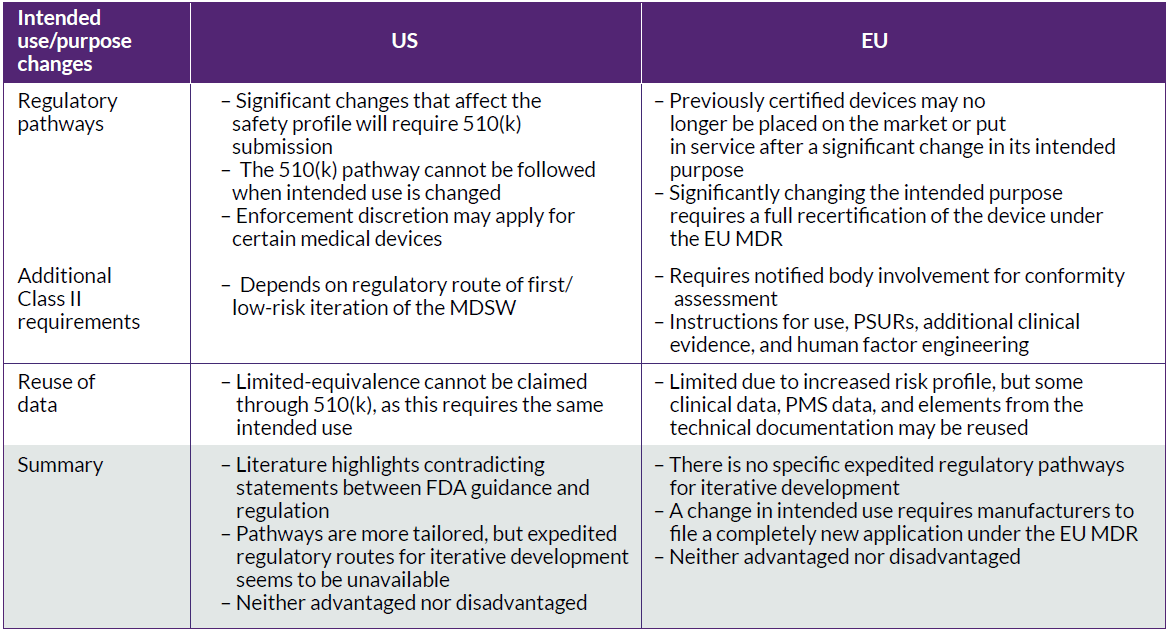
EU MDR, EU Medical Devices Regulation; MD, medical device; MDSW, medical device software; PMS, postmarket surveillance; PSUR, periodic safety update report.
The comparisons between the EU and the US show that there are aspects that both hamper and support iterative MDSW development. These have been summarized in Table 5. Some elements, such as governance, are inherently related to regional structures (with the EU being more decentralized due to the inclusion of multiple countries) and may, over time, become an asset rather than a barrier. One region should therefore not be typified as superior to the other. However, until the EU's decentralized system evolves to better leverage its unique structure, manufacturers are likely to perceive the US market and its regulatory framework as more appealing.
Table 5. Advantages and disadvantages for iterative software development in the EU and US
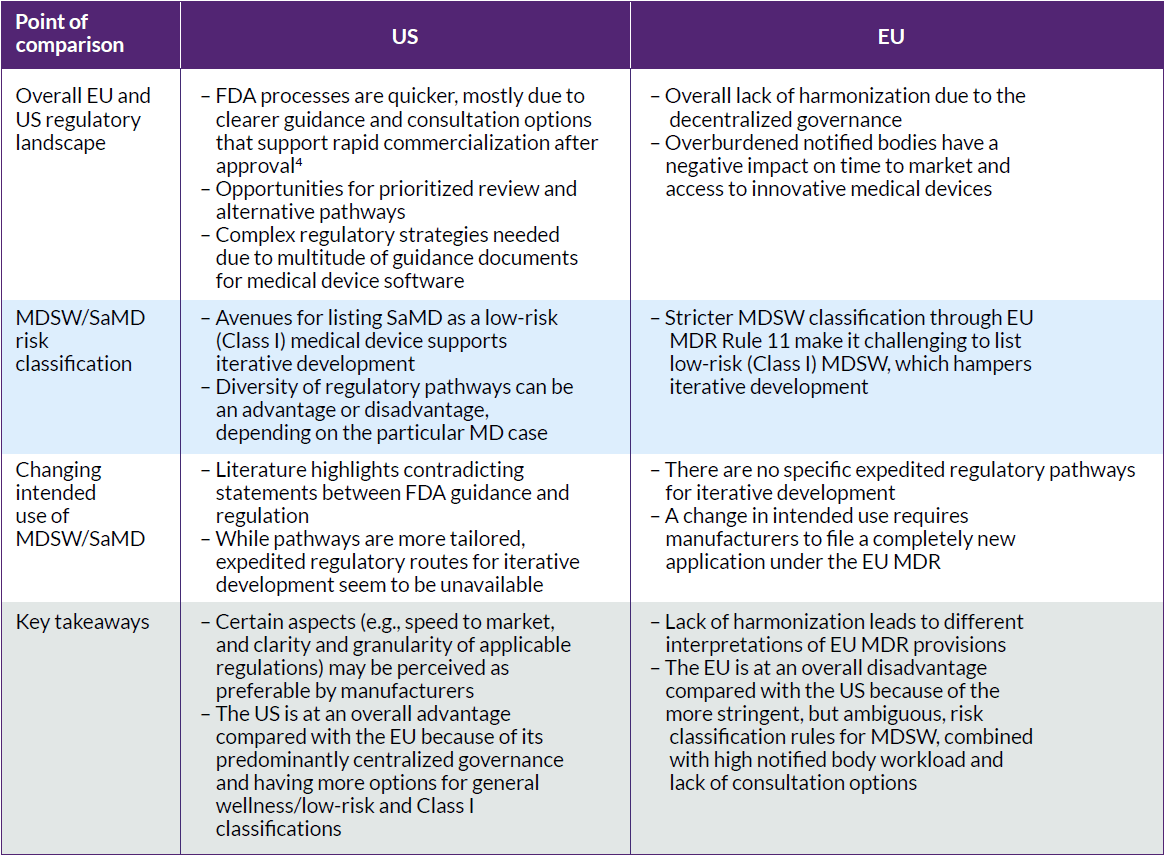
FDA, Food and Drug Administration; IMDRF, International Medical Device Regulators Forum; MDR, Medical Device Regulation; MDSW, medical device software; SaMD, software as a medical device.
FDA-cleared medical devices for EU MDSW
This section examines considerations when seeking approval under the EU MDR for MDSW that interacts with other medical devices that are not yet CE marked under the EU MDR. Specifically, it considers combinations with other hardware devices and evaluates the potential for leveraging FDA-cleared medical devices in associated EU MDR applications. To achieve this, the applicable EU regulations governing combinations of MDSW with other hardware medical devices are reviewed.
MDSW and hardware combinations
To evaluate how FDA-cleared MDSW can be leveraged for EU registration, the applicable EU regulations and guidance on MDSW interacting with other medical devices were reviewed. The EU MDR identifies three scenarios in which MDSW and hardware can be placed on the market together:²
- Scenario 1: In combination with one or more distinct medical devices (EU MDR Article 2(1));
- Scenario 2: As part of a system (EU MDR Article 22); or
- Scenario 3: As an integrated part or component of a medical device.
Acknowledging ongoing confusion around MDSW and hardware compatibility,28 MDCG 2023-429 adds two more scenarios:
- Scenario 4: Hardware as an accessory to an MDSW; and
- Scenario 5: Hardware as an integral part of a general consumer product or wearable digital product with no intended medical purpose.
Despite this additional guidance, MDCG 2023-4 leaves several points ambiguous. For Scenarios 1 and 4, it remains unclear whether the MDSW should be viewed as an accessory to the hardware, the inverse, or whether this depends on the specific case. The permissive language of MDCG 2023-4, which states that the MDSW manufacturer may rely on hardware or hardware-component compliance with the EU MDR,29 does not clarify whether the associated hardware must itself be CE marked under EU MDR.
For Scenario 2, EU MDR Article 22 offers partial clarity, specifying that where a system includes devices that are not CE marked, "the entire system of devices shall be treated as a device"² and must comply with applicable conformity assessment procedures. Hardware components in isolation, however, have no intended medical purpose and therefore cannot comply with EU MDR provisions in their own right.³0 For Scenario 5, the MDSW manufacturer becomes responsible for the entire system, including the safety, performance, and reproducibility of the hardware (e.g., a tablet or smartphone) in its combined use.29 MDCG 2023-4 provides no further specificity for Scenarios 1, 3, or 4.
Leveraging FDA-approved MDSW for EU market
As already noted, medical devices that do not bear either an MDD or EU MDR CE marking will need to complete EU MDR conformity assessment procedures to enter the European market. There are, however, indirect ways by which FDA-cleared or -approved MDSW may expedite entry into the EU market.
Postmarket surveillance data. FDA pathways are reported to allow for swifter approval and subsequent commercialization, partly due to clearer guidance and consultation options.4 This increased speed to market consequently helps to gather PMS data that is likely also relevant for the EU application as part of the clinical evaluation requirements under the EU MDR.
Use of international standards. Another opportunity lies in leveraging common requirements and best practices needed for achieving both FDA clearance in the US and approval in the EU. As such, when undertaking the initial FDA listing, it is advisable to ensure compliance with common international guidance, such as IEC 62304, IEC 60601-1-11, IEC 62366, and ISO 14971, that are applicable for both the EU and the US. EU MDR Article 8 confirms that devices conforming to such harmonized standards are also presumed to be in conformity with the relevant provisions of the EU MDR.2
While the EU MDR and MDCG 2023-4 contain ambiguities, they also seem to indicate that, to successfully file an application for MDSW combined with another hardware medical device or component in the EU, compliance with the relevant conformity assessment procedures is required to obtain CE marking. Consequently, there are limited opportunities to leverage FDA-cleared MDSW because these devices are not CE-marked. FDA-approved/cleared MDSW can mainly be leveraged through the generation of EU-relevant PMS data and through development in accordance with internationally recognized standards. Therefore, acceptance of FDA-approved/cleared devices by the European Commission would pave the way for the potential to significantly expedite EU approvals and reduce the regulatory burden on manufacturers of MDSW combined with hardware, thereby shortening time to market.
Market prioritization and regulatory strategies
The comparison between the US and EU continues in this section, along with an assessment of how the applicable regulations dictate market prioritization. The purpose is to evaluate the relationships between regulatory requirements and market prioritization.
International market selection model
A previously conducted study on international market selection31 that aimed to assess opportunities in the EU for mobile health medical devices proposed a model (Figure 3) that uses several parameters to evaluate market ecosystems across different European countries, identifying relevant stakeholders and barriers. The model lays out a set of parameters for a given firm (in the center of the model), allowing interdependencies to be analyzed and enabling conclusions regarding a country’s attractiveness to mobile health medical device developers.31 As such, it visualizes how regulation is just one element that should be evaluated by medical device manufacturers, together with reimbursement models and collaborators (as discussed in the literature review).
The model illustrates the extent of the EU’s decentralized model, which requires assessments on a country-by-country basis. Accordingly, regulatory considerations are listed as one of the key parameters. However, some parameters are specific to mobile health, and the study was conducted under the MDD, meaning that the regulatory parameter may have been based on European regulations that have since been superseded. Therefore, some of the conclusions drawn from this study may no longer fully hold true. Nonetheless, the ecosystem the model visualizes still applies, albeit within the context of evolving regulations such as the EU MDR.
Figure 3. Proposed international market selection model31
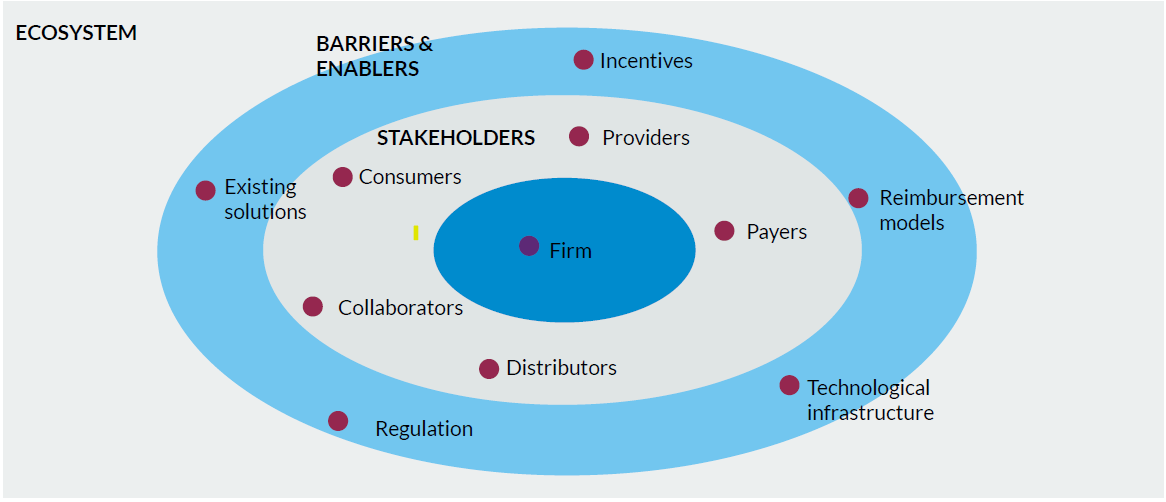
Reproduced with permission from Gavefalk G, Widén L
Importance of regulation in market selection
The internal market selection model identifies regulation as one of the key factors influencing market selection. As such, a clear understanding of regulatory approval pathways is essential when evaluating potential markets. This subsection first examines the current level of understanding of the EU MDR's implications, followed by a discussion of its financial and commercial implications. It concludes by evaluating the relationship between regulations and market prioritization in the US, as well as the role of FDA user fees.
Understanding EU MDR implications
Others have similarly argued that understanding regulatory implications for both the product and the organization early in the product lifecycle is fundamental to developing a successful commercialization strategy.32 However, understanding of the implications of the EU MDR appears to be lacking among industry professionals. A recent survey of 104 senior executives at medtech companies found that only 22% of respondents considered the EU regulatory pathways to be predictable.33
This contrasts with earlier expectations. In relation to the internal market selection model, it was argued that although regulatory barriers exist within the EU’s decentralized structure, the EU MDR was expected to simplify matters, especially for start-ups.31 The findings presented here suggest that this may have been an overly optimistic view. Start-ups appear to be among the groups requiring the most support for successful EU MDR implementation and are therefore unlikely to find the EU MDR simpler to navigate.
Financial implications under EU MDR
Manufacturers should also consider the increased financial burden associated with long notified body lead times, which can negatively impact time to market. Some have argued that notified bodies are likely to prioritize a steady, predictable workload associated with recertifying multiple MDD CE-marked devices from well-established medtech companies over a single or a small number of new devices from a start-up.5 Consequently, while larger firms are likely to have the financial means to absorb any delay to market, for smaller companies, every delay has an increasingly concerning impact on the organization’s viability.
US regulation and market prioritization
The FDA facilitates consultations. In addition, the FDA sunset its precertification pilot program in 2022, which was intended to remain suited to the way digital health software is designed, validated, and improved, while also capitalizing on the capabilities of medical device software.34 This illustrates how regulatory agencies may review and adapt regulatory pathways to support the development and commercialization of novel digital health technologies. Such initiatives appear to make the US more appealing than the EU, considering the aforementioned internal market selection model.
While the EU MDR was being implemented, the FDA appears to have achieved its aim of positioning the US as a priority market for developers of novel devices.33 This is further supported by a 2022 survey, which found that 89% of companies intended to prioritize the US regulatory approval.35 This statistic may be partly attributable to initiatives such as Q-submissions, breakthrough device designations, precertification pilots, and STeP, which enable companies, including smaller firms, to progress toward commercialization while maintaining the necessary standards of safety and effectiveness.36 The attraction of the US market may be further stimulated by the EU MDR’s constraints, especially for smaller firms.
FDA user fees
The aforementioned US initiatives have, in part, been funded by FDA user fees, which are fees paid primarily by industry for certain medical device applications. For example, the previous Medical Device User Fee Amendments (MDUFA) IV, which was in effect from 2017 to 2022, included a commitment under its digital health process improvement program to build the regulatory infrastructure, capabilities, and capacity needed to evaluate emerging digital health technologies,37 as demonstrated through the FDA’s DHIAP. As part of these efforts, the Digital Health Center of Excellence was established in 2020 to provide advice and support regulatory reviews of digital health technology.38
Moreover, under MDUFA V, effective from 2023 to 2027, the FDA established the Total Product Life Cycle Advisory Program pilot to improve early premarket engagement between the FDA and industry and to better understand regulatory expectations. The updated MDUFA performance goals also retain digital health as an area of continued improvement, with a particular focus on developing software-related technical expertise.39
These examples indicate the FDA’s continued commitment to improving engagement with industry by enhancing regulatory clarity and actively developing its capabilities through updated regulations that align with technological innovation. This commitment may help explain why the US seems to appear more attractive to medical device manufacturers. User fees also ensure sufficient FDA staffing, enabling more predictable review timelines. In addition, the FDA has also considered that user fee payments may form a bottleneck for small and medium-sized enterprises, which is why significant fee reductions are available to qualifying businesses.40
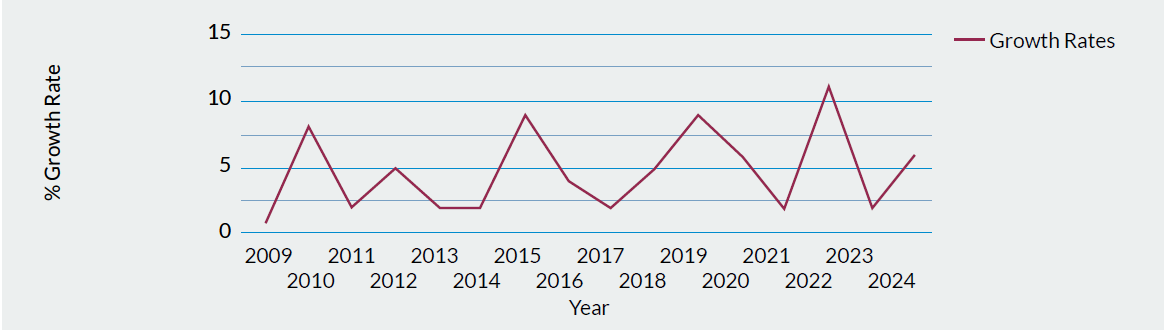
For now, the limiting impact of EU MDR provisions on companies operating the EU has not yet materialized, as negative medical device growth rates in the EU have not been observed in reports published by MedTech Europe. As the primary European trade association representing the medical technology section, including medical devices and digital health companies, MedTech Europe provides widely cited industry data and market analyses. This trend is illustrated in Figure 4, which shows that the compound annual growth rate continues to follow the historical trend over the previous 15 years. Unfortunately, this report does not include granularity by company size, which limits the ability to further identify a decline in growth among smaller firms. This does not imply the absence of challenges. Some healthcare professionals have reported losing access to roughly a dozen devices, forcing them to improvise and, in some cases, revert to practices associated with healthcare delivery 20 to 30 years ago because of reduced access to state-of-the-art medical devices.41
Figure 4. European medical device market growth rates 2009-202442
Adapted from MedTech Europe
The EU MDR provisions appear to negatively affect medical device manufacturers’ perceptions of the attractiveness of the EU, potentially leading some to prioritize the US market instead. While MedTech Europe growth figures do not yet indicate a significant decline in the overall market, a continued preference for the US over the EU may lead to a loss of access to innovative devices in the EU. These trends underscore the importance of regulatory requirements in shaping market prioritization. Supported in part by user-fee program commitments, the FDA appears to have attracted innovators and start-ups through pilot programs, structural efficiencies for innovative medical devices, expedited access pathways, and a range of regulatory consultation opportunities.
Conclusion
All considered, there are signals that the EU MDR has created challenges for manufacturers seeking to expand their presence or newly enter the European market. Capacity constraints with notified bodies, limited options for harmonized consultations, and few options for classifying MDSW as low risk, negatively impact the time to market and increase both financial and regulatory burden. However, quantifying these issues remains difficult, as MedTech Europe reports do not show any abnormal decline in growth.
In contrast, FDA regulations and guidance appear ample and appropriately granular. However, this research did not include a comprehensive review of FDA-specific regulatory requirements, instead focusing on higher-level governance, the availability and clarity of regulations and guidance, and risk classification mechanisms associated with intended use. A more detailed analysis of FDA requirements could arrive at different conclusions. However, such research would be unlikely to come to a significantly different conclusion regarding the overall perceived preference for the US regulatory framework, provided that the critique of the EU MDR remains unchanged.
The literature generally portrays the EU MDR – particularly the implications of Rule 11 – as allowing relatively few medical device software products to be classified as low-risk (i.e., Class I), and thus as not supporting iterative product design across changing risk classifications. This research confirms that listing low-risk, software-based devices is more feasible in the US, though it also concludes that iterative product development is not particularly well supported by regulations in either region. Regulatory requirements can clearly drive market prioritization, but nonregulatory elements should be weighed alongside them.
On that basis, manufacturers working with novel MDSW technologies, particularly start-ups and smaller innovators, are likely to find a more supportive regulatory environment in the US, where the FDA has actively positioned itself as a partner through tailored guidance and accessible consultation options. For the EU, a reassessment of MDSW risk classifications and the creation of formal or informal consultation mechanisms would help close the competitive gap. Economic operators could help catalyze this by initiating dialogue with regulators and notified bodies on whether a user-fee-style model, similar to the FDA's, could fund more detailed medtech guidance and additional staffing: an avenue warranting dedicated further research.
Research limitations and recommendations for future research
The findings in this research are based on the identified literature. While this does provide a solid foundation for understanding the theoretical framework of iterative product design, verifying how these have been implemented in practice would add greater value to the research topic. Therefore, the authors suggest that future research should examine the research questions in the context of particular use cases (i.e. actual medical devices). Preferably, such studies should be conducted at companies operating in the EU and the US, and should focus on SiMD and/or different types of SaMD, allowing for a broad analysis.
Furthermore, a dedicated literature review of the use of AI in medical device software is expected to highlight additional regulatory requirements and potential differences between the US and the EU. In addition, the EU-specific topic of the General Data Protection Regulation was outside the scope of this research. Data privacy is, however, a relevant additional research topic because MDSW has the potential to store interpret, and transfer data. It would therefore be valuable to understand again if regulations in this field differ between the US and EU and how they influence medical device manufacturers’ decision making.
Abbreviations
CMS, Centers for Medicare & Medicaid services; DHIAP, digital health innovation action plan; EMA, European Medicines Agency; FDA, Food And Drug Administration; IMDRF, international medical device regulators forum; MDCG, Medical Device Coordination Group; MDD, Medical Device Directive; MDR, Medical Device Regulation; MDSW, medical device software; MDUFA, Medical Device User Fee Amendment; NCA, national competent authority; PMS, post-market surveillance; RO, research objective; SaMD, software as a medical device.
About the authors
Wybe Hoffmann, MSc, is the regulatory affairs & pharmacovigilance strategy partner at Astellas Pharma Europe BV. He has more 9 years’ experience in regulatory affairs and 2 years in corporate strategy of healthcare products, with a focus on regulatory operations, medical device regulations, and strategic project delivery. Hoffmann has a bachelor of arts degree in Japan studies from the Leiden University in the Netherlands, a master of science degree in regulatory affairs (medical devices) from the University of Hertfordshire in the UK, and holds a professional certification in agile project management from the University of Maryland. He can be reached at [email protected]
Patrick Mahoney, MBA, RAC, is the co-founder of RAPID Regulatory and an adjunct professor for the Case Western Reserve University School of Medicine. He has more than a decade of experience in regulatory affairs with a master of business administration, with a focus on health care policy & regulation, and has earned the Regulatory Affairs Certification credential. Mahoney’s primary focus and expertise are in consultation, regulatory strategy development, and software solutions for regulatory affairs professionals. Mahoney is a RAPS member and holds the RAC. He can be reached at [email protected]
Disclaimer This article is solely attributed to the authors and is not associated with their respective employment. The views expressed in the article are their own and do not represent those of their respective employer.
Acknowledgement This article is based on aspects of a broader thesis that was conducted for a master of science degree in regulatory affairs (medical devices), accredited by the University of Hertfordshire (London, UK).
Citation Hoffmann W, Mahoney P. Understanding iterative medical device software development in the US and EU. RAPS Journal of Regulatory Affairs. 2026;1(5):25-40. Published online 3 November 2026. https://www.raps.org/resource/understanding-iterative-medical-device-software-development-in-the-us-and-eu.html
References
All references were last checked and verified on 17 October 2026.
- Software as a medical device market expect to reach US$ 5.4bn by 2032 [press release]. Open PR website. Published online 15 November 2022. Accessed 31 January 2026. https://www.openpr.com/news/2807030/software-as-a-medical-device-market-expect-to-reach-us-5-4-bn
- Regulation (EU) 2017/745 of the European Parliament and of the Council of 5 April 2017 on medical devices, amending Directive 2001/83/EC, Regulation (EC) No 178/2002 and Regulation (EC) No 1223/2009 and repealing Council Directives 90/385/EEC and 93/42/EEC (May 2017). https://eur-lex.europa.eu/legal-content/EN/TXT/PDF/?uri=CELEX:32017R0745
- Minghetti P, et al. Patient-managed digital medical devices: Do we need further regulation? Informatics in Medicine Unlocked. Published online 20 April 2024. Accessed 8 December 2024. https://doi.org/10.1016/j.imu.2024.101506
- EIT Health. Are we MDR Ready? Summary of research findings. Published online June 2021. Accessed 8 December 2024. https://eithealth.eu/wp-content/uploads/2021/10/EIT-Health-Think-Tank_Are-we-MDR-ready.pdf
- Baines R, et al. Navigating medical device certification: A qualitative exploration of barriers and enablers amongst innovators, notified bodies and other stakeholders. Ther Innov Regul Sci. Published online 4 October 2022. Accessed 8 December 2024. https://doi.org/10.1007/s43441-022-00463-4
- National Institutes of Health. Reimbursement knowledge guide for medical devices. Small Business Education and Entrepreneurial Development Office. Last updated 20 March 2024. Accessed 8 December 2024. https://seed.nih.gov/sites/default/files/2024-01/Reimbursement-Knowledge-Guide-for-Medical-Devices.pdf
- Sexton ZA, et al. Time from authorization by the US Food and Drug Administration to medicare coverage for novel technologies. JAMA Health Forum. Published online 4 August 2023. Accessed 8 December 2024. https://doi.org/10.1001/jamahealthforum.2023.2260
- Food and Drug Administration. Requests for feedback and meetings for medical device submissions: The Q-Submission Program [guidance]. Dated May 2025. Accessed 31 January 2026. https://www.fda.gov/regulatory-information/search-fda-guidance-documents/requests-feedback-and-meetings-medical-device-submissions-q-submission-program
- Food and Drug Administration. FDA and Industry procedures for selecting 513(g) requests for information under the Federal Food, Drug, and Cosmetic Act [guidance]. Dated 23 August 2024. Accessed 8 December 2024. https://www.fda.gov/regulatory-information/search-fda-guidance-documents/fda-and-industry-procedures-section-513g-requests-information-under-federal-food-drug-and-cosmetic
- Gerhart M. MDR Classification Rule 11: The classification nightmare? Johner Institute. Published 21 January 2026. Accessed 31 January 2026. https://blog.johner-institute.com/regulatory-affairs/mdr-rule-11/
- MDCG 2019-11: Guidance on qualification and classification of software in Regulation (EU) 2017/745 – MDR and Regulation (EU) 2017/746 – IVDR [guidance]. Dated October 2019. Accessed 31 January 2026. https://health.ec.europa.eu/system/files/2020-09/md_mdcg_2019_11_guidance_en_0.pdf
- International Medical Device Regulators Forum. “Software as a medical device”: Possible framework for risk categorization and corresponding considerations. Dated 18 September 2014. Accessed 8 December 2024. https://www.imdrf.org/sites/default/files/docs/imdrf/final/technical/imdrf-tech-140918-samd-framework-risk-categorization-141013.pdf
- Food and Drug Administration. Digital Health Innovation Action Plan. Published online 27 July 2017. Accessed 8 December 2024. https://www.fda.gov/media/106331/download
- Food and Drug Administration. Clinical decision support software [guidance]. Dated 29 January 2026. Accessed 31 January 2026. https://www.fda.gov/regulatory-information/search-fda-guidance-documents/clinical-decision-support-software
- Food and Drug Administration. Medical device data systems, medical image storage devices, and medical image communications devices [guidance]. Dated 28 September 2022. Accessed 8 December 2024. https://www.fda.gov/regulatory-information/search-fda-guidance-documents/medical-device-data-systems-medical-image-storage-devices-and-medical-image-communications-devices
- Food and Drug Administration. Policy for device software functions and mobile medical applications [guidance]. Dated 28 September 2022. Accessed 8 December 2024. https://www.fda.gov/regulatory-information/search-fda-guidance-documents/policy-device-software-functions-and-mobile-medical-applications
- Food and Drug Administration. Multiple function device products: Policy and considerations [guidance]. Dated 29 July 2020. Accessed 8 December 2024. https://www.fda.gov/regulatory-information/search-fda-guidance-documents/multiple-function-device-products-policy-and-considerations
- Food and Drug Administration. General wellness: Policy for low risk devices [guidance].Dated 6 January 2026. Accessed 31 January 2026. https://www.fda.gov/regulatory-information/search-fda-guidance-documents/general-wellness-policy-low-risk-devices
- Beckers R, Van Hoydonck P. Impact of the regulatory framework on medical device software manufacturers: Are the guidance documents supporting the practical implications?; Comment on “Clinical decision support and new regulatory frameworks for medical devices: are we ready for it? – A viewpoint paper”. Int J Health Policy Manag. Published online 10 July 2023. Accessed 8 December 2024. https://doi.org/10.34172/ijhpm.2023.7470
- MDCG 2020-6: Regulation (EU) 2017/745: Clinical evidence needed for medical devices previously CE marked under Directives 93/42/EEC or 90/385/EEC [guidance]. Dated 23 April 2020. Accessed 8 December 2024. https://health.ec.europa.eu/system/files/2020-09/md_mdcg_2020_6_guidance_sufficient_clinical_evidence_en_0.pdf
- Joint industry position on significant changes according to MDR Article 120(3). AESGP, COCIR, EUROMCONTACT, MedTech Europe. Published online 12 February 2019. Accessed 8 December 2024. https://www.dm-experts.fr/wp-content/uploads/2019/03/2019-02-12_Joint-industry-paper_significant-changes_art-120_3.pdf
- MDCG 2020-3: Guidance on significant changes regarding the transitional provision under Article 120 of the MDR with regard to devices covered by certificates according to MDD or AIMDD [guidance]. Dated 16 March 2020. Accessed 8 December 2024. https://health.ec.europa.eu/system/files/2020-09/md_mdcg_guidance_significant_changes_annexes_en_0.pdf
- Food and Drug Administration. Deciding when to submit a 510(k) for a software change to an existing device [guidance]. Dated 25 October 2017. Accessed 8 December 2024. https://www.fda.gov/regulatory-information/search-fda-guidance-documents/deciding-when-submit-510k-software-change-existing-device
- 21 CFR §807.81. When a premarket notification submission is required. Current as of 13 August 2026. Accessed 31 January 2026. https://www.ecfr.gov/current/title-21/chapter-I/subchapter-H/part-807/subpart-E/section-807.81
- Food and Drug Administration. Deciding when to submit a 510(k) for a change to an existing device [guidance]. Dated 25 October 2017. Accessed 8 December 2024. https://www.fda.gov/regulatory-information/search-fda-guidance-documents/deciding-when-submit-510k-change-existing-device
- Food and Drug Administration. Premarket notifications 510(k). Current as of 22 August 2024. Accessed 8 December 2024. https://www.fda.gov/medical-devices/premarket-submissions-selecting-and-preparing-correct-submission/premarket-notification-510k#se
- Food and Drug Administration. Acceptance review for de novo classification request [guidance]. Dated 5 October 2021. Accessed 8 December 2024. https://www.fda.gov/regulatory-information/search-fda-guidance-documents/acceptance-review-de-novo-classification-requests
- Van Raamsdonk A. New European guidance clarifies medical device software requirements. Emergo by UL. Published 10 October 2023. Accessed 8 December 2024. https://www.emergobyul.com/news/new-european-guidance-clarifies-medical-device-software-requirements
- MDCG 2023-4: Medical Device Software (MDSW) – Hardware combinations – Guidance on MDSW intended to work in combination with hardware or hardware components [guidance]. Dated 18 October 2023. Accessed 8 December 2024. https://health.ec.europa.eu/system/files/2023-10/md_mdcg_2023-4_software_en.pdf.
- Johner C. MDCG 2023-4 on combinations of MDSW and hardware. Johner Institute. Published 31 October 2023. Accessed 8 December 2024. https://blog.johner-institute.com/iec-62304-medical-software/mdcg-2023-4/
- Gavefalk S, Widén L. International market selection: Assessing opportunities in the European Union for a mHealth consumer medical device start-up [MSc Thesis]. Stockholm (SE): KTH Industrial Engineering and Management. Published online 7 June 2016. Accessed 8 December 2024. https://www.diva-portal.org/smash/get/diva2:939530/FULLTEXT01.pdf
- Beckers R, et al. The EU medical device regulation: Implications for artificial intelligence-based medical device software in medical physics. Physica Medica. Published online 28 February 2021. Accessed 8 December 2024. https://doi.org/10.1016/j.ejmp.2021.02.011
- Taylor NP. US replaces EU as priority market for medtech industry: survey. Medtechdive. Published 16 March 2022. Accessed 8 December 2024. https://www.medtechdive.com/news/us-replaces-eu-priority-market-medtechs/620450/
- Food and Drug Administration. Digital Health Software Precertification (Pre-Cert) Pilot Program. Current as of 26 September 2022. Accessed 8 December 2024. https://www.fda.gov/medical-devices/digital-health-center-excellence/digital-health-software-precertification-pre-cert-pilot-program
- Johnson C, et al. For cutting-edge innovations, the US pulls ahead of the EU in Medtech Regulation. Boston Consulting Group. Published 11 March 2022. Accessed 8 December 2024. https://www.bcg.com/publications/2022/us-ahead-in-medtech-regulation
- AlvaMed. US Favored Over EU for medical device market entry. Published online 9 May 2023. Accessed 8 December 2024. https://alvamed.com/newsletter/us-favored-over-eu-for-medical-device-market-entry/
- Shuren J. MDUFA IV and Beyond – Video Reports [FDA YouTube video]. Posted online 15 October 2020. Accessed 8 December 2024. https://www.youtube.com/watch?v=1-hTAKFGEwk
- Food and Drug Administration. About the Digital Health Center of Excellence. Current as of 22 September 2020. Accessed 8 December 2024. https://www.fda.gov/medical-devices/digital-health-center-excellence/about-digital-health-center-excellence
- Food and Drug Administration. MDUFA performance goals and procedures, fiscal years 2023 throughout 2027. Published 28 March 2022. Accessed 8 December 2024. https://www.fda.gov/media/157074/download
- Food and Drug Administration. Medical Device User Fee Amendments (MDUFA): Fees. Current as of 30 September 2025. Accessed 31 January 2026. https://www.fda.gov/industry/fda-user-fee-programs/medical-device-user-fee-amendments-mdufa
- Fick M. Insight: Medical device makers drop products as EU law sows chaos. Reuters. Last updated 19 December 2022. Accessed 8 December 2024. https://www.reuters.com/business/healthcare-pharmaceuticals/medical-device-makers-drop-products-eu-law-sows-chaos-2022-12-19/
- MedTech Europe. The European medical technology in figures. Last updated 4 September 2025. Accessed 31 January 2026. https://www.medtecheurope.org/datahub/market/#:~:text=Based%20upon%20manufacturer%20prices%2C%20the,over%20the%20past%2010%20years