
AI won’t erase jobs, but regulatory professionals need to be vigilant, experts say
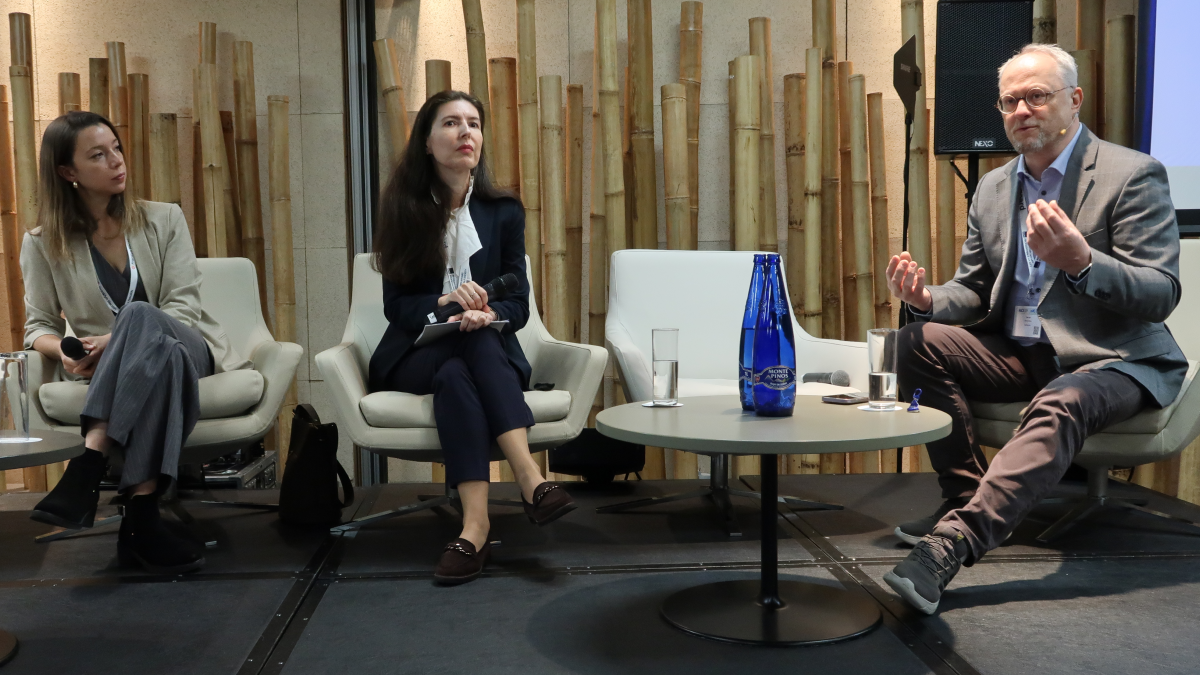
Left to right: Laura Van Vaeck, Laura Faur-Mogos, and Gert Bos spoke at the RAPS Regulatory Intelligence Conference Europe (credit: Ferdous Al-Faruque)
BARCELONA – As artificial intelligence (AI) permeates the regulatory world, experts said it won't take over regulatory professionals' jobs but will instead help them work more efficiently and dedicate more time on human interactions. However, they said it is the responsibility of regulatory professionals to understand the technology's capabilities and limitations, as well as their ability to use it effectively.
Laura Faur-Mogos, regulatory affairs specialist at Avantor, and Laura Van Vaeck, regulatory director at Franklin Health, presented on the emergence of AI in the regulatory space and considerations for using the technology at the RAPS Regulatory Intelligence Conference Europe.
As in other sectors, some have raised concerns that AI may take some regulatory jobs, but according to Faur-Mogos and Van Vaeck, that won’t be the case.
"Don't be afraid, AI is here to stay," said Van Vaeck. "It's not necessarily going to take your job, and we will be adapting as humans, as experts, to this and incorporate it as an intelligent kind of assistance to do things that we want it to do."
"My personal take is to embrace it," she added. “It is here, and it can definitely facilitate your life and give you more time to think critically and to also focus a bit more on these kinds of face-to-face human interactions that you sometimes miss."
Faur-Mogos agreed but noted that effective use of AI depends on the user's experience and awareness. She said that AI is incapable of understanding some nuances, especially when it comes to making ethical and moral choices, and that’s where the regulatory professional comes in.
"Gnothi seauton... it is ancient Greek, it is written on the front of Apollo's Temple in Delphi, and it means know thyself," said Faur-Mogos. "Start by knowing yourself and put yourself in perspective.
"See what you have to offer to this world, to this company, to this role," she added. "Know yourself."
Faur-Mogos and Van Vaeck said that AI will ultimately redefine the meaning of regulatory expertise, so it's important for regulatory professionals to understand the different kinds of AI at their disposal, their capabilities, and their limitations. They highlighted that there are currently three types of AI available to regulatory professionals: narrow AI, generative AI, and agentic AI.
They explained that narrow AI performs single defined tasks and is prone to bias. Generative AI can create new content but may be prone to privacy violations, hallucinations, and automation bias. Finally, agentic AI can plan and act on its own, but it carries risks inherent to its autonomy and may be prone to ethical problems and cascading failures.
They noted that the use of AI may lead to deskilling, where regulatory professionals lose certain skills because they have allowed AI to take over such tasks; never-skilling, where they never acquire certain skills because AI has always handled certain tasks; and mis-skilling, where AI's errors are accepted as knowledge. To safeguard against such problems, they said the AI should be tested before deployment, evaluated through a risk assessment, and monitored and intervened when a problem arises.
Faur-Mogos and Van Vaeck said that AI ultimately is a tool that can help regulatory professionals monitor sources and regulatory changes, process large volumes of documents, aggregate and summarize information, and compare different versions of documents.
"Do you enjoy using Excel nowadays, or do you enjoy doing tons of calculations manually on paper?" asked Faur-Mogos. "AI will become our tool; we will be in charge, but AI will be in the loop."
While AI is a tool, Faur-Mogos and Van Vaeck emphasized that it needs human expertise to ensure good judgment and accountability. They said it will be up to the regulatory professional to use ethical reasoning, apply context, conduct risk assessments, and take accountability for decisions informed by AI.
One possible negative impact of AI that worries her, Van Vaeck said, is the potential loss of mentorship, experience, and knowledge that could lead to deskilling and never-skilling. She pointed out that while today’s professionals have the experience to debate AI, newer graduates into the field might not have the experience to question assertions by the technology.
Gert Bos, chief scientific officer at QServe Group and the session moderator, said this highlights the importance of critical thinking and of ensuring that future regulatory professionals have strong values. He also emphasized that it's important for more experienced professionals to trust their junior counterparts.
"Looking at some of the older people in the room, people that are the managers, people that are the CEOs, you have to start trusting the people that are no longer doing it only with their own expertise, but are scrambling to get the information right," said Bos. "There's a lot of panic basically in getting it right.
"How will we in the future, as managers, as department heads, responsible for making a business decision, be able to trust people in this changing landscape," he added.
Faur-Mogos said it's important to accept that people will make mistakes when using AI, as will the AI.
"You have mentioned that AI hallucinates, but haven't we ever made a mistake? Haven't we ever made a wrong decision?" said Faur-Mogos. "As human experts, we have done so, so why not allow AI to do that sometimes until it becomes fully reliable?
"Maybe that would be a starting point," she added. "Let them do some mistakes... How do you build up expertise? By accumulating experience and build up on numerous cases. Not all are fortunate. Not all have a happy ending. But we have to go through it all."