

Journal of Regulatory Affairs: A guide for submitting articles
Updated 6 October 2026
The Journal of Regulatory Affairs is an independent, peer-reviewed journal that delivers original, research-based content on emerging issues in the global regulatory landscape. The journal is a bimonthly (i.e., six times a year) publication that also publishes Online Only articles, which may be included in a subsequent bimonthly issue. It reaches an audience of 30,000 regulatory professionals globally. The journal was launched in January 2026 and is built on the success of its predecessor, RF Quarterly.
- Publishes topic-focused articles based on priority topics selected by regulatory experts on RAPS' Editorial Advisory Committee. Topics for 2027 will be published in late September;
- Includes ad hoc articles on topics of author interest/specialty not on the list of priority topics;
- Publishes dissertations/capstone projects – in full, or as articles based on the work;
- Publishes articles adapted from Convergence and Euro Convergence presentations; and
- Provides information with a strong “how-to” subtext for use in the real-world regulatory setting.
Resources at a glance
- Style Guidelines for Authors
- Presubmission checklist
- Article document settings
- RAPS Media Planner
- 2027 Editorial Focus Areas
- JRA AI Policy & Acknowledgment Form
The following comprehensive editorial and article submission guide covers:
- Journal mission and scope
- AI-generated content, plagiarism, and promotional content
- Submission process
- Editorial process: Review, editing, proofreading, and publication
- Editorial expectations
- Examples of published articles
- Archives for RF Quarterly and monthly articles
- Editorial contact
- Advertising sales
Journal mission and scope
The Journal of Regulatory Affairs replaces RF Quarterly and is published bimonthly as an online RAPS publication. As noted, it also publishes Online Only articles, which may or may not be included in a subsequent bimonthly issue. Articles are:- Original to RAPS and member exclusive; and
- Written by regulatory subject matter experts
- Publish in-depth, evidence-based, original content, exclusive to RAPS members;
- Expand coverage of global regional regulatory issues and trends;
- Provide information for use as guidance or a resource in daily regulatory work;
- Allow authors to share their knowledge and expertise with their regulatory peers;
- Publish dissertations/capstone projects – in full, or articles based on the work;
- Publish articles adapted from Convergence and Euro Convergence presentations; and
- Advance existing regulatory literature.
- Global drug and medical device regulation and related science and technology
- Product lifespan, from development through postmarket surveillance
- Career- and workplace-related topics, (e.g., professional development, career advancement, mentoring, leadership, diversity, skills development)
AI-generated content, plagiarism, and promotional content
AI-generated content will not be considered for publication. References also should not be generated by AI. Articles must be informed by authors’ residual regulatory knowledge and supported by original-source references. In addition, when writing about AI, authors must provide critical assessments of the technology, addressing both its challenges and limitations, as well as its advantages. Authors will be asked to sign an acknowledgment form upon submission of the article, which affirms that the submitted content is in line with our policy regarding AI-generated content.Likewise, plagiarized content or content promoting or referencing a tool or service provided by an author or the company they work for will not be considered for publication.
Submission process
Initial author inquiry
Please reach out to us at [email protected] to share an article proposal, as it helps with our planning purposes. The proposal should specify the topic's relevance for regulatory professionals in the real-world setting. It should include the following elements:
- A working headline of no more than 70 characters, including spaces
- The authors’ names, degrees, and affiliations
- An abstract of no more than 75-80 words
- 3-5 keywords in alphabetical order
Editorial staff will evaluate your proposal and provide feedback. If the proposal is accepted, the editorial staff will assign a submission deadline.
Presubmission checklist
Before submitting the final version of the article for peer review, authors should note the requirements for:
- References, as outlined on pp. 7-11 of the Style Guidelines;
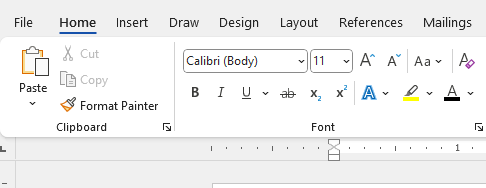
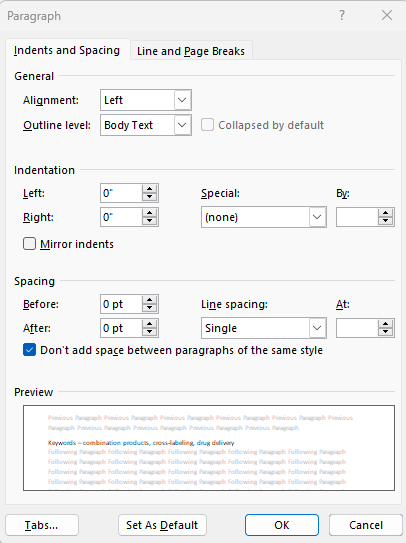
- Article presentation, as outlined in the Article sample document and shown in these two images: article font + type size and article paragraph settings; and
- Checking the article before submission, as outlined in the Presubmission checklist (also on p. 44 of the Style Guidelines).
Submitting the article
As already noted, the submission must comply with the Style Guidelines, particularly the requirements outlined in the Presubmission checklist on page 44 of the Guidelines.
Corresponding author
Articles with more than one author must have a designated corresponding author who will be the sole liaison with the editorial team through the submission-to-publication stages. The corresponding author should be a senior member of the writing team who can address substantive editing queries and others related to the article, coordinate the article proofreading process, and sign off on the final PDF version of the article.
Article presentation
Submitted articles must:
- Cite references in the text as superscript numbers corresponding to source reference information in a Reference list at the end of the article. Please do not use linked or automated in-text citations that connect to the reference list. In-text citations should be standard, unlinked text.
- Be a minimum of 3,200 words and a maximum of 7,000 words, including references
- Be structured to include:
- Article title
- Author(s) name(s)
- Abstract
- Keywords (3-5, in alphabetical order)
- Introduction/background that includes the stated purpose of the article
- The main body of the article, with subsections clearly marked with subheads
- Conclusion
- Abbreviations list
- Author biography/biographies (no more than 100 words)
- Disclosures and/or acknowledgment (only if needed), and
- References
- Where possible, be accompanied by tables and figures
Figures should be sent as an accompanying editable PowerPoint file. (Images of the figures may be included as part of the text, but the editable PowerPoint version must also accompany the submission.)
Each figure must include its source information. If it is a reproduction from another publication or is not from an open access source, the author must provide confirmation in writing that they have permission to use and reproduce it.
The completed article must be emailed as a Word document (not a PDF) to [email protected]
Editorial process: Review, revision, editing, proofreading, and publication
Authors work directly with the editorial staff, from initial inquiries about submission, through the review and editing phases, to publication of the final version.Reviewers are seasoned regulatory subject matter experts. We do not use AI for reviews.
Technical review
The submitted article will undergo an initial technical review to ensure it complies with the Style Guidelines and requirements outlined in the Presubmission checklist (p. 44). If it does not comply with those requirements, it will be returned to the author for technical corrections before advancing to peer review. Note that in some cases, editorial staff may reject an article at the technical review stage without the option for revision.
Peer review
If the submission complies with the Style Guidelines, the article will be de-identified and sent to reviewers (usually 2-3) for double-blind peer review.
The article is reviewed for:
- Relevance to a regulatory audience [individuals, organizations, reader experience level]
- Technical accuracy, including adequate and properly cited references
- Timeliness
- Quality of presentation
- Organization and structure, incl. an abstract with a clearly defined goal(s) and conclusion with a succinct summary and important takeaways
- Areas for improvement [specific suggestions are provided to guide the author with revisions ]
- Yes, as is
- Revise, with suggested changes
- Revise, with mandatory changes
- No, not suitable (does not align with journal mission or scope; is AI-generated; is promotional of a product or service; is an opinion/perspective piece)
Most articles require revision based on reviewer feedback:
- After peer review, the editorial team will consolidate the reviewer comments and return the reviewed article and comments to the corresponding author for revision.
- The corresponding author will co-ordinate with the other authors in addressing the reviewer requests and any additional requests from the editorial team. If a particular reviewer issue is not addressed by the authors, written support for that decision must be provided.
- Revisions and updates must be done in Track Changes so that the reviewers can easily see the revisions and new content. If revisions are not in Track Changes, they will be returned to the corresponding author for the changes to be tracked.
The article will undergo a substantive edit and a second edit once the revisions have been sent back to the editorial team. It will then be returned to the corresponding author as a Word document for a final round of proofing before publication.
All proofreading edits must be done in Track Changes.
Authors must consider this their final opportunity for making any substantive or detailed text or reference changes.
The corresponding author will email the proofread article to the editorial staff, who will check, approve, and prepare it for publication.
At this stage, each author must also:
- Sign the copyright release form, which will be included in the initial email containing the article for proofreading. The article will not be published until the all authors, expect those working for the US Food and Drug Administration, have signed the form and it has been returned to RAPS.
- Provide a recent, good quality, hi-res headshot of themselves to run with the article. The image should:
- Be in color
- Be about 4” x 5” in size
- Be at least 150 dpi, or about 600 x 750 pixels
- Have a background, that is, it should not be close cropped
- Have a solid background, that is, no distracting background elements
The corresponding author will also receive a PDF of the article for final check. As already noted, major changes, edits, and rewrites will not be accommodated at this stage. The corresponding author must ensure that all such changes were addressed during the proofreading stage.
Publication of the article
- Each issue of the new journal will be compiled into a PDF. The full issue and the individual article PDFs will be published online and sent to each contributing author.
- RAPS will also publish ad hoc Online Only articles, which may or may not be included in a subsequent bimonthly issue. The final, author-approved Word document version of the article will be published online, and authors will receive a PDF of the article.
- The full journal issue and individual articles will be highlighted on social media, including LinkedIn, and newsletters, reaching 30,000 regulatory professionals globally.
Editorial expectations
As already mentioned, content should be original and exclusive to RAPS. The article must be submitted in accordance with the Style Guidelines, with particular attention to the Presubmission checklist requirements on p. 44 of the Guidelines. To reiterate, articles should:- Add value to and expand the broader body of the regulatory literature;
- Not be AI generated – such content will not be considered for publication and will be returned to the person who sent it;
- Support statements of fact through references to the original, primary source in the regulatory literature, including laws and regulations/guidance;
- Be written from a neutral, non-advocating perspective;Not promote a product and/or service offered by any author or author’s company; and
- Be more formal in tone rather than conversational or journalistic (no clichés, verb contractions, or addressing the reader as “you”).
Note The editorial team expects to deal directly with the lead or corresponding author and regulatory specialists, not through communications or marketing intermediaries.
Examples of published articles
- Understanding predetermined change control plans: Lessons for postmarket innovation and global alignment
- Navigating convergence and divergence between the EU MDR and EU AI Act
- From IVDD to IVDR: The interplay between notified bodies and EU reference laboratories
- The EAEU regulatory pathway: A practical guide for global applicants
- Engineering safety and effectiveness: A first-principles approach to drug-device combination products
Archives for RF Quarterly and monthly articles
- RF Quarterly – All articles (2021-2025)
- Regulatory Focus – Monthly articles (2012-2025)
Advertising sales Eric Gershowitz • +1 410-584-1983 • RAPS Media Planner