
Convergence: Regulators highlight efforts to streamline the European regulatory framework
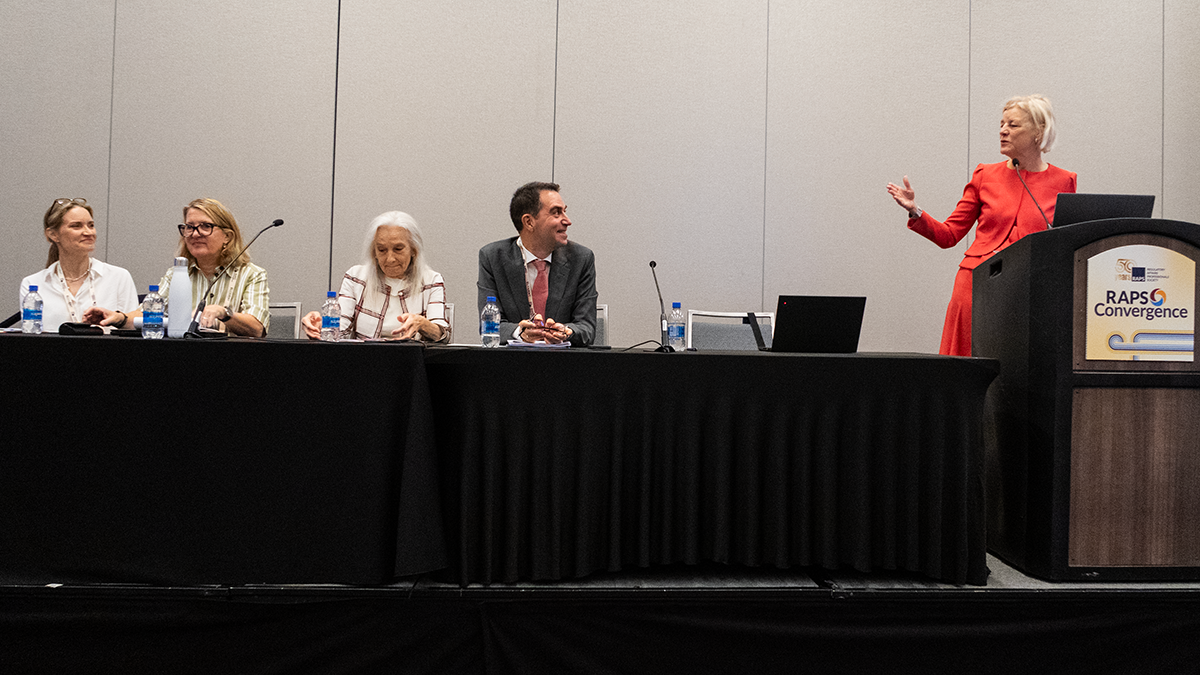
CHARLOTTE, NC – A panel of regulators convened at the 2026 RAPS Convergence to discuss several initiatives underway in Europe to help sponsors bring products to market more streamlined and predictably.
Alberto Gañán Jiménez, head of the committees and quality assurance department at the European Medicines Agency (EMA), provided an overview of several programs designed to support innovation, including the EU Innovation Network (EU-IN), Innovation Task Force (ITF), PRIority MEdicines (PRIME) scheme, and expert panels to discuss innovative medical devices. He noted that EU-IN is intended to address gaps in early regulatory support by enabling regulators to share best practices with innovators. At the same time, ITF provides similar opportunities for drug developers to brainstorm innovative ideas with regulators on topics for which there is currently no guidance.
“In the European Medicines Agency, the sector that supports this EU Innovation Network is called the EMA Innovation Task Force,” said Ganan. “This is a group of colleagues at the European Medicines Agency that links with the experts of the network.
“We have a network of more than 5,000 experts in the European Union, and what this innovation task force does is coordinate these experts from the network to provide support to developers in emerging technologies in drug development,” he added.
Gañán added that drugs under development that are of major public interest can use the PRIME scheme to receive expedited follow-up scientific advice.
Andrea Laslop, a regulatory expert at the Malta Medicines Authority, discussed the Scientific Advice Working Party, established by EMA's Committee for Medicinal Products for Human Use (CHMP). The group brings together expertise from across Europe to address issues related to the development of advanced therapy medicinal products.
Laslop noted that they address questions about quality, non-clinical development, and clinical development. She also noted that the working party provides broad advice on general procedures and qualified advice and opinions on issues such as biomarker selection and novel methodologies. Furthermore, she added that it can provide parallel advice from organizations, including the US Food and Drug Administration (FDA) and health technology assessment (HTA) institutions, and can also advise on eligibility requests for the PRIME scheme.
“The idea behind [SAWP] is to give a link between the [CHMP committees] via their input to the scientific advice working party,” said Laslop. “The main goal, of course, is to tailor development for marketing authorization.
“What is really important is that the working party cannot do a pre-assessment of data,” she added. “This is not in the remit of these experts.”
Laslop also highlighted the work of the Committee for Advanced Therapies (CAT), which includes members of CHMP, EU member states, representatives of the European Economic Area (EEA) and the European Free Trade Association (EFTA), the European Commission (EC), and patient representatives. She noted, however, that a group of experts will most likely replace CAT and won’t have the status of a CHMP committee by 2028, based on the proposed European new pharmaceutical legislation.
“But collaboration will continue, and the main activity of the CAT is the assessment of the quality, safety, and efficacy of advanced therapies, where the committee brings up a draft opinion on each of those marketing authorization applications,” said Laslop. “Final opinion, however, is then concluded by the CHMP and forwarded to the European Commission, which is the body officially giving the marketing authorization.”
One area that Laslop emphasized was the ability to receive parallel scientific advice from EMA and FDA. She noted the average time to get advice from EMA through the program was 70 days. Furthermore, she noted that it can optimize global product development while helping avoid unnecessary duplication of testing for both agencies.
“By sharing information and perspectives in joint discussions, it offers really broad expertise… but also helps in understanding the views of why sometimes we really differ in our requirements,” said Laslop. “However, ultimately, the advice given by both the EMA and the FDA is done individually, separately; there is not yet a joint opinion on this.”
Corinne de Vries, EMA liaison to FDA, noted that sponsors submit their request for parallel review to EMA and FDA at the same time, which then triggers the agencies to liaise and follow the SAWP timetable.
“FDA has a very flexible interaction on scientific advice, where you can just come whenever,” said de Vries. “In Europe, we've got legal deadlines and timelines, so it follows the EMA timetable for SAWP.
“Before you come to the SAWP, FDA and EMA have a long bilateral meeting and really go through your dossier and identify what the questions are that we have,” she added. “What I actually find is we often are aligned.”
Stiina Aarum, a senior scientific specialist at EMA, discussed the agency's efforts to strengthen the EU regulatory landscape for clinical trials, combination products, and companion diagnostics. She noted the adoption of the 2022 Clinical Trials Regulation (CTR), which harmonized clinical trial submissions, evaluations, and supervision, and allowed a single submission applicable to all EU member states. She also discussed the launch of the Accelerating Clinical Trials in the EU (ACT EU) initiative that same year, a collaborative initiative between EMA, the European Commission, and the Heads of Medicines Agencies (HMA) intended to build consensus and develop guidance and training tools to navigate regulatory changes.
Aarum noted that European lawmakers and policymakers are working to enact the Biotech Act, which includes provisions intended to shorten clinical trial evaluation timelines, allow flexibility for multiple major modifications in ongoing trials, and strengthen the role of the Reporting Member State (RMS). She added that it is also intended to create a single assessment process for combination products that is already being tested under the COMBINE pilot program.
Another EU pilot program is the Facilitating and Accelerating Strategic Clinical Trials (FAST-EU) program. Aarum said that the intent is to test the accelerated clinical trial evaluation timelines proposed under the Biotech Act, conduct better-coordinated assessments of multinational clinical trials, and streamline assessments within 70 calendar days. She noted there's been a lot of interest in the project, with 110 requests to participate since its launch in January 2026.
"What the EMA does in this pilot is that we provide technical expertise and facilitate the accelerated processes in [the Clinical Trials Information System (CTIS)]," said Aarum. "This pilot shows that it is possible to already have more efficient timelines through EU-wide coordination within the currently existing framework.
"For EU sponsors, this means faster and more predictable multinational trial assistance across Europe," she added.
An audience member asked Aarum to elaborate on EMA’s plan to allow flexibility in modifying ongoing clinical trials, to which Aarum noted that there are some limitations in the current system.
"I think it's mostly related to the technical limitations of the CTIS platform," said Aarum. "We can only accept one modification at a time, and I understand that this is a big limitation for you as developers, but also something that my colleagues working with this system are very frustrated about.
"They very much welcome the proposal under the Biotech Act to make improvements to this," she added.