

Orchestrating an AI-first regulatory organization
The life sciences industry is on the brink of an operational paradigm shift. Driven by the rapid acceleration of artificial intelligence (AI) in molecule discovery and the subsequent explosion of data from digital twins, biomarkers, and decentralized clinical trials, the volume and velocity of research output are reaching unprecedented levels.
Simultaneously, health authorities worldwide are modernizing their infrastructures, moving away from static document submissions toward rolling, real-time data submissions, leveraging AI for internal reviews. For regulatory affairs and regulatory operations leaders, this environment creates an opportunity to shift human involvement in regulatory processes further up the value chain. The regulatory organization of tomorrow will be an AI-first, data-driven, strategic partner to research and development (R&D).
Macro trends reshaping the regulatory organization
The traditional regulatory organization model is built on a document-centric foundation where submissions are treated as discrete, linear projects. As AI matures, this model will dissolve. Submissions will increasingly transition from independent, heavily managed projects to continuous, digital byproducts of the core R&D lifecycle. And there will be many submissions that leadership will expect regulatory teams to handle while maintaining headcount.
To handle these trends, organizations need to evolve how they think about working with AI. There are three distinct approaches for this:
- Human in the loop. The current, proven standard, where AI suggests content or data patterns, and a human manually reviews, edits, and approves every individual step. This is a great model for high-risk, complex regulatory tasks that may impact patient safety and hence benefit from human judgment, regulatory intent assessment, and experience with health authorities.
- Human on the loop. A collaborative approach being piloted by some leading pharma companies. AI autonomously completes routine tasks within human-defined guardrails, while a central team, with a mix of agent stewardship and process expertise, continuously monitors their progress and intervenes as needed.
- Human by exception. An emerging operational state where AI handles end-to-end task execution but notifies a designated subject matter expert (SME) as its “human manager,” seeking aid when exceptions with lower-than-expected task quality are detected. This is an excellent model for low-risk, high-volume, laborious tasks.
It is essential to use the right collaboration approach with AI based on the risk profile of the task at hand. And as AI technology becomes more proficient, health authority guidance on AI oversight will also evolve. As this new world of working with AI agents as interns, assistants, and colleagues becomes more accepted, more tasks will move from left to right (see Figure 1).
Figure 1. The continuum of human/AI collaboration
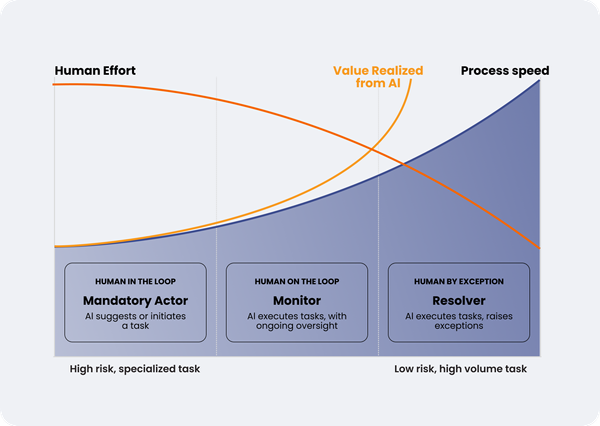
During this shift, organizations will see the compounded value of using AI to improve human productivity and accelerate processes. It will give regulatory teams much-needed bandwidth to manage their growing portfolio without excessive hiring and evolve from a reactive, manual cycle of submit, reject, and fix to a proactive, automated approach of predict, prevent, and submit.
An AI-enabled organization model
Regulatory organizations have historically been organized by linear processes and have been execution focused.
Consequently, the organizational chart must be reimagined. The traditional separation between regulatory strategy, regulatory information management (RIM), submissions management, and publishing will diminish, and teams will flatten into a networked, horizontal function. Teams will become more blended, integrated directly within therapeutic areas to act collaboratively alongside regulatory affairs partners from the beginning of the product lifecycle.
This new structure will result in new and modified roles:
- Regulatory data stewards and architects. As publishing specialists and submission managers move away from being "last-minute heroes" who compile and format final documents, they will become upstream data architects. These specialists will own data flows across R&D and ensure information is structured correctly from the outset.
- Content stewards. This role merges authoring and data stewardship across all data disciplines: medical writing; regulatory affairs chemistry, manufacturing, and control; or non-clinical. Content stewards will leverage tools and data with AI-generated baselines to synthesize compliance narratives without the constraints of legacy document formats or functional silos.
- Agent managers. A new but critical governance role will emerge, responsible for understanding how specific AI agents operate, testing their functional boundaries, and providing feedback during practice runs. This role will also manage model drift and justify AI-driven decisions to health authority auditors during inspections.
Human involvement will systematically move up the value chain. As automated systems handle preparation, assembly, and routine compliance checks, human teams will focus primarily on data stewardship at the source, regulatory strategy, intent validation, and decision ownership.
The skillsets and mindsets of an AI-enabled team
For individual professionals, the rise of AI should be viewed as an energizing opportunity. The prevailing sentiment among industry experts is clear: AI will not replace people but will enhance the way people work and solve problems. Skilled and experienced humans will be indispensable for their advanced judgment, creative thinking, and knowledge. They will work alongside the next generation of hires who bring in their AI and digital fluency skills.
To prepare for this future, regulatory professionals must build a multifaceted skill set grounded in data fluency and cognitive agility. Essential skills include:
- Systems and data mindset. An understanding of how regulatory strategy translates into interconnected data models with lineage across multiple systems, recognizing how a change in one area impacts the entire ecosystem.
- Critical thinking and skepticism. An ability to evaluate AI outputs to identify errors, counter bias, and understand the strengths and weaknesses of different agentic frameworks.
- AI literacy. A mastery of effective prompting and mentoring of AI assistants, combined with the ability to monitor evolving health authority expectations and confidently explain AI-driven decisions to auditors.
- Adaptive reframing. The flexibility to reframe objectives and achieve controlled disruption within established regulatory boundaries set by health authorities.
- Resilience. The capacity to embrace uncertainty and evolve with curiosity and flexibility.
Organizations should seek neural-network thinkers who possess strong regulatory fundamentals but are fluid and adaptive, hiring for capability adjacency by embedding digitally skilled talent into expert regulatory teams to build highly innovative, hybrid units.
What leaders can do today
Regulatory leaders can execute specific strategic moves today to use AI as a competitive advantage. Instead of waiting for a perfect future state, leaders can reshape organizational blueprints now through deliberate, progressive shifts.
- Facilitate AI literacy, up and down. Arm executives with AI-enabled systems to allow for self-driven realization of the value of AI. Upskill experienced regulatory professionals for AI fluency, while hiring smartly to build hybrid talent. This will build confidence, spark curiosity, and foster an adaptive culture ready for deeper collaboration with AI.
- Break down data siloes across R&D. AI is only as good as the data feeding it. Invest in cleaning datasets to ensure consistency and completeness, and establish clear ownership and lineage.
- Baseline current processes. Don’t just automate a broken workflow. Before applying AI to any process, re-examine the workflow holistically to identify bottlenecks and top pain points and measure its current state. This ensures readiness to prove positive ROI.
Ultimately, introducing AI into regulatory operations is about increasing efficiency and speed in getting new therapies to market. But it’s also about elevating the value of human input by reducing manual labor, unifying data, and creating better conditions for clearer judgment.
Learn more about purpose-built AI for regulatory teams.
Pratyusha Pallavi is Executive Director of Falcon Strategy at Veeva Systems
This content is sponsored by Veeva Systems. The views and opinions expressed are those of the sponsor and do not necessarily reflect those of the Regulatory Affairs Professionals Society.