Regulators, industry experts look to streamline EU combination product oversight
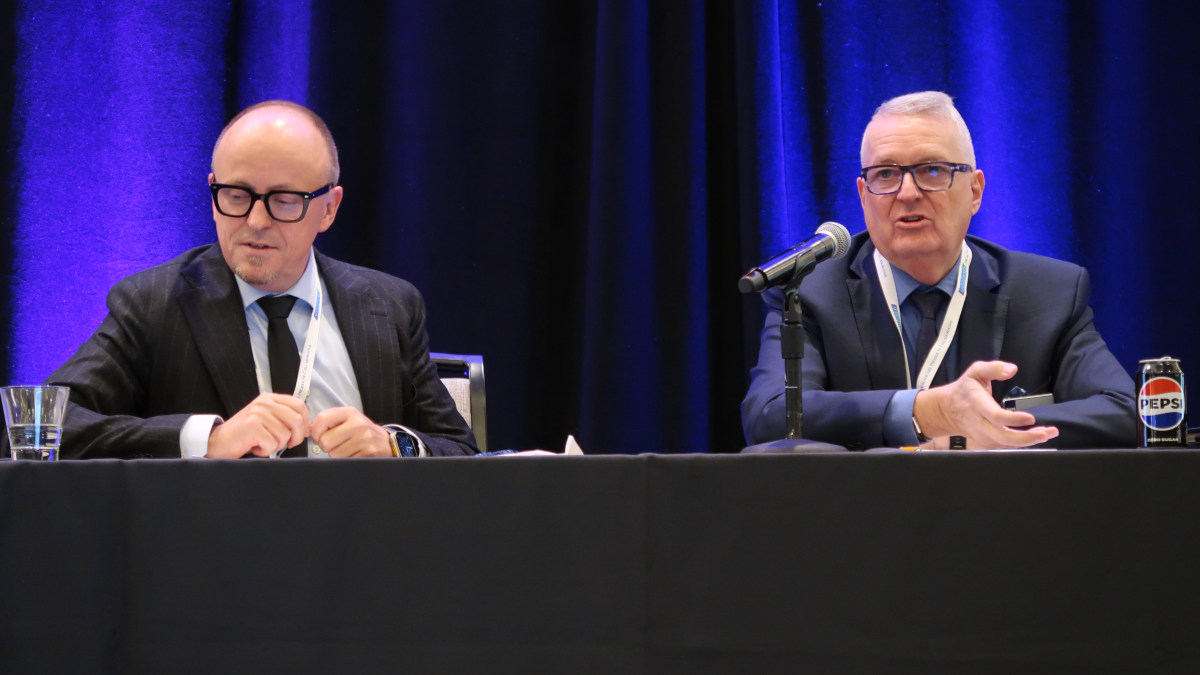
Thomas Wejs Møller (left) and Andreas Emmendörffer (right) spoke at the 2026 Combination Products Summit. (credit: Ferdous Al-Faruque)
BALTIMORE – A panel of European regulators and industry representatives discussed how to streamline the regulatory process for combination products in the European Union at the AFDO/RAPS Combination Products Summit.
The panelists noted that regulators are changing the process, with notified bodies playing a larger role in product assessments, and proposed changes to reduce regulatory burdens.
Notified body assessments
Alberto Gañan Jimenez, head of committees and quality assurance at EMA, said that one of the areas with the greatest potential for regulatory harmonization is streamlining combination product assessments between notified bodies and regulatory authorities. In particular, he said there is significant opportunity to streamline and harmonize Article 117 under the EU Medical Device Regulation (MDR) that applies to drug-led integral drug-device combination products (iDDC).
Jimenez noted that before 2020, such assessments were conducted entirely by health authorities, who assessed the medical device component of more well-established integral products, which consisted mostly of prefilled syringes, prefilled pens, and similar products. However, notified bodies have been providing opinions on such products in more recent years.
"However, I think we are now going to face much more complex integral medicinal products," said Jimenez. "We will really start seeing delivery systems that can incorporate artificial intelligence (AI) software... in that context, it will be crucial to have a streamlined process of notified body opinions that really complement the assessment of health authorities, and that is aligned and integrated into the assessment of new marketing authorizations or cross authorizations."
Structured dialogue
Maria Chiara Orlandi, notified bodies team leader at the European Commission, emphasized the importance of greater cooperation across stakeholder groups, which she said is already happening with the Combination Products Operational Group (COMBO), which is a collaboration of EMA, notified bodies (NBCG-Med), medicines and device competent authorities, and the European Commission.
"We are not yet there; there is still work to do, but already starting to talk to each other really makes the difference," said Orlandi. Additionally, she said that, as part of the effort to harmonize and streamline the regulatory process for combination products, they need to allow manufacturers to engage in structured dialogues with notified bodies.
"We believe this will bring great improvement for the preparedness of the manufacturers," she added. "This dialogue should be taking place before the application is launched, before starting the conformity assessment, and continue during the conformity assessment or even after the certification."
Orlandi said that the European Commission has proposed provisions regarding the need for notified bodies to have documented procedures for establishing structured dialogue with manufacturers. She also noted that the EU Implementing Act, adopted earlier this year, specifically references the structured dialogue phase, which would take place before the certification process starts.
"It is something that we believe is essential," said Orlandi. "We are working together with colleagues from EMA to see how this can work in practice under the current framework."
High hopes
Thomas Wejs Møller, senior director for global medical device regulatory affairs at Novo Nordisk, commended the COMBO group and said the industry has high hopes for what it can achieve. He also noted that US Food and Drug Administration (FDA) officials were present at the meeting and wished that their European counterparts, including Jimenez and Orlandi, could be there too to speak face-to-face.
"I wouldn't say there's scientific advice going on over the coffee machine, but you can interact here," said Møller. "This is something we maybe miss in Europe.
"I think it would be nice of you to join one day," he added.
Andreas Emmendörffer, principal consultant at Phalcon Consulting, also noted that the New Pharmaceutical Legislation has created significant opportunities for harmonization by defining combination products. He said that until now, there has been significant uncertainty because there has been no clear definition.
"Another opportunity definitely is to exploit the well-established technology concept, which is in the MDR proposal right now, and also use the well-established medicine and product approach for these integral device combinations," said Emmendörffer.
Emmendörffer also noted that many regulatory frameworks are currently under development or implementation and could be more burdensome for manufacturers. However, he welcomed the European Commission's recent proposal to have medical devices with AI elements assessed under the MDR framework rather than the EU AI Act. He said the move would help simplify the process and reduce regulatory burdens.
Reducing burdens
While some more challenging issues regarding combination products require legislative changes, Jimenez said there are steps that can be taken through guidance, coordination, or process improvements to help harmonize the regulatory process and reduce burdens. In particular, he highlighted steps such as harmonizing notified body opinion templates and improving process alignment by requiring notified body opinions, especially in the postmarket setting. Regarding the lifecycle management of combination products, he said there need to be very high-level classification guidelines.
Møller said the regulatory process under Article 117 needs to be streamlined. He noted that manufacturers must navigate 52 notified bodies and the EMA under the current system and recommended that it would be easier for manufacturers to engage a single notified body that acts as a subcontractor to the others. He said that while his company is okay with handling the current process, smaller companies really struggle to navigate multiple notified bodies.
"We need a little bit more steering on this and a little bit more centralized position... as we have here in the US," said Møller.