

Advancing Complex Trial Designs: FDA Discusses Upcoming Pilot Program
Thanks to the latest Prescription Drug User Fee Act (PDUFA VI), the US Food and Drug Administration (FDA) will soon launch a pilot program on complex clinical trial designs, according to the public meeting held Tuesday on promoting the use of such designs.Dionne Price, acting deputy director at FDA’s Office of Biostatistics, explained to attendees that under the complex innovative design (CID) pilot, FDA will select two proposals quarterly and will grant participants two meetings - an initial and follow-up meeting - on the same trial design.
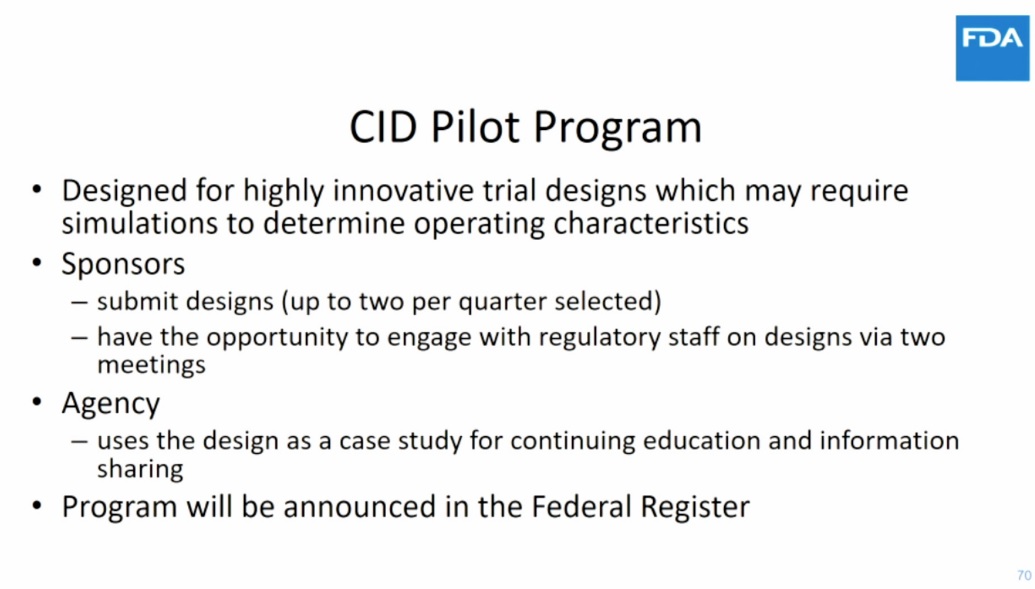
One unique aspect of the pilot program is that FDA will publicly discuss sample designs to provide industry and public with more clarity, though FDA and sponsors will agree before the release on what information should be shared publicly, Price said.
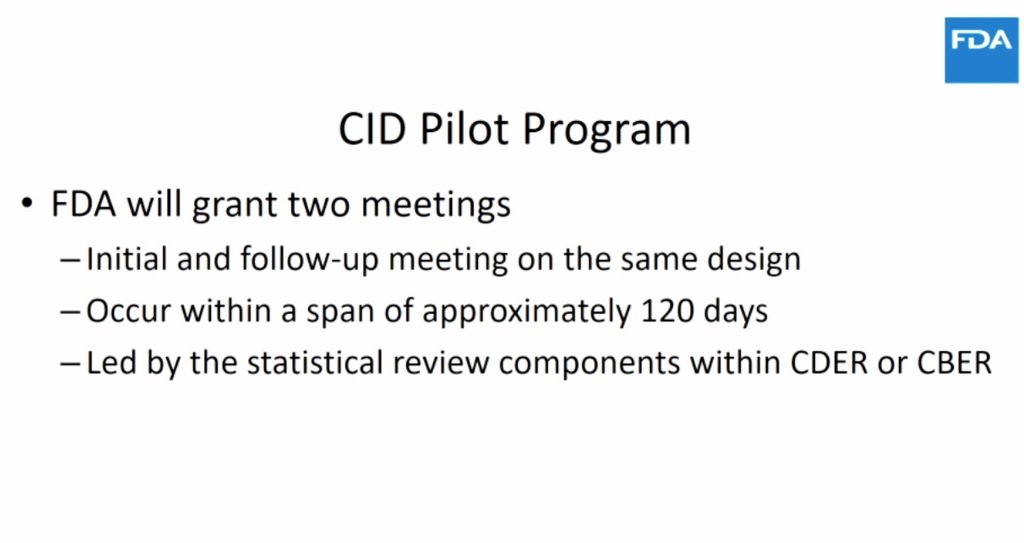
Price also said a Federal Register notice on the pilot program is coming, and that an FDA complex innovative design website is also coming.
Gracie Lieberman, director of regulatory policy at Genentech, said the pilot will require some flexibility and creativity, particularly with timelines and transparency on FDA’s decision making, and not just on the endpoints but on the selection of populations too. For instance, she said, if the trial involves diagnostics, will FDA’s Center for Devices and Radiological Health (CDRH) be involved?
John Zhong, senior director of biostatistics at Biogen, stressed that the scope of information released publicly should be carefully considered and be enough to promote public learning but not everything in a drug development program.
Lisa LaVange, professor at the University of North Carolina and president of the American Statistical Association, noted that when the latest user fee agreement was crafted, the pilot was expected to not necessarily disclose the same information for every trial design.
Roger Lewis, professor of medicine at the University of California, Los Angeles, called for the pilot to encourage sharing of the nature and complexity of a simulation’s code. He also said though traditional for-profit sponsors will likely be represented in the pilot, though work in master protocols driven by patient advocacy groups might also be shared.
Deborah Ashby, a professor at Imperial College London, also called on FDA to be transparent about the selection process, suggesting the agency “start off with the easiest one you can and gradually get more complex. The thing I would really like to see done is where adaptive studies are most needed, which is in emerging and infectious diseases.”
Promoting the Use of Complex Innovative Designs in Clinical Trials