
Convergence: CBER expert offers tips for effective BLA submissions
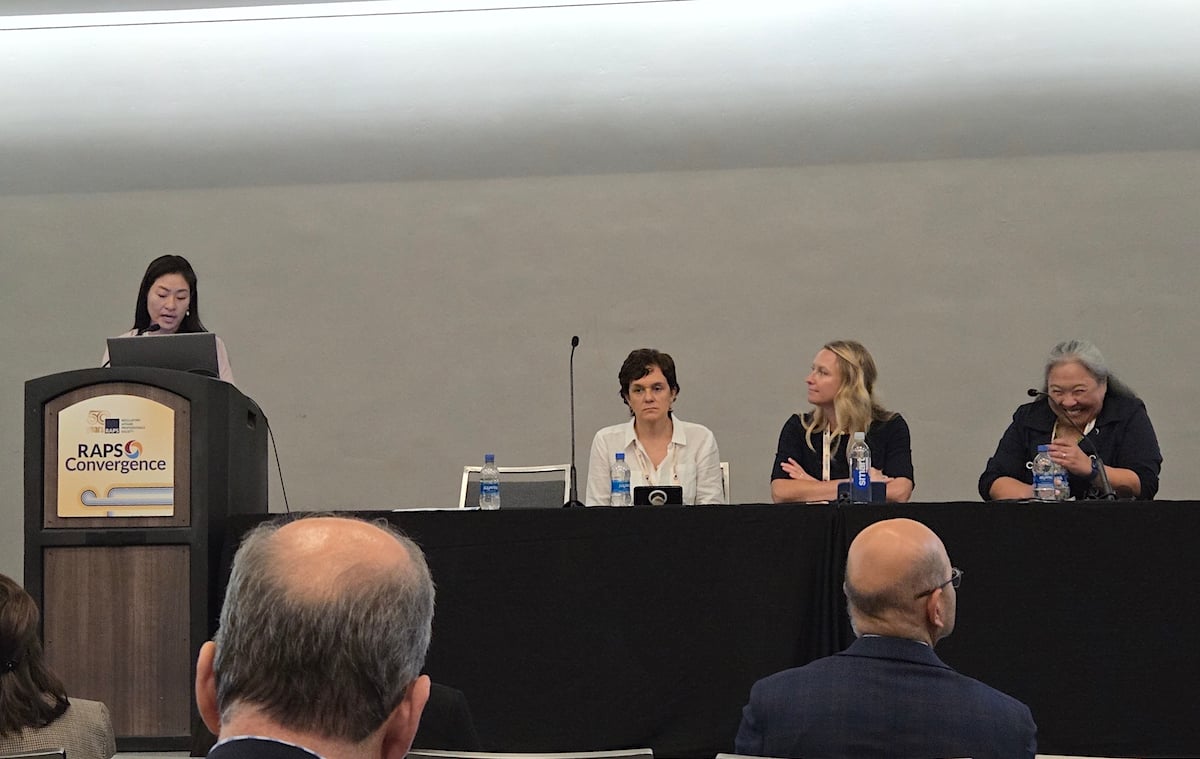
Left to right: FDA's Jennifer Albert, Iliana Valencia, Deanna Beechener, and Cecilia Crowley. (Credit: Jeff Craven)
CHARLOTTE, NC — When submitting a biologics license application (BLA), it is important to engage with the US Food and Drug Administration’s (FDA) Office of Therapeutic Products (OTP) early, make every attempt to prepare for and prevent technical and administrative errors, and keep the regulatory project manager (RPM) in the loop during the process.
An RPM is your “single point of contact for everything related to a BLA,” including all clinical and regulatory questions, Jennifer Albert, regulatory project manager and regulatory scientific reviewer at FDA, told attendees at RAPS Convergence 2026.
“We are genuinely committed to being your partners in this process,” Albert said.
The RPM coordinates your submission across all six OTP offices and are the applicant’s partners during the review. Applicants should always use secure FDA email, include the BLA number in every amendment subject line, and clearly mark urgent communications. Albert emphasized that individual reviewers should not be contacted during a BLA review.
“Keep the RPM in the loop. Alert them when the applicant is submitting amendments to a BLA as a courtesy, so we are ready,” Albert said.
End-of-phase 2 and pre-BLA meetings
She also encouraged attendees to go to end-of-phase 2 and pre-BLA meetings, even if they may not be required for a submission. “There is no disadvantage to having these meetings. An end-of-phase 2 meeting is an opportunity to ensure FDA agrees with your pivotal clinical trial design for that major investment of phase 3,” Albert explained.
Similarly, FDA also recommends attending the pre-BLA meeting. Albert noted that OTP grants one pre-BLA meeting per product or indication. During the pre-BLA meeting, the content and format of the BLA will be discussed, as will any topline data, outstanding issues, and labeling concepts. “Issues identified in your pre-BLA meeting are expected to be addressed in your BLA submission, so treat it as a strategic checkpoint, and not a formality,” she said.
Also discussed during a pre-BLA meeting will be the ability to submit a rolling review request to OTP. Product with a regenerative medicine advanced therapy (RMAT), breakthrough therapy, or fast track designation can qualify for rolling review, which allows for applicants to submit a completed BLA module on a rolling basis.
Albert said applicants can formally request rolling review in an associated investigational new drug (IND) application, but BLA modules should not be submitted under a grant letter for rolling review is received.
CMC information in BLA
While FDA doesn’t allow reference to chemistry, manufacturing, and controls (CMC) information from a type 2 drug master file into a BLA, Albert said the agency does permit use of some information from type 3 and type 4 drug master files into BLAs, including references to
packing materials, container closures, excipients, stabilizers, penetrants, or raw materials used in the preparation of drug substance, drug substance intermediate, or drug product.
“The BLA holder is expected to have knowledge of and control over the manufacturing process for the biological product which is seeking licensure. Information regarding drug substance, drug substance intermediate, or drug product must be in Module 3,” she explained.
Albert referred attendees to FDA’s 2019 proposed rule on the use of master files in BLAs and its 2024 final rule for more information on the rationale behind this decision.
“If you are not sure about what belongs in your Module 3 for your specific product, that’s a great question to bring to the pre-BLA meeting,” she said.
Avoiding refuse-to-file decisions
Albert said that common issues that result in a refuse-to-file (RTF) decision include missing modules, missing required forms, and gaps in CMC or clinical data packages. If a BLA is not complete enough at day 60, FDA can issue an RTF at that time.
To avoid an RTF decision, be aware of common issues, prevent, and correct them early, Albert said.
“It starts with a strong pre-BLA meeting. The issues are identified and discussed. After the pre-BLA meeting, when the BLA is submitted, make sure you have included all the agreed-upon components and address all the issues by the FDA,” she explained.
The application should be complete and well organized, and study data should be in proper CDISC format, Albert added. She encouraged attendees to review standard operating procedures and policies (SOPPs) 8401 on administrative processing of original BLAs and 8404 on RTF procedures for an exact list of what OTP looks for when assessing scientific completeness.
“Use these publicly available documents that describe CBER internal procedures,” she said. “They should be of high interest in putting together the BLA.”
Reviewer guide and assessment aid
A successful reviewer’s guide for a BLA should contain an overview of the entire application structure, organization of the modules, the locations of key data and study reports, and elaborate on any unique aspects of the submission. It is essentially a roadmap for the review team, Albert said.
“A well-prepared reviewer’s guide tells reviewers to navigate the application efficiently, particularly for complex submissions for cell and gene therapy products,” she said.
The assessment aid is a clinical and clinical pharmacology tool that should be discussed during the pre-BLA meeting and included with a BLA submission. “Both the reviewer guide and the assessment aid are very valuable to the OTP review team,” Albert said.