
Convergence: Regulators emphasize need for harmonized approach to AI
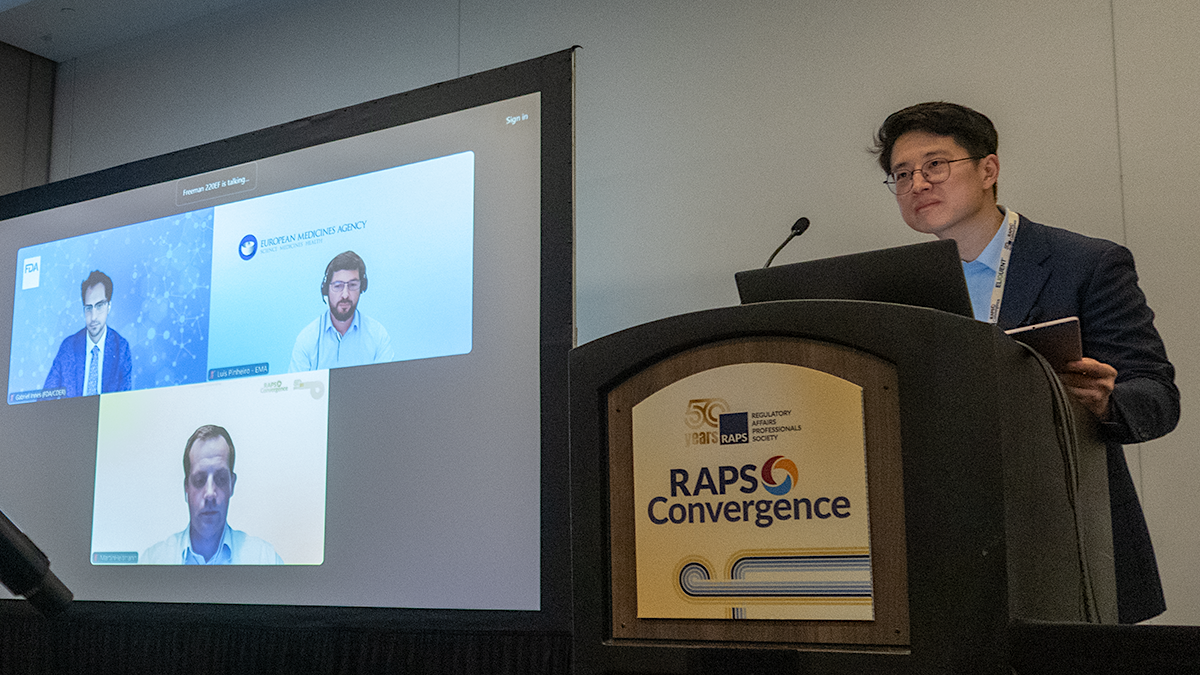
Junyang Wang moderated a panel on AI with Gabriel Innes, Luis Correia Pinheiro, and Martin Heitmann at RAPS Convergence 2026. (credit: Ferdous Al-Faruque)
CHARLOTTE, NC — Regulators and industry experts stressed the need for regulatory harmonization around artificial intelligence (AI) to ensure the technology is used responsibly in drug development during a panel discussion at RAPS Convergence 2026.
They noted that while the US Food and Drug Administration (FDA) and European Medicines Agency (EMA) have made significant progress in developing AI guiding principles, there is a further need to set standards in this space as the technology becomes more widespread.
Gabriel Innes, assistant director for data science and AI policy at FDA’s Center for Drug Evaluation and Research (CDER), said that the drug center has received more than 1,500 AI-related submissions. He noted that these submissions have grown exponentially since 2016, with the vast majority being investigational new drug applications (INDs), followed by new drug applications (NDAs), biologic license applications (BLAs), abbreviated new drug applications (ANDAs), emergency use authorizations (EUAs), and drug development tools (DDT).
"AI is really no longer an emerging phenomenon, although we do classify it as an innovative technology, it's becoming quite routine, which means that our frameworks, our review capacity, and our engagement infrastructure really all have to scale accordingly," said Innes. "When you see that kind of volume, it's reflecting a signal from the industry.
"The responsibility falls to us as regulators to respond, and we want to do so proactively and with rigor, not just reactively," he added.
To address the growing interest, Innes said FDA issued a draft guidance in January 2025 on considerations for using AI for regulatory decision-making for drugs and biologics. He emphasized that the guidance is intended to create a risk-based framework intended to assess the credibility of an AI model for a particular context of use. He also emphasized that the guidance is not intended to assess drug discovery except in very specific cases or to assess operational efficiencies such as internal workflows and resource allocation.
Innes said the agency received comments from stakeholders that signaled they wanted more information about the scope of the guidance and its terminologies, clarity on the regulatory engagement process, expectations for third-party models, more use cases, and guiding principles for good AI practices.
Inness noted that FDA and EMA have developed 10 guidance principles for good AI practices in drug and biological product development.
"We need to assure reliability, transparency, and patient safety, and these principles aren't aspirational statements," said Innes. "They're supposed to be a foundational starting point for future standards and international harmonization efforts."
Luis Correia Pinheiro, a senior epidemiology expert at EMA, said there is strong public interest in Europe to ensure that AI regulation is applied internationally. As a result, he said the European medicines regulatory network has engaged in a work plan to help develop guidance, policy, and tools when regulating AI. He also echoed the importance of the AI guiding principles developed with FDA.
Pinheiro said that the European medicines regulatory network also surveyed their stakeholders to understand public regulatory priorities for using AI in the medicinal lifecycle and found that the top three priorities were to ensure the accuracy and reliability of AI models, ensure the models remain robust and trustworthy over time, and define when explainability matters most in regulatory decision-making.
He noted that the agency has also been working with the International Coalition of Medicines Regulatory Authorities (ICMRA) and the World Health Organization (WHO) on knowledge sharing on AI oversight, guidance, and horizon scanning.
One area that needs more work, according to Pinheiro, is developing standards for AI, which he noted is a slower process than the work EMA has been able to do with its international regulatory partners.
"Convergence is not really a future event," said Pinheiro. "We're not looking only at the future and sort of expecting it to come, it is already active through bilateral and multilateral collaborations.
"I think a very good example of that is the joint guiding principles that FDA and EMA published," he added.
Martin Heitmann, managing director at MH Consulting and Advisory and a volunteer at ICMRA, highlighted the work ICMRA has done to bring more clarity and predictability to AI regulations. He noted that the organization has published a set of Good Automated Manufacturing Practice (GAMP) guidelines for using computerized systems, and the International Society for Pharmaceutical Engineering’s ISPE AI, an initiative aimed at supporting AI readiness within the pharmaceutical industry.
From a computer systems perspective, Heitmann said that AI best practices should ensure that the technology being used is suitable for the task, the standard operating procedures take a lifecycle approach, the data used considers the context of use, the computer hardware is also capable and scalable to the task, and those operating the AI have the necessary literacy.
During the question-and-answer portion of the session, the panelists were asked how industry should respond to public concerns about AI and most recent urging by AI developers to pause the technology.
Heitmann said that it's important to consider the individual capabilities of the AI models being used and distinguish them based on their technical aspects, how they are integrated and their control layers.
"I think this is a sign that necessitates more transparency as to what are the limitations, what are the capabilities, and what are the controls that are actually implemented to mitigate such behavior as it was observed," he added.
From the European perspective, Pinheiro said that AI regulation is multi-layered and the EU’s AI Act attempts to address the issue by legislating safeguards and ensuring its safe and responsible use.
One of the attendees asked Innes about FDA’s embrace of AI. Innes noted that the agency has an internal AI council that has worked on adopting the technology.
"I will say that these AI technologies are purposeful to augment our work," said Innes. "They don't replace or conduct the reviews without the human decision maker and the expert in the loop.
"It helps to augment and to make things a little bit more efficient on the operational side of things," he added.