

Euro Convergence: Experts discuss simplifying regulations while maintaining balance
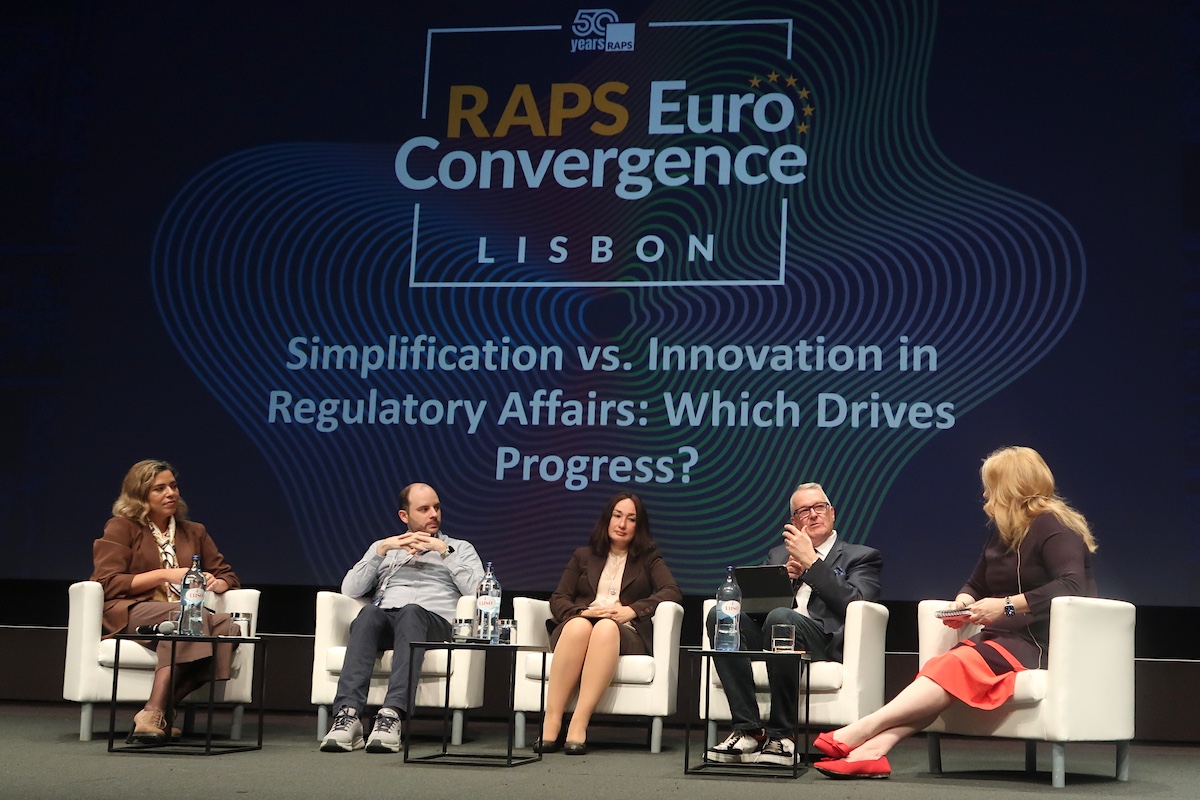
LISBON – Regulators and industry representatives highlighted the importance of simplifying regulations to promote innovation at the RAPS Euro Convergence 2026 conference closing plenary; however, they cautioned that oversimplification could backfire and lead to more regulation down the road.
Kate Stockman, a VP of regulatory affairs at Kenvue, moderated the panel and asked whether simplifying regulations could enable innovation or whether innovation could enable simpler regulations.
"We've heard over the course of the week lots about the evolving regulatory frameworks for medical devices and medicines, MDR 2.0, the AI [Artificial Intelligence] Act, digitalization, all of these are driving change in how we work as regulatory professionals," said Stockman. "Whilst we navigate the transitional period that are in some complexity, I think Leonardo da Vinci is credited as saying simplicity is the ultimate sophistication, and simplicity can allow innovation to scale.
"As regulatory systems become more advanced, there's a responsibility to ensure that they're understandable and operational ... but also that they remain human-centered to drive patient access," she added.
Andreas Emmendoerffer, principal regulatory program director at Roche, said that simplification and innovation go hand in hand and foster one another. He emphasized that bringing products to market requires simplifying the existing regulatory system and innovating to implement new models and principles.
Nataliya Deych, VP of regulatory affairs at Edwards Lifesciences, agreed that simplification and innovation are often connected.
"When you think about simplification, it enables innovation by freeing time, budgets, and attention," she said. "In return, innovation enables simplification.
"Think about minimally invasive therapies, think about the digital pathways, digital infrastructures of hospitals," she added. "They all react to capacity, and capacity today is one of the major challenges in hospitals, especially after COVID."
Miguel Amador, chief innovation officer at Complear, said that trying to simplify regulations too much can also lead to a lack of clarity, ultimately requiring the European Commission to go back to the drawing board to revise and negotiate new regulations.
"We need clarity today, but at the same time, we need a way of adapting as things progress," said Amador. "Simplicity is definitely, I think, the biggest challenge we have with 27 member states with different opinions... when innovation seeks clarity."
Nada Alkhayat, a policy officer at the European Commission, noted that the EU has been trying to support innovation and simplify regulations. She echoed that simplification and innovation go hand in hand in the proposed updates to the Medical Device Regulation (MDR) and the In Vitro Diagnostics Regulation (IVDR), though she stressed that those principles must be balanced with ensuring patient safety.
"If you oversimplify, then it becomes difficult to innovate, because then you don't have, perhaps, the specific rules that you consider necessary in order to have more of a kind of a rule book for compliance for your device in order to reach the markets and patients," said Alkhayat. "Then again, if it's overly complicated, then it's also difficult to innovate.
"It's more about trying to find that balance where simplification supports innovation and vice versa, where innovation is kind of challenging simplification in itself, but there's are tools around it," she added.
Alkhayat said that in its proposed reforms for MDR/IVDR, the Commission has sought to use simplification to address legal certainty and risk proportionality, reduce possible reporting obligations when there's duplication of information, and facilitate innovative methods or tools to achieve compliance. She also noted that predictability was a key aspect of its simplification efforts.
"When all actors know what is expected from them according to what timelines, to what iterations, etc., then they can plan better, and they can internally, both from the notified body and manufacturer side, have the structured dialogue that's necessary and expectations set out," said Alkhayat. "That's also a simplification deliverable that we've tried to deliver on."
Emmendoerffer said that from his perspective at a large pharmaceutical company with combination products and standalone devices on the market, the proposed amendments to the MDR and IVDR are a step in the right direction to enhance European competitiveness. He noted that it's good to have a single office to contact for medical device and drug applications and said he appreciated the ability to seek scientific advice. He praised the Commission's work on the new Pharmaceutical Legislation, highlighting the benefits of the regulatory sandboxes.
Stockman agreed with his assessment and emphasized that the structured dialogues in MDR/IVDR will make a big difference for manufacturers, providing transparency and predictability, especially in early product development.
Deych said that while there were valid safety reasons why Europe lost its position as a leader in bringing innovative medtech products to market first, she is glad the Commission is working to make it more attractive to innovation and said they need to find the right balance.
Amador emphasized that regulation isn't the same as bureaucracy and noted that regulatory science is better funded as a share of GDP in the US than in Europe. He added that regulators should be empowered to be more comfortable making decisions when there are uncertainties.
“Things will fail. We just want to fair it fast and do not damage our people, because the opposite often is an issue of ethics,” he said.
Emmendoerffer said that, from an industry perspective, there are additional measures the Commission should have proposed to further simplify, such as placing the European Medicines Agency (EMA) in more or a coordinating role and piloting a system to allow a single submission for drug and device clinical trials.
"Acknowledging that we have a federal system, I think it was already a brave step in the right direction, and it shouldn't be the end," said Emmendoerffer. "I think it's just the start of innovation, not the end of innovation."
Alkhayat said the Commission tried its utmost to propose measures to simplify regulations, not only to drive innovation but also to ensure public safety and product availability. She added that the revision is now in the hands of the EU co-legislators.
Some of the panelists said they also want to see more consistency between member states and notified bodies.
Alkhayat noted that the EU regulatory framework is a hybrid system with 52 notified bodies and that under MDR, there are 27 competent authorities with reliance partners, 12 expert panels, and a 13th screening panel, which together provide the combined expertise. She noted that bringing the expertise together is the role of the Medical Device Coordination Group and its 13 subgroups, each with different specialties, which also bring together notified bodies to harmonize their practices, align on principles, and align on guidance.
"It's a difficult task to do; 52 different [notified body] opinions, 27 different [competent authority] opinions, plus the contribution of industry, healthcare professionals, and patients," said Alkhayat. "It takes time, but that's the price that we pay.
"It's a beautiful price for the union that we have, and for being able to place your product on the market, reaching all 27 member states," she added. "And hopefully also beyond that, as we know that there's many reliance partners out there."
Alkhayat also spoke about the Commission's work on international reliance. She noted that it already participates significantly in the International Medical Device Regulators Forum (IMDRF) and in the Medical Device Single Audit Program (MDSAP).
"It's no surprise to sometimes come to the conclusion that the problems that we are sometimes facing in Europe are challenges that are faced by many other regulators worldwide," said Alkhayat. "It's important to have the opportunity to also put our minds together with our counterparts from Australia, Canada, the US, Japan, Korea, learn from their experience and be able to translate it into something concrete, like predetermined change control plans (PCCP), regulatory sandboxes, breakthrough pathways, the examples are infinite.
"A lot of these principles are already kind of co-developed at the international level," she added. "What we saw was a great opportunity, also in terms of simplification in itself."
Alkhayat noted that the Commission already spends significant time and resources developing international guidelines and standards and decided that it makes sense to adopt the same guidelines and standards at the EU level, while taking into account EU-specific requirements.
Stockman asked Alkhayat about the Commission's views on the use of artificial intelligence (AI) and large language models (LLM) in healthcare and the challenges to regulate them. Alkhayat noted that there are a variety of LLM applications, ranging from general-purpose AI to wellness products to those designed for clinical decision-making, and they are looking to understand where the regulatory borders for those products lie.
"We can't go [with] the most restrictive, risk-averse approach, which is saying everything's a medical device, [that's] not realistic," said Alkhayat. "I don't think it supports innovation in itself, but also it's more about company practices.
"Not all models are the same, they're not all trained the same way, they don't have the same prompts or actions, they're not feeding on the same data in order to provide a particular output," she added.
Alkhayat said the Commission is working with competent authorities to examine the output generated by some LLMs currently on the market and how those outputs are triggered. As an example, she said an AI that summarizes a doctor-patient interaction without making inferences or conclusions would be considered a general-purpose LLM.
"At the moment, we're building our knowledge base as regulators and as the regulatory science community," said Alkhayat. "We're sampling different cases, we're investigating how each model was trained, where perhaps the manufacturer has pushed the limits into this gray zone.
"We hope that based on that, we are able to come up with a well-educated outcome that can hopefully be published and provide legal certainty," she added. "But too early legal certainty is also not helpful to innovation."
