

Euro Convergence: Experts envision the future of regulatory

LISBON – Regulators will need to evolve as new technologies come to market, according to experts who spoke at the opening plenary session of RAPS Euro Convergence 2026. Major challenges include finding the right balance between safety and regulatory flexibility and determining an acceptable level of uncertainty.
Rui Santos Ivo, president of Portugal's National Authority of Medicines and Health Products (INFARMED) and chair of the European Medicines Agency (EMA) management board, said it is important to promote a regulatory culture that is both flexible and one that instills public trust.
"I have seen this [regulatory] profession evolve enormously over the years," said Santos Ivo. "At one time, regulatory works were often seen mainly in terms of compliance procedures and submissions.
"Of course, those remain essential, but today, the profession is much broader than that," he added. "It is more scientific, it is more strategic, it is more connected to the full lifecycle of medicines and devices, and it is much more central to decisions about innovation, development, access, safety, and trust. That evolution is very visible in Europe,” he said.
Europe is at a crossroads, Santos Ivo said. He noted that the European Commission has clearly stated a commitment to keeping the European Union an attractive region for research, product development, and innovation, and is strengthening its position for European investment and competitiveness. Santos Ivo said the Commission also wants to bring member states together by promoting legislation such as the new EU Pharmaceutical Legislation and the Biotech Act as part of its broader life sciences strategy.
"Europe offers a stable, predictable, and evidence-based regulatory environment," said Santos Ivo. "That is one of our great strengths; it is a strength we should continue to value and protect.
"At the same time, we know that legislation on its own is never enough," he added. "What matters is the implementation, what matters is the coordination, what matters is the delivery... We are fully committed to that work and to making coordination and working together full of tangible results."
Santos Ivo said that the scope of the regulatory profession is already expanding and will continue to do so, as evidenced by work in advanced therapies, digital health, and artificial intelligence (AI). He said that means the profession will need more than technical expertise; it will also need adaptability and the ability to work across disciplines.
"As future regulators, we will need to be scientifically strong, comfortable with complexity, open to innovation, and also be able to work in increasingly complex environments," said Santos Ivo. That means regulators at the European level will face the challenge of implementing the largest regulatory reforms in two decades, as scientific and geopolitical developments require their collective global wisdom, he said. On the national level, Santos Ivo said it means going beyond regulators' traditional remit and being more proactive.
"I hope we continue to build a professional culture that is rigorous, forward-looking, and deeply grounded in public service, because in the end, our work is about more than rules and procedures, but about helping to ensure that patients have access to safe, effective, and quality medicines and devices," said Santos Evo. "It's about maintaining trust in science, it's about maintaining trust in our institutions, it's about ensuring that our laboratory systems remain robust and able to evolve with science and society."
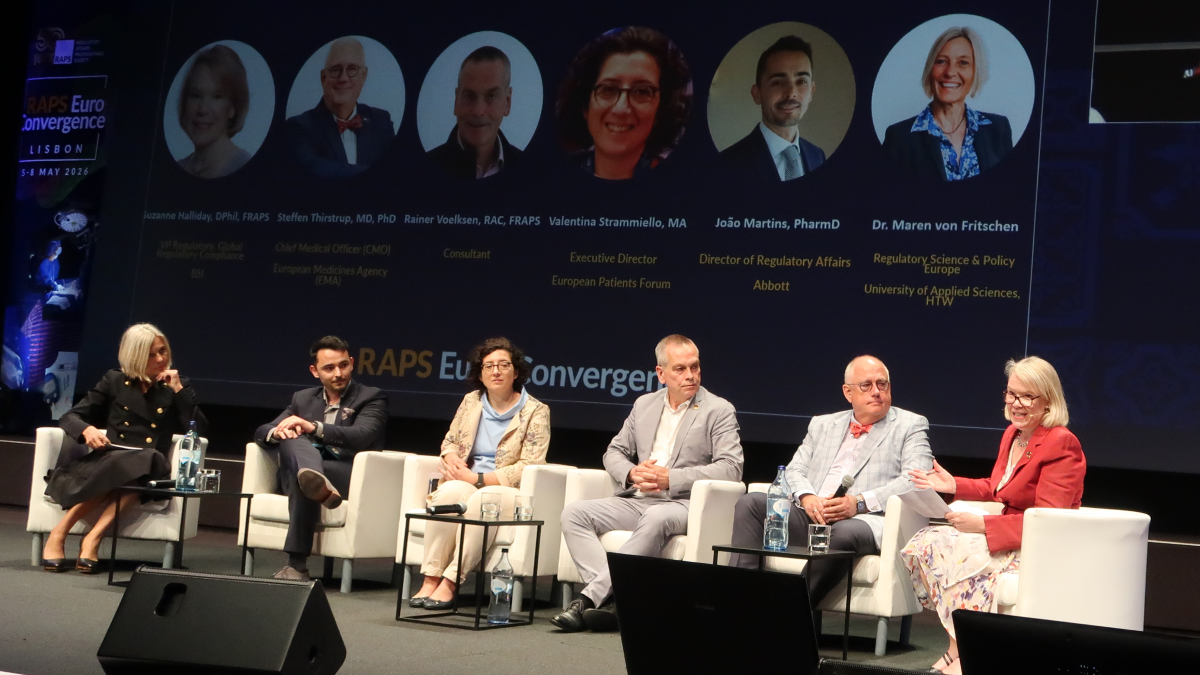
Left to right: Maren von Fritschen, João Martins, Valentina Strammiello, Rainer Voelksen, Steffen Thirstrup, and Suzanne Halliday (credit: Ferdous Al-Faruque)
The plenary session also featured a panel of experts, who discussed the future of European medical regulations, moderated by Suzanne Halliday, VP of global regulatory compliance at BSI. She asked the panelists about the state of the European regulatory sector and what they foresee in its future.
Steffen Thirstrup, chief medical officer at EMA, noted that the European Union is not the United States of Europe but rather 27 like-minded countries that have decided to collaborate, which can mean it takes a long time to reach agreement and can complicate matters, while sometimes overregulating. Despite that, he said that its differences are also a source of its strength.
"We are working for peace and prosperity in Europe, and we want to create a Europe that is globally competitive, that still takes care of its citizens, provides universal healthcare, and the most innovative medicines," said Thirstrup. "That's where our unity in diversity is both a strength and an opportunity.
"We need to leverage those challenges, we need to regulate in the interest of safety, but we should also think of not overregulating," he added. "We need to be flexible in our mindset to be able to still be an important part of this world."
João Martins, director of regulatory affairs for Abbott in Lisbon, outlined his wishes for the future of the regulatory profession, including focusing on how people work rather than where they work. He noted that there's been a U-turn on companies requiring workers back to the office. He also promoted the need for global convergence, noting that at one point, the Medical Device Single Audit Program (MDSAP) was only a dream, and regulators should take inspiration from it.
Martins encouraged regulatory professionals to embrace AI while maintaining their role as gatekeepers and challenging the algorithms.
"Those are skills we're going to have to have, as well as how we interpret dashboards, how we interpret data," said Martins. "That's going to be key as many of us already use it on a daily basis.
"Our role is to make sure that the AI does the right interpretations appropriate to our products, to our business, etc.," he added.
Like other panel speakers, Martins also said regulatory professionals need to ensure patients are at the heart of their work. He also said future regulatory professionals will need to continue educating themselves after their formal education, be more politically and globally aware, be more digitally savvy, and have networking, diplomatic, and communication skills.
Maren von Fritschen, professor of regulatory science at the University of Applied Sciences in Berlin, said she wants to see the medical industry and regulators come together in regulatory sandboxes and jointly confront regulatory uncertainties. She said that sandboxes are places where they can learn together and be open to regulatory iterations.
"We need to change our mindset, we need to change expecting and seeking certainty, but rather explore uncertainty," said von Fritschen.
Valentina Strammiello, executive director of the European Patients Forum, said patients are also open to accepting uncertainties and risks, and added that this is why it is important to involve patients in conversations to understand the level of risk they are willing to accept.
"It's not true that [patients] are completely risk-averse," said Strammiello. "Patients are very supportive of innovation because they know that's the driver for better care in the future.
"There is this sense of solidarity that maybe patients today won't have access to new treatment that may be a cure, but maybe the relatives and other patients in the future will, and that's also an important driver," she added.
Thirstrup agreed with Strammiello and said patients are less risk-averse than regulators. He said he's seen examples where regulators were ready to deny or restrict a product, but after consulting patients and explaining the consequences, they changed their decision.
Rainer Voelksen, a senior regulatory consultant and former regulator, said the challenge is deciding who defines what an acceptable level of uncertainty and risk is. Ultimately, he said such decisions can have political consequences and result in public outcries.
Strammiello said another challenge lawmakers and regulators in the EU face is that member states often bring their own regulatory demands to bear when drafting legislation, driven by national interests. She said that it often harms the medical sector and prevents patients from accessing those products.
"If we want to have a more integrated system, we need to put national interest aside," said Strammiello. "I think we should put aside national pride.
“If you want to be stronger as a European market, we also need to make sure that we work together," she added.
