

Euro Convergence: Experts say safety information should be transparent, accessible
AMSTERDAM – Safety information related to medical products in Europe should be accessible and presented in a way that it can be understood by laypersons, said panelists speaking at the Euro Convergence 2023 opening plenary.
Their remarks were made against the backdrop of recent developments in the EU, including the soft launch of the EUDAMED database for medical devices and the EU Clinical Trials Information System (CTIS). According to the European Commission, EUDAMED will undergo an independent audit in the first half of 2024 before the full system can be released, followed by a 24-month transition period before use of the system becomes mandatory. Use of the CTIS became mandatory for all new clinical trial applications on 31 January 2023.
According to the panelists, the information submitted to these systems should be transparent and accessible for non-professional users. They argued that the information needs to be presented in such a way that patients have enough understanding to advocate for their own care.
Several of the panelists noted that they hope safety reports submitted to EUDAMED can be written in a way that most patients can understand.
The panel was moderated by Sabina Hoekstra-van den Bosch, vice-president of Team-NB and global director of regulatory strategy at TÜV SÜD, and Gert Bos, executive director of the Qserve Group, who asked a panel of regulators, experts, healthcare professionals and an investigative journalist about how the growing mountain of clinical data can be leveraged to improve healthcare delivery.
Jet Schouten, an investigate journalist with the Dutch newspaper NRC, who worked on the Implant Files with the International Consortium of Investigative Journalists (ICIJ), said that while EUDAMED will contain safety reports, she still uses the US Food and Drug Administration’s Manufacturer and User Facility Device Experience (MAUDE) database when she is researching a product’s safety record. “Patient safety and access to data go hand in hand,” she said, noting that while obtaining information from the European Medicines Agency (EMA) and organizations such as the Netherlands’ Central Committee on Research Involving Human Subjects (CCMO) through freedom of information requests has worked so far, EUDAMED doesn’t offer that same level of access.
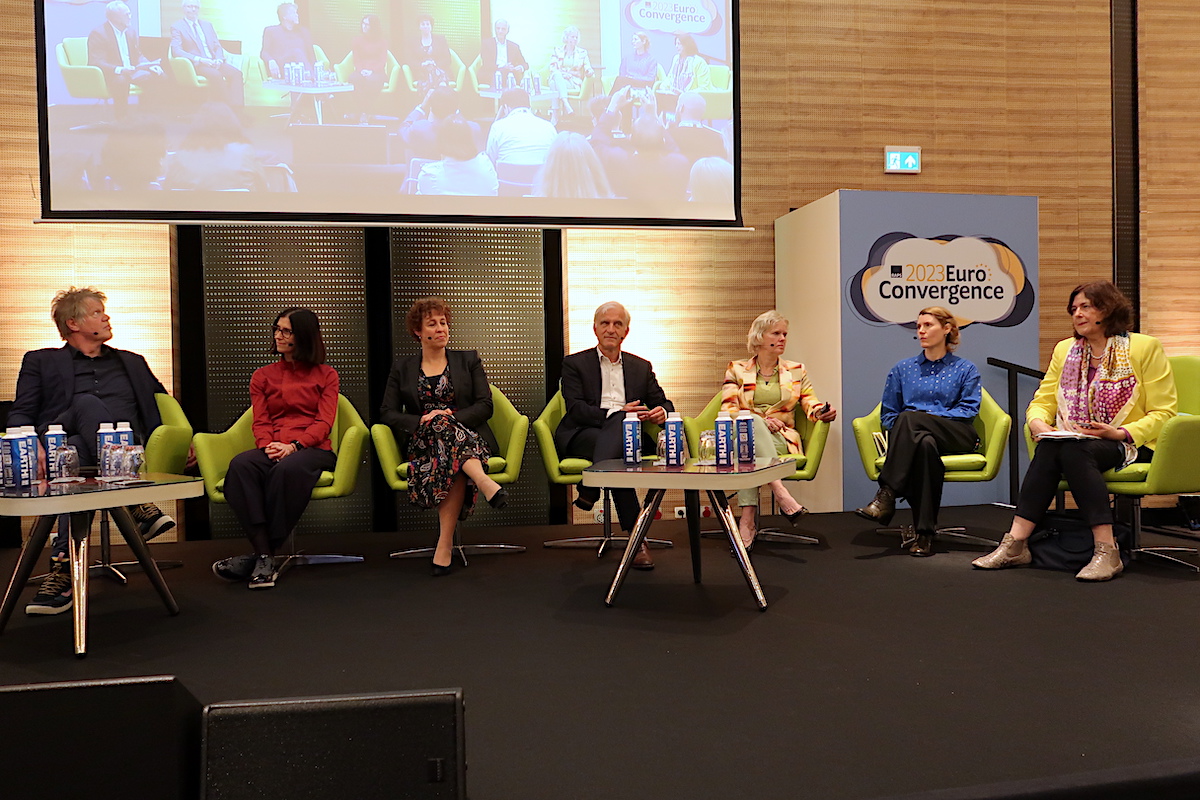 Left to right: Stan van Belkum, Marta Carnielli, Bianca Lutters, Rob Nelissen, Anja Wiersma, Jet Shouten and Sabina Hoekstra-van den Bosch
Anja Wiersma, CEO of mi-CE consultancy, recalled an incident in June when she broke her hip and needed to undergo emergency surgery to have dynamic hip screws implanted into her. As someone with a regulatory background she was able to have a thorough conversation with her physician about the treatment and asked to keep the boxes the devices she received so that she could track potential safety issues and recalls. She noted that the many patients may not have as much understanding of medical devices and safety communications and need information presented in such a way that they fully understand the care they are receiving.
While EUDAMED is still being developed, Wiersma asked, “What will the patients see, and will it be in lay user language?”
“I’m confident it won’t be in lay user language,” said Bianca Lutters, head of clinical operations at QServe Group. “But then hopefully [their physicians] will be able to explain.”
Rob Nelissen, a professor of orthopedics at Leiden University and a practicing orthopedic physician, noted that part of a physician’s duty is to ensure patients are well-informed about their treatment. He said he has high hopes for the EU’s Coordinating Research and Evidence for Medical Devices (CORE-MD) consortium. The project is a collaborative between regulators, researchers and industry to review methods for evaluating high-risk medical devices.
Nelissen added that he hopes the project will lead the EU to assess product safety in collaboration with researchers, physicians, regulators, patients and even journalists.
Stan van Belkum, general director of CCMO, said that his organization aims to not only ensure patient safety in clinical trials but also encourage more trials to take place in Europe. He noted that there are 1,500 trials in Europe that fall under CCMO’s jurisdiction, of which 600 are for medicines, and around 300,000 people participate in trials in the Netherlands each year.
“The message we want to convey is CCMO wants to take patient empowerment seriously,” said van Belkum. “We are trying to take steps so patients are involved from the very beginning of trial design.”
He said that trials are often designed in silos in Europe, which makes it hard to share data. He added that he is skeptical that reports from EUDAMED will be easy to understand.
“Systemically, we’re on the right path,” he said. “But who is going to read 100-page assessment reports.”
Juan Garcia Burgos, head of public and stakeholders engagement at EMA, said that transparency continues to be a top priority for regulators. He noted that while the first European Public Assessment Report (EPAR) in 1995 was around 20 pages, the latest reports can be more than 200 pages.
“When the pandemic hit us there was a need to be more transparent than ever,” said Garcia Burgos. “Lots of questions were raised because of novel vaccines and the record time they were approved.”
Ultimately, he said the issue is about ensuring public trust and he hopes the agency will be able to continue to work to provide the kind of transparency it achieved during the pandemic.
“The patient and the public has a right to know,” he said. “I don’t think we can leave this responsibility to healthcare professionals only.”
