

Experts offer insights on de novo requests, MDUFA VI changes
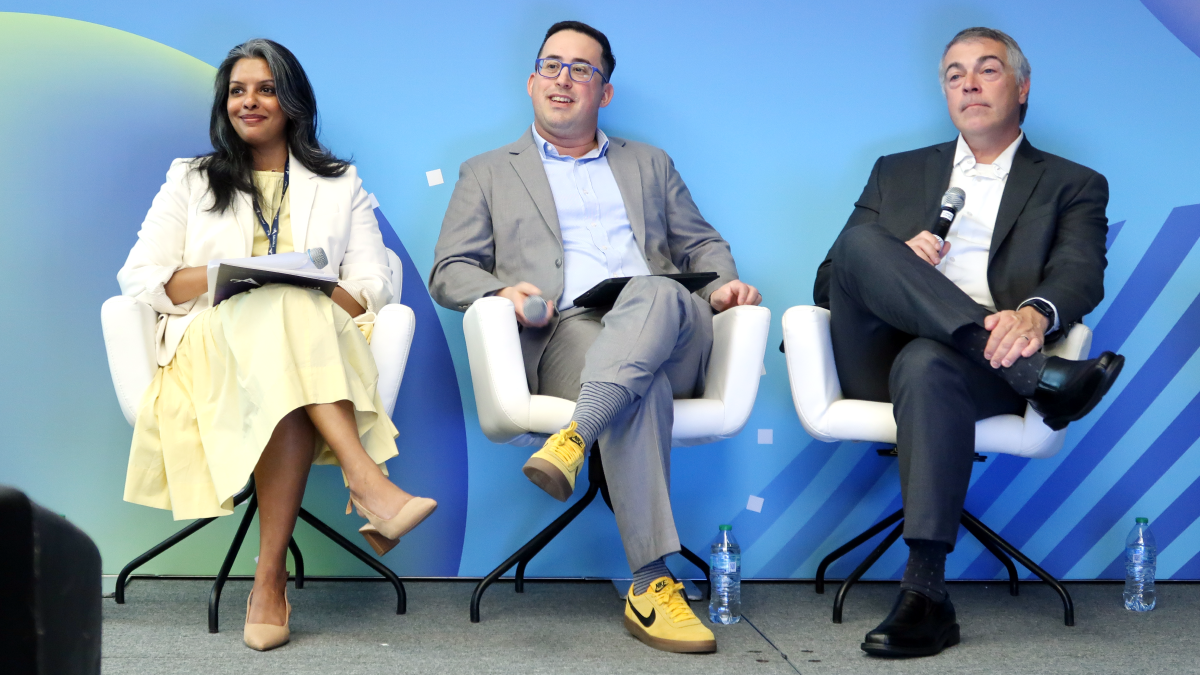
Geeta Pamidimukkala (left), Joshua Silverstein (center), and Joashua Nipper (right) spoke at The MedTech Conference. (credit: Ferdous Al-Faruque)
BOSTON – An expert and officials from the US Food and Drug Administration (FDA) offered tips for de novo classification requests and reviewed some of the changes related to de novos being proposed under the Medical Device User Fee Amendments (MDUFA VI) program at The MedTech Conference last week.
"De novos have the lowest authorization of the programs for marketing applications," said Owen Faris, principal deputy director of the Office of Product Evaluation and Quality (OPEQ) at FDA’s Center for Devices and Radiological Health (CDRH), who spoke during a CDRH Town Hall session. "Some of that is structural, and we thought that we could develop some improvements to the program that would help you with many of them."
Geeta Pamidimukkala, AdvaMed vice president for technology and regulatory affairs, spoke on a panel about de novo classification requests and presented data from the CDRH FY 2026 third quarter performance report.
Even though the FY 2025 data is somewhat incomplete, Pamidimukkala said the data so far indicates the device center is meeting its performance goals, noting that the agency is "knocking it out of the park" with regard to its goal of reaching a decision on de novos within 150 days 70% of the time, having managed to do so under 150 days more than 90% of the time each year of the program so far.
While the number of de novo requests FDA received has declined from 96 in FY 2023 to 78 in FY 2024 and 68 in FY 2025, the rate of rejections during the first administrative review fell from 30% in FY 2023 to 11% in FY 2025.
Pamidimukkala noted that while the average total time to decision has gone up slightly in FY 2025 compared to FY 2023, the agency has granted a greater proportion of those requests, with 44.6% granted in FY 2023 compared to 56% in FY 2025.
“Perhaps it's beneficial to have a little bit more time in the review if the outcome gets us to yes,” Pamidimukkala said, adding that some of the process changes being proposed for MDUFA VI could positively affect that balance.
That said, Pamidimukkala remarked that the number of de novo requests has fallen throughout MDUFA V, with FY 2026 on track for being the lowest submission year to date. She suggested that the pathway may be seeing fewer submissions due to its low predictability compared to other pathways.
"Not to be facetious here, but the granting rate is like a coin flip, and when you compare that to the other more mature programs like 510(k) and [premarket approval (PMA)], where you have authorization rates above 80 percent, you know there is some room for improvement on de novo in terms of outcome predictability," said Pamidimukkala. "And so, my suspicion is that part of the reason why submission volumes are decreasing is that de novo is an expensive submission type.
"My presumption is that people might be a little bit gun-shy to go with a de novo device, given that it can be kind of risky if you can't have predictability in the outcome, and so we're hoping that some of these trends will reverse through some of the performance improvement or process improvements that we're going to see in MDUFA VI," she added.
Pamidimukkala pointed out that the average time to a MDUFA decision for de novos has generally declined since 2007 and noted that unlike 510(k) and PMA submissions, where most of the time to decision is taken up by FDA, for de novos, time is split more evenly between FDA and manufacturers.
"It's interesting that in FY 2025 industry time is exceeding FDA review time, meaning when you get the deficiency letter, you are taking on average 145 days in this cohort to respond to that letter," said Pamidimukkala. "I think what that means is [...] perhaps that extra time that you're taking to prepare a comprehensive response to FDA's deficiencies is helping to support that trend for increasing the granting rate."
Pamidimukkala addressed some of the improvements to the de novo program that have been proposed under MDUFA VI, which is anticipated to take effect on 1 October 2027 pending Congressional authorization. One of the key changes is that FDA will call an introductory meeting between the review team and the de novo sponsor within 30 days of accepting their submission.
"We think this is really important because this is your opportunity to tell your story, why is the data in your submission and your study design appropriate and suitable to demonstrate safety and effectiveness," said Pamidimukkala. "The intention here is for you to help FDA understand your perspective on why you've prepared the submission the way you have, and for you to get off on the right foot so that you can help the review team get oriented to the way you've prepared your submission."
Another change is that de novo sponsors can receive a not grantable (NG) decision within 150 days of submission, similar to what happens with PMAs, which includes a comprehensive list of outstanding deficiencies, and additional response opportunities for those deficiencies, which the sponsor can try to address before the agency issues a final decision. Furthermore, she said sponsors will get 360 calendar days to respond to both additional information letters and NG letters, compared to 180 days to respond under MDUFA V.
"CDRH had done some analysis and found that during those COVID years, they were automatically granting 360-day timeframes, and the granting rates went slightly up in those years," said Pamidimukkala. "The thinking is that by automatically giving you additional time to respond comprehensively to the deficiencies, it's more likely to help you respond comprehensively, so that you can hopefully get to a granting decision."
She also said that the agency has agreed to develop a pre-submission template for de novo submissions under MDUFA VI by the end of September 2029 that specifically addresses clinical study design, which is a major reason de novo sponsors receive a deficiency.
"The hope is that by having more guided conversations in the early pre-sub phase, we can reduce the frequency of clinical study deficiencies that come up during the de novo review itself," she added.
Pamidimukkala also noted that the commitment letter includes changes to enable more trackable, direct engagement with review staff and that, in addition to the traditional pre-submission process, the agency will allow certain requests to go through a follow-up pre-submission process that provides feedback within 45 days.
Joshua Nipper, director of the Division of Submission Support at the Office of Regulatory Programs within OPEQ, noted that the number of de novos with an FDA decision has declined in recent years from their peak of 83 in 2023 to 50 in FY 2025. However, he noted that this is a significant increase from the early years of the de novo program, when only a few submissions were made each year.
When examining de novo submissions under MDUFA IV, Nipper said that smaller companies tended to be less successful in obtaining authorization than larger ones, largely due to a lack of capacity and funding. He emphasized that de novo sponsors should take advantage of the pre-submission process to obtain early, substantive feedback from regulators before moving forward with their development plans.
"I know there's discussion about not submitting too many pre-subs, and we totally understand that, but if you're planning a de novo, if you're really trying to get through the de novo pathway, we strongly recommend at least an initial discussion to figure out what type of data FDA may be thinking about," said Nipper. "There's not a lot of precedent to go on for a lot of the de novos that we see.
"Even a lot of PMAs have their third, fourth, fifth of a kind," he added. "We have an idea of what kind of data we want to see versus in a de novo, you're kind of treading new ground."
Nipper said the biggest factor for denying a de novo submission is lack of evidence demonstrating significant benefit. He noted that the agency often isn't asking for evidence of large-scale benefit, especially when the device is low risk. He also noted that de novos that already have an investigational device exemption (IDE) tended to be more successful in getting authorized.
"We really think that was because in many instances the IDE came through us," said Nipper. "We got to weigh in on the clinical study design, weigh in on the endpoints, and were able to have more of a voice in getting the data that we need, versus it's truly a non-significant risk study, there was no IDE, they get the data dumped on us and are kind of left trying to tease out what we have left."
Deficiencies largely centered on a lack of supporting data in preclinical testing, Nipper said, including gaps in cybersecurity and biocompatibility testing. While some denials were easier to figure out, such as lack of significant clinical impact data, unresolved safety risks, and failure to demonstrate benefit, other issues are more complex, such as small device therapeutic effects that are confounded by clinical study design limitations, risk of misinterpretation of the diagnostic data, and when the device uses new techniques with unjustifiable risks.
Nipper said that FDA tries to work with sponsors in situations where there may be insufficient data to support the primary indication, and that the agency may explore other indications with the manufacturer based on the data.
He also recommended that sponsors align with FDA on how to demonstrate benefit, test in the intended patient population, develop strategies to address uncertainties, and make the least burdensome case for their special controls.