

Framework in Place, FDA Looks to Go After Counterfeiters with Interoperable Data Standards
The US Food and Drug Administration (FDA) is calling for comments from the pharmaceutical industry on the interoperability of transaction standards required under a recently passed law intended to strengthen the supply chain against counterfeiters.
Background
In 2013, Congress passed and President Barack Obama signed into law the Drug Quality and Security Act (DQSA). While the law is perhaps better known for its extensive pharmaceutical compounding reform provisions, it also contains another major component formally known as the Drug Supply Chain Security Act (DSCSA).
The core of the DSCSA is meant to establish a nationwide pharmaceutical track and trace system that deters drug counterfeiting. Drug packages would be required to carry a serial number as part of a lot-level tracking system within four years of the law's implementation, with a package-level tracing system coming six years after that.
One of the key components to the track and trace system is its traceability provisions. Each entity in the supply chain, from the original manufacturer to the end distributor, is supposed to keep track of the product coming into and out of its possession, allowing its path to be traced by federal regulators in the event of a problem. FDA could, for example, determine the point at which a counterfeit product entered into a legitimate supply chain, making it easier to bring a company into compliance or track down a counterfeiter.
Devil in the Details
But as the saying goes, the devil is in the details. And the details of this plan lie in the data each entity must hand off to one another, known as "transaction data."
In a new Federal Register announcement by FDA on 20 February 2014, the agency says it wants to figure out how to make sure all that transaction information, including histories and statements, is interoperable in both paper and electronic formats.
Part of the problem is simply with the scale of the DSCSA, which involves pharmaceutical manufacturers, federal regulators, drug distributors, drug dispensers, and a host of other supply chain companies, all of which need to be able to process and generate transaction data. Each of these entities has unique needs, as well as unique processes already in place for processing transactions.
The other part of the problem, as noted by Dirk Rodgers, an expert on track and trace, is that there are a lot of standards in this area already. Front-runners for data standards to be used in any FDA-mandated system include the Electronic Data Interchange (EDI) Advance Shipment Notice (ASN) standard, GS1 Electronic Product Code Information Service (EPCIS), the National Drug Code (NDC) system, electronic packing lists and invoices, and GS1's Drug Pedigree Messaging Standards (DPMS).
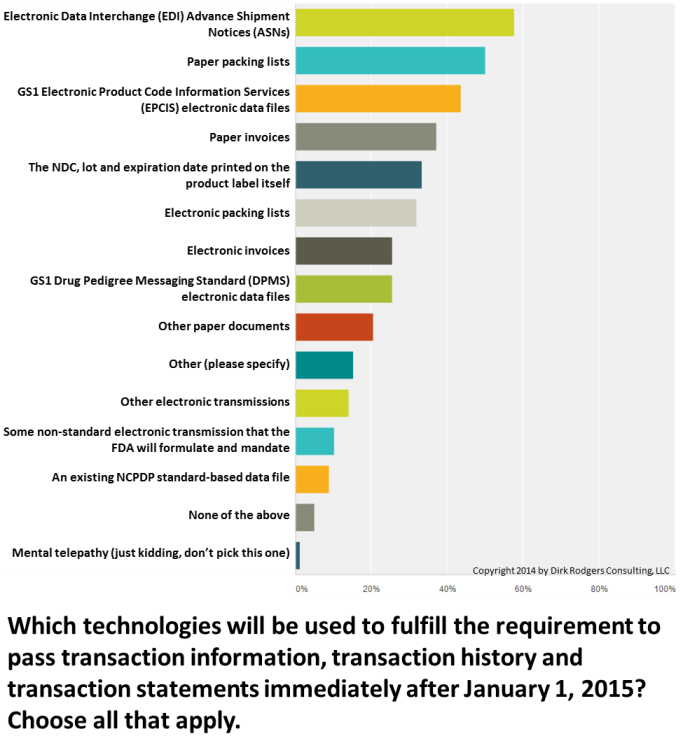
And while EDI is already widely used and a clear front-runner, it's not quite ready for primetime just yet, Rodgers noted.
"EDI is currently designed as a point-to-point data exchange technology that is intended to describe the current shipment," he wrote. "It will be necessary to come up with a way to include previous Advance Ship Notices (ASN) to fulfill the transaction history requirement, and some way to meet the requirements of the transaction statement."
Finding ways to make these standards interoperable will take time, Rodgers added.
And based on the amount of information FDA wants made available in each transaction file-name, strength, NDC, container size, container numbers, lots numbers, transaction date, shipment date, and business information-there's a lot to make interoperable.
FDA Seeks Input
For its part, FDA seems intent on getting to interoperability. Its Federal Register notice asks industry to weigh in on current practices, the feasibility of establishing documentation standards, and how information can be exchanged between private industry and regulators.
FDA's notice also contains 13 specific questions related to interoperability, split up into three categories:
Questions related to (1) current practices and suggestions for the interoperable exchange of transaction information, transaction history, and transaction statements and (2) the feasibility of establishing standardized documentation to be used by members of the pharmaceutical distribution supply chain to convey the transaction information, transaction history, and transaction statement to the subsequent purchaser of prescription drugs and to facilitate the exchange of lot level data:
- What types of information about transactions do you exchange? What practices, processes, or systems, either paper-based or electronic, do supply chain stakeholders use to exchange this information? Are the practices, processes, or systems based on a standard? Are they interoperable with other systems that supply chain stakeholders may be using?
- What practices, processes or systems, either paper-based or electronic, do supply chain stakeholders use to exchange information related to prior transactions? Are the practices, processes, or systems based on a standard? Are they interoperable with other systems that supply chain stakeholders may be using?
- Do the practices, processes, or systems that supply chain stakeholders use to exchange transaction information or transaction histories include or have the ability to include lot level data?
- If you are currently using paper means to exchange transaction information or history, when do you plan to move to an electronic format?
- Are there challenges to adopting and using a system, in paper or electronic format, for the interoperable exchange of transaction information or history? How can these challenges be addressed?
- Are there practices, processes, or systems that supply chain stakeholders can use now to exchange the information in the transaction statement required by the DSCSA?
- Are there challenges to providing the transaction statement to supply chain stakeholders in either paper or electronic form? How can these challenges be addressed?
- Are there standards or current practices that you would recommend for FDA to consider as a model for providing any or all of the transaction information, transaction history, or transaction statement to other supply chain stakeholders?
- Are there other technologies, systems, or solutions available now that would enable the interoperable exchange of transaction information, transaction history, or transaction statements?
Questions related to (3) current practices and suggestions for the exchange of information between supply chain stakeholders or with FDA to provide, receive, and terminate notifications, respond to requests for verification of suspect product, and respond to requests for information from FDA or other appropriate Federal or State officials in the event of a recall or for the purpose of investigating a suspect or illegitimate product:
- Are there current practices, processes, or systems that could be used to exchange information between supply chain stakeholders and FDA with respect to providing, receiving, and terminating a notification that an illegitimate product is found in distribution? Are these practices, processes, or systems effective? If not, please provide recommendations to improve these practices, processes, or systems.
- Are there current practices, processes, or systems that could be used to exchange information between supply chain stakeholders or with FDA to respond to requests to verify the lot number, expiration date, and other indices of identity assigned to a product by the manufacturer or repackager (i.e., requests for verification of suspect product)? Are these practices, processes, or systems effective? If not, please provide recommendations to improve these practices, processes, or systems.
- Are there current practices, processes, or systems that could be used for providing information in response to requests from FDA or other appropriate Federal or State officials in the event of a recall or for the purpose of investigating a suspect or illegitimate product? Are these practices, processes, or systems effective? If not, please provide recommendations to improve these practices, processes, or systems.
Question related to capturing information that has not necessarily been addressed by the previous questions:
- Are there other considerations related to standards for the interoperable exchange of information for tracing of human, finished, prescription drugs that have not been addressed by the previous questions? Please provide any additional information that you think could be helpful for the Agency to consider as it implements these provisions of the DSCSA.