Høeg touts FDA efforts to speed rare disease drugs to market
ARLINGTON, VA – The top drug regulator at the US Food and Drug Administration (FDA) said the agency is working to develop new pathways for rare diseases to reduce regulatory barriers for medical products and emphasized the need to challenge medical dogma.
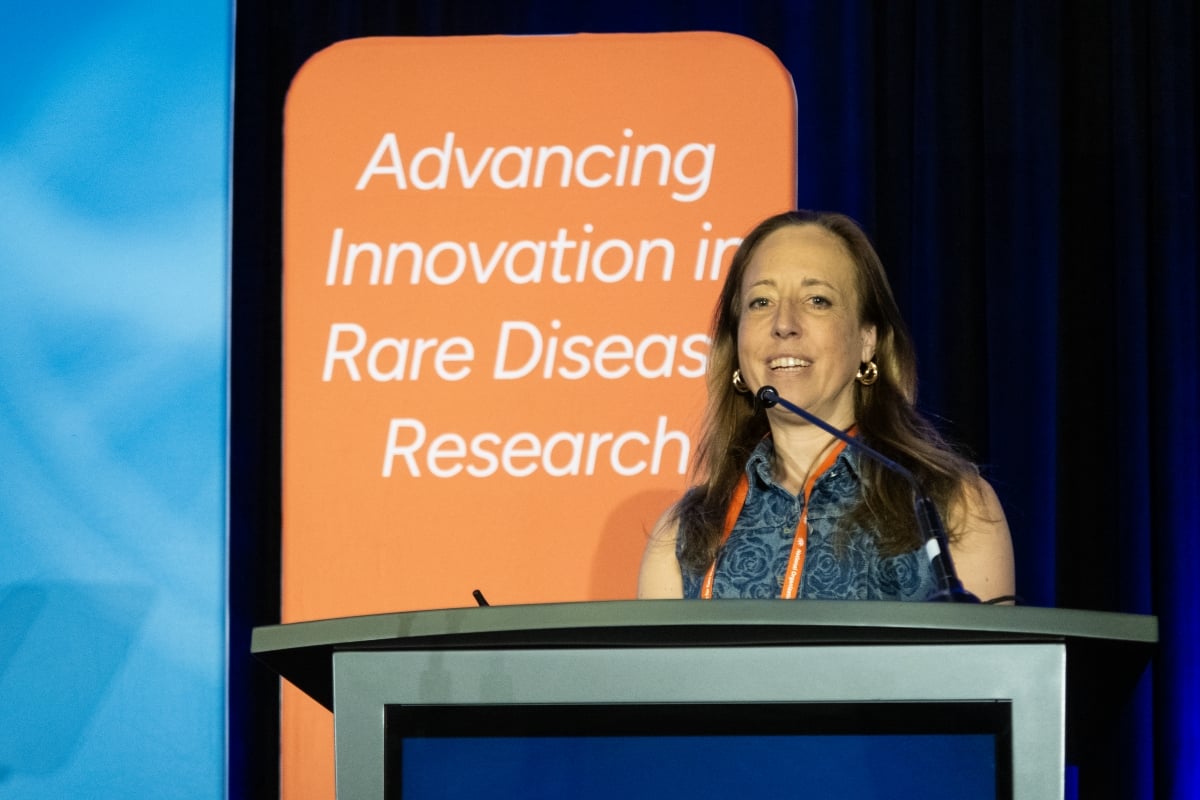
Tracy Beth Høeg, the acting director for the Center for Drug Evaluation and Research (CDER), was the keynote speaker at the 2026 National Organization for Rare Diseases (NORD) Rare Disease Scientific Symposium, where she said the Trump administration is working to speed new products to market.
Høeg, a dual citizen of the US and Denmark, noted that when she moved back to the US during the COVID-19 pandemic, she questioned the US' response to the pandemic based on her experience in Denmark. In particular, she questioned the need for school closures and mask mandates, which led her to publish several studies in collaboration with other researchers and brought her into contact with current FDA Commissioner Marty Makary and Vinay Prasad, the outgoing director of the Center for Biologics Evaluation and Research, both of whom have voiced similar skepticism about COVID-19 public health mandates.
"I believe very strongly in retaining the integrity of the scientific process and keeping it apoliticized," said Høeg. "Whether a drug is effective or ineffective, we must communicate those results and be transparent and honest.
"One of our biggest roles and challenges of the FDA is effective communication about how we are evaluating the data," she added.
Høeg listed several initiatives FDA is undertaking, including efforts to reduce animal testing. The agency recently announced draft guidance to assist pharmaceutical manufacturers in transitioning from animal studies to non-animal alternatives for drug development. It is urging companies to adopt new approach methodologies (NAMs), incorporating in vitro human-based systems, such as organs-on-chips and in silico modeling, to assess drug safety. (RELATED: FDA drafts guidance on animal testing alternatives, Regulatory Focus 18 March 2026)
"I think that this is also very important in drug development in the rare disease space to save time, money, and also to use and develop more predictive methodologies of toxicology and safety in humans, and that we can move towards novel methodologies to better predict what we're going to see," said Høeg. "This is going to allow drugs to come to the market much faster."
Høeg also highlighted FDA's recent announcement in the New England Journal of Medicine (NEJM) to require only one clinical trial to demonstrate that a product meets its regulatory requirements for safety and efficacy in most cases by default. She noted that this was already the case for rare disease drug development, but now the agency will accept data from single clinical trials for any product if the researchers demonstrate that their trials are well-designed and can provide sufficient evidence. (RELATED: Experts react to FDA’s shift to single pivotal trials for most drugs, Regulatory Focus 18 February 2026)
Additionally, Høeg mentioned FDA is working to finalize guidance on external controls and is seeking feedback on a proposed guidance on a plausible mechanism of action pathway for ultra-rare diseases by 27 April. She also said that CDER and CBER plan to host a workshop on the proposed pathway soon.
According to the latest FDA data, Høeg said approval times from the time an application is first filed have dropped below 400 days, despite the mass firings at the agency over the past year. She noted that during COVID-19, the agency's approval times were even shorter and emphasized that Makary wants to treat serious diseases and rare diseases as urgent public health matters to speed products to market.
Høeg admitted that before coming to the FDA, she had an outsider's perspective of the agency and didn't fully appreciate the work the agency does or its staff.
"That has been my biggest surprise, it's the quality of the scientists and the work that is being done there and the care that goes into these approvals," she said. "I feel one of my jobs is to communicate that with the public, that there are extremely caring and competent, highly intelligent, experienced people working at the FDA, and I'm proud to work with them."
Adaptive trials and external controls
On the topic of developing products for ultra-rare diseases, Olivia Morgan, an FDA statistician, provided an overview of the agency’s approach to adaptive clinical trial designs for such products and offered tips on how to address the issue.
She noted that it is difficult to propose a fixed maximum sample size for such trials and said sponsors may need to plan for interim trial adaptations, including sample size re-estimation and subpopulation selection. She also highlighted some analysis considerations specific to adaptive trials, including controlling for Type I error rates, considerations about asymptotic assumptions for small sample sizes, conducting a simulation study, and more.
More broadly, Morgan said sponsors of ultra-rare disease trials must consider the impact of the small patient population, adapt to efficiently enroll potential trial subjects, control Type I error, prespecify the analysis plan, and evaluate whether asymptomatic normality is a reasonable assumption. If not, they should use analysis methods that don't rely on the assumption.
Wonyul Lee, a senior statistical reviewer at CDER, spoke at a later session about FDA's perspective on externally controlled trials where outcomes in patients receiving the test treatment are compared to outcomes in people outside the trial who have not received the same treatment. He noted that the agency published a draft guidance in December 2019 on demonstrating substantial evidence of effectiveness that sponsors should reference when considering conducting externally controlled trials.
Lee outlined design considerations for externally controlled trials as well as data considerations. He emphasized that the design stage is critical to successful externally controlled trials and said sponsors should carefully assess whether such trials are truly suitable to their needs, address potential sources of bias when designing them, and finalize their protocol and analysis plan before initiating the trials.
Lee also noted that external control data should include sufficient information to support comprehensive comparability assessments, and that sponsors should engage with the relevant FDA review division early in the drug development program, before initiating trials.