

HHS, FDA dispute spills out onto Twitter
In the final months and weeks of the Trump administration, the Department of Health and Human Services (HHS) has advanced several policies to consolidate its authority over the US Food and Drug Administration’s (FDA).Today, with just one day left in the Trump administration, the latest dispute between HHS and its subagency spilled into the public.
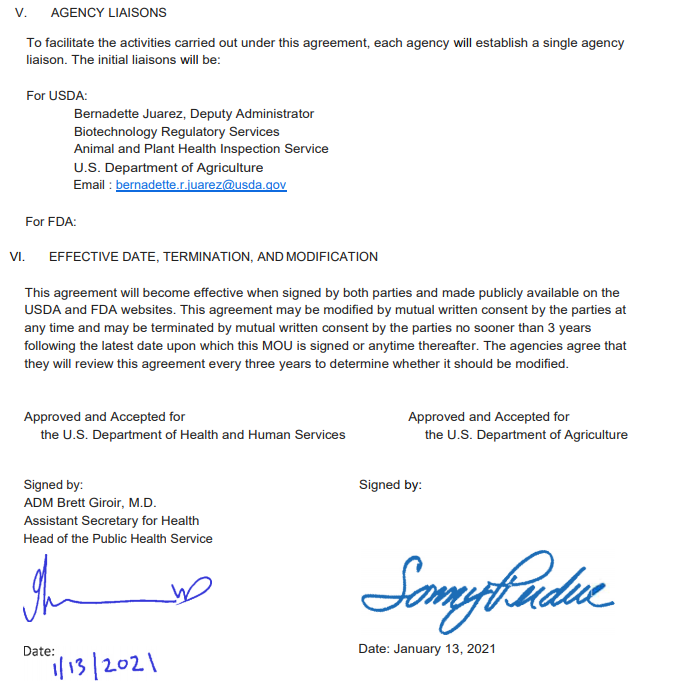
Following media reports last week that FDA Commissioner Stephen Hahn refused to sign a memorandum of understanding (MoU) that would cede FDA’s oversight of genetically modified animals to the US Department of Agriculture (USDA), HHS pushed ahead with the policy. A copy of the MoU posted to the USDA website shows the document was signed by Assistant Secretary for Health Brett Giroir and Secretary of Agriculture Sonny Perdue and, tellingly, lists a liaison for USDA but leaves the corresponding section for FDA’s liaison blank.
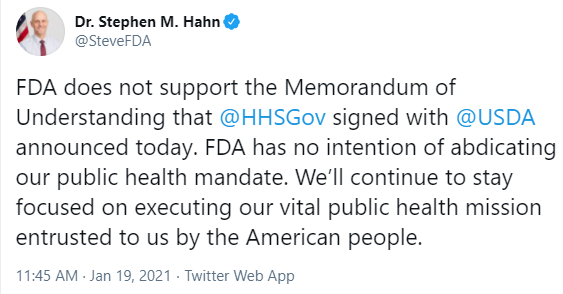
In a stunning move, Hahn tweeted that FDA would not abide by the MoU, a rare public airing of a dispute between top administration officials that follows heightened political pressure on the agency to quicky authorize therapeutics and vaccines for COVID-19. That pressure has led to discussion among health experts as to whether FDA should have greater independence from political influence, something Hahn himself has said should be on the table. (RELATED: Hahn offers advice to incoming Biden administration, Regulatory Focus 11 January 2021).
In a statement to Focus, an HHS spokesperson said the MoU was pushed through at the direction of the White House. “Today’s MOU announcement involving HHS and USDA regarding agricultural animal biotechnology is the result of a formal policy process coordinated by the White House. Secretary Azar was and remains supportive of Commissioner Hahn’s and FDA’s position on the MOU, but at the direction of the White House, the decision was made to execute the MOU,” the spokesperson said.
Aaron Kesselheim, director of Harvard Medical School and Brigham & Women’s Hospital’s Program on Regulation, Therapeutics and Law, told Focus that the MoU fits in with the other “last-minute radical policy changes” being pursued by HHS. “These changes are uniformly bad in that they diminish the FDA’s vital role in protecting the public health,” he said, adding that he hopes that “the incoming administration of President Biden reverses as many of them as he can as quickly as he can.”
Former FDA Commissioner Scott Gottlieb also criticized the MoU and HHS’ attempt to strip FDA of its oversight of gene-edited animals, calling it an “unprecedented usurping of FDA public health authority. FDA should regulate animal biotech as part of its mandate. This policy move threatens the health and well-being of Americans and should be immediately reversed.”
Other recent moves by HHS include reining in delegated authorities by requiring the secretary of HHS’ signature on all department rules, lifting regulatory requirements for certain medical devices, imposing “term limits” on director-level staff and sunsetting regulations if they are not assessed and reviewed every 10 years. HHS also overruled FDA regarding its oversight of laboratory developed tests last fall, asserting that the agency “will not require premarket review of [such tests] absent notice-and-comment rulemaking” and recently awarded a contract to a private consulting firm to review emergency use authorization (EUA) requests for some LDTs. (RELATED: HHS pushes through last-minute policies impacting FDA, Regulatory Focus 12 January 2021; FDA updates COVID-19 testing FAQ, will no longer accept EUAs for LDTs, Regulatory Focus 8 October 2020).
In an unusual turn of events last week, HHS and FDA, independently from one another, named different individuals to be FDA’s top lawyer after former Chief Counsel Stacy Cline Amin stepped down. (RELATED: FDA’s top lawyer resigns, Regulatory Focus 12 January 2021).
Gottlieb and Kesselheim’s statements both raise a point about the durability of this and other recent policies enacted by HHS. Some actions, such as the MoU, could be relatively straightforward for the new administration to reverse, whereas rules may be challenged in court or overturned via the Congressional Review Act.