

ICH adopts S11 guideline on nonclinical safety testing for pediatric drugs
The International Council for Harmonisation (ICH) on Tuesday adopted its S11 guideline on nonclinical safety testing to support the development of pediatric drugs following consultations by its regulatory members last year.The 39-page guideline, first endorsed as a topic by ICH’s steering committee in 2014, lays out harmonized recommendations for nonclinical pediatric safety testing across ICH regions with the goal of pediatric clinical trials and reducing the need for juvenile animal studies (JAS) according to 3R (replace, reduce and refine) principles. (RELATED: FDA Offers ICH S11 Guidance for Comment as Shutdown Threatens Further Guidance, Regulatory Focus 22 January 2019; Industry Groups Call for Changes to ICH S11 Guideline, Regulatory Focus 23 April 2019).
ICH says the guideline will encourage “streamlined drug development and higher scientific rigor while minimizing the unnecessary use of animals,” and notes that additional nonclinical investigations should only proceed when there is insufficient previous nonclinical and human data to support the conduct of pediatric studies.
ICH emphasizes that pediatric patients represent a distinct population and face unique safety challenges compared to adults. “Immaturity of organ systems and maturation of systems during drug treatment can affect drug pharmacokinetics (PK), pharmacodynamics (DP) and/or off-target effects of pharmaceuticals, potentially leading to differences in safety and/or efficacy profiles,” ICH writes.
The guideline prescribes a weight of evidence (WoE) approach to determine the extent of nonclinical investigations required to support the clinical development of drugs for pediatric population. ICH says that “an understanding of the overall clinical development plan is needed to design an appropriate, efficient nonclinical plan” and encourages companies to consider nonclinical studies to support pediatric development early on.
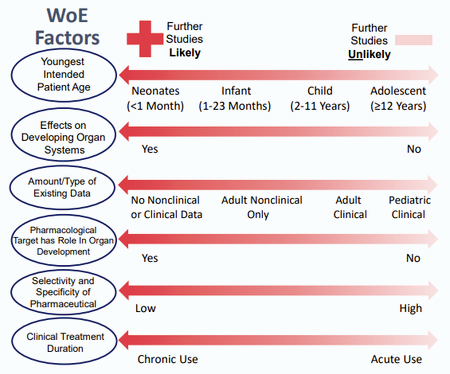
Under the WoE approach, ICH says sponsors should consider the available clinical data for a treatment, its pharmacological properties, pharmacokinetic data and existing nonclinical safety data. ICH says sponsors should consider the feasibility of additional animal studies, noting that “some endpoints might not be practical in some species.”
The guideline also includes recommendations for the design of nonclinical JAS, pediatric-first/only development and considerations for assessing the safety of excipients and combination drugs for pediatric patients.
ICH, S11 Guideline