MHRA’s Tallon says agency wants risk-proportionate device, AI regulation
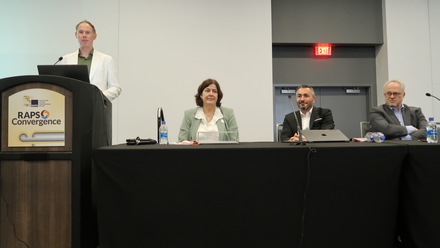
SAN DIEGO — The head of the UK’s Medicines and Healthcare products Regulatory Agency (MHRA) said the agency has learned from the challenges that have plagued the implementation of the EU Medical Device Regulation and In Vitro Diagnostic Regulation. The big takeaway from the ordeal has been implementing a more risk-proportionate regulatory regime, including when it comes to regulating artificial intelligence (AI).MHRA CEO Lawrence Tallon discussed how his agency plans to regulate products coming into the UK with limited resources during a panel discussion at the 2025 Medtech Conference. He said the aim is to avoid implementing regulations that can be too burdensome while finding a risk-based approach to ensure patients have access to treatments.
During the discussion, Tallon was asked what lessons MHRA has learned from the EU’s attempt to implement MDR and IVDR across the channel.
“Any time you introduce complex new legislation or new regulations, you can have somewhat unintended consequences,” said Tallon. “As we've seen with MDR and IVDR, the ability of the notified bodies to handle the additional workload was stretched.
“That meant that products were taking much, much longer to get to market,” he added.
Tallon said one of the key outcomes is that MHRA has decided to allow sponsors to self-declare Class B IVDs to avoid a similar backlog of IVD applications as in the EU. He said the decision is part of a larger risk-proportionate approach his agency has decided to take.
“There are certain things where we clearly need to provide full, thorough, scrutiny, but actually there are other things where we can calibrate the level of regulation oversight needed to the risk,” said Tallon. “And that's what we've been able to do, learning from the experience of MDR/IVDR, with our own proposals for our own regulations.”
Tallon mentioned a recent study published in the British Journal of Clinical Pharmacology (BJCP) that evaluated MHRA’s risk-proportionate approach to clinical trials. He noted that the research shows that the agency has been able to calibrate its level of scrutiny and oversight based on the clinical trial's risk level, which has allowed regulators to reduce the average number of days to approve a clinical trial from 91 days to 41 days.
“This is about smart, sensible, proportionate regulation, not over-regulation, not disproportionate regulation, but regulation calibrating to risk,” said Tallon. “Our response to seeing IVDR/MDR is essentially to take that risk proportion approach into what we're doing, particularly through the self-declaration class to IVDs.”
Tallon said MHRA has also learned lessons from the US Food and Drug Administration (FDA) based on their history of collaboration. He noted that the two agencies are philosophically aligned regarding their regulatory approach.
“We've also, of course, got the benefit of a common [regulatory] language as well as a common cultural language,” said Tallon. “I see that there are a couple of really, really important reciprocal benefits between our countries when we're looking at bringing new products to market.”
Tallon said MHRA is open to using regulatory standards developed by FDA. At the same time, he said FDA could benefit from the UK’s National Health Service’s (NHS) multimodal and longitudinal healthcare data, which he said was genotypically and phenotypically similar to the US population. While the two agencies have been working together to address emerging technologies, he also noted that the most important area they have been working on is regulating AI, which he argued will also require a risk-proportionate approach.
“Clearly AI and how you regulate for AI is absolutely at the top of our mutual agendas,” said Tallon. “I think it would probably be fair to say that the way that all of our regulatory bodies have been set up around the world have primarily been to date from an era where the principal purpose is to identify the safety and efficacy of small molecules medicines against defined disease targets so you know that the product that you have authorized is a static product that is the same before you authorized it and after you authorized it.”
“AI is fundamentally challenging this whole regulatory paradigm,” he added “We need to really think quite creatively about how we redesign the whole regulatory paradigm for an era of AI.”
To address the challenge, Tallon said the British government launched the National Commission into the Regulation of AI in Healthcare to bring together key stakeholders, AI experts, academics, clinicians, ethicists, big and small tech representatives, patient advocates, and regulators to advise MHRA on a new regulatory AI healthcare framework expected to be published next year.
“Whilst I don't want to prejudge the outcome of that work, it's reasonably clear, I think, to all of us that we need to have a different approach to the initial barrier to entry, so that we have a more proportionate barrier to getting AI enabled devices into market, patients being able to interact with these devices, and then a much more sophisticated approach to real-world monitoring,” said Tallon. “Rather than having a single high [barrier] to get into market, we would have a more proportionate series of hurdles to get into market with a much greater onus on post-market monitoring and surveillance.”