

Optimizing EDDO control strategies for drug/biologic combination products
Abstract This article explores the development of control strategies for drug/biologic-led combination products for new drug applications (NDAs) and biologics license applications (BLAs). The authors discuss the recent draft guidance on essential drug delivery outputs (EDDOs), focusing on risk-based control strategies, effective submission strategies, and when to engage with the US Food and Drug Administration (FDA). The article highlights regulatory expectations for EDDO upstream controls, discusses implementation challenges, and offers insights on practical approaches for robust submissions, including integrating prior knowledge, risk assessments, submission strategies, and global trends.
Keywords – combination products, control strategy, manufacturing
Introduction
Drug delivery combination products play an important role in delivering medications to patients by enabling safe, effective, and reliable administration of the intended dose. Examples include ready-to-use devices intended for at-home or in-clinic use and may incorporate multidose formats or digital connectivity. Combination product presentations may be single-entity (i.e., integral), co-packaged, or cross-labeled.1 In all configurations, the device constituent is responsible for safely and effectively delivering the intended dose to the target drug delivery site, and its performance may be influenced by interactions with the drug/biologic.
In June 2024, draft FDA guidance Essential Drug Delivery Outputs for Devices Intended to Delivery Drugs and Biological Products2 (hereafter referred to as the draft guidance) clarified how the existing International Organization for Standardization (ISO) standards regarding design and development output principles3 (identification, verification, validation) can be used to inform drug delivery combination product submission expectations, specification development and validation, control strategy and postapproval change management. Note that this draft guidance is not final, is for comment purposes only, and not for implementation. The draft guidance also introduced essential drug delivery outputs (EDDOs) as a new term, replacing the term essential performance requirements, which has been used in previous FDA communications.
EDDOs refer to the device drug-delivery design outputs necessary to ensure delivery of the intended drug dose to the intended delivery site, including product preparation/ initiation, progression, and completion of the dose delivery. EDDOs build on the existing design control concept of essential design outputs and may be interpreted as analogous to critical quality attributes (CQAs), which define key quality attributes that require control for the drug constituent of a combination product.
Effective control strategies in NDA and BLA submissions are critical for ensuring that each lot of the finished combination product is manufactured to conform to the combination product specifications and maintain overall product quality. The draft guidance clarified that not all device functions need to be included in product specifications and proposed a filtering method to instead prioritize functions directly related to drug delivery. The draft guidance also described factors that may support the use of effective design and/or upstream manufacturing controls, rather than final release specifications, to control EDDOs. In this article, the sections labeled Industry perspective are attributed to the industry’s perspective on the topic and do not represent the FDA’s perspective.
EDDO control strategy: Industry experiences and best practices
Overall, industry stakeholders were pleased that the draft guidance stated that EDDO control strategies should be risk-based and included an example of an EDDO being controlled through upstream controls rather than through release specifications. However, questions remain regarding how manufacturers should implement these recommendations within their organizations and present the information clearly in NDA/BLA submissions. Additional considerations include regulatory, organizational, and systems-related implementation challenges, as well as the potential impact of evolving global International Council for Harmonisation (ICH) frameworks.
Industry perspective: Industry experience with control strategy
A practical way to build an EDDO control strategy is to treat it as a risk-based exercise from the outset by intentionally applying the most stringent controls to higher-risk EDDOs while avoiding “over-controlling” low-risk EDDOs in ways that add cost, effort, and potential scrapping of good product with-out improving patient safety. Over-reliance on release testing alone could result in true de-fects being missed, while potentially delaying products from reaching the market due to the development, validation, and implementation of EDDO release tests across multiple global manufacturing sites.
A risk-based strategy is not just about how many controls to apply, but also about selecting the types of controls that are most effective. One way to structure this decision is through a hierarchy of controls (Figure 1), with the most effective controls at the top and the least reliable at the bottom.
Figure 1. Hierarchy of controls
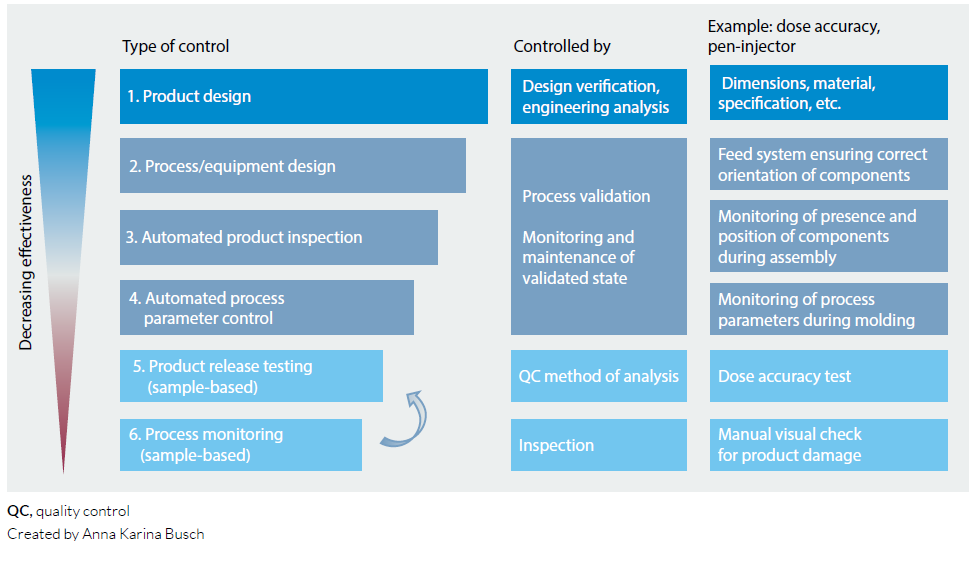
At the top of the hierarchy for device functionality is robust product design, demonstrated through thorough design verification showing that the device meets specifications across the expected design space. In other words, the fundamental control is built into the combination product design rather than solely tested at the end of the manufacturing process. Next in the hierarchy are controls that build robustness into manufacturing processes and equipment, including (where relevant and feasible) 100% automated inspection/testing and 100% automated control of key process parameters. These controls are evaluated during process validation across multiple batches and then monitored and maintained in a validated state throughout the product lifecycle. Their practical advantage is coverage: validated 100% controls can detect even rare single-unit defects within large batches, enabling targeted rejection rather than broad batch disposition.
Lower in the hierarchy are sample-based controls, such as in-process sampling and batch release testing. While batch release testing can be appropriate for certain high-risk, high-complexity EDDOs, it is generally a less effective primary control because it is sample-based rather than 100% coverage-based, is often manual, and can be destructive. Destructive testing may potentially lead to scrapping acceptable product while still missing true defects.
The hierarchy-of-controls lens helps justify why higher-risk EDDOs may require multiple layers of controls, including, in some cases, release testing, while lower-risk EDDOs can often be effectively controlled through product design, upstream controls, and process controls.
When developing a combination product control strategy, the process can be implemented as a stepwise framework: identify the relevant EDDOs for the product, characterize each EDDO, determine the overall risk level, and develop a risk-based control strategy for each EDDO. The risk characterization drives the selection of proportionate, defensible controls. The control strategy should also be supported by evidence, including stability data, manufacturing consistency data, and any other supportive data demonstrating that the EDDO can be met reliably throughout the product lifecycle. The overall EDDO risk level can be assessed by combining three perspectives:
- Failure impact – Using risk management principles, teams evaluate within the context of the specific drug, indication, patient populations, and the severity of harm if the EDDO fails. This step also identifies risk control measures that should be built into product design and into manufacturing processes;
- Complexity – A cross-functional decomposition exercise helps map how the EDDO is achieved by breaking down system-level outputs into component-level contributors. This analysis clarifies whether the EDDO depends on many versus few components, whether it is drug-agnostic or drug-dependent, and whether the manufacturing process and its sources of variation are simple or complex; and
- Level of knowledge – A thorough design analysis (e.g., design verification, tolerance analysis, structural analysis, and shelf-life testing) establishes how well the EDDO is understood. Sponsors should consider prior knowledge of currently marketed device constituents, as they may be able to leverage years of manufacturing consistency experience, stability data, and postmarket insights when introducing a new drug or variant for use with the proposed device constituent.
In general terms, EDDOs with high failure impact, high complexity, and limited knowledge fall at the high-risk end of the overall risk scale, whereas EDDOs with low failure impact, low complexity, and extensive knowledge fall at the low-risk end. Where an EDDO lands on this scale determines both the number of controls and the type of those controls. Figure 2 demonstrates the overall EDDO risk, which is determined by failure impact severity, complexity, and level of knowledge.
Figure 2. Overall risk driving control strategy in essential drug delivery outputs
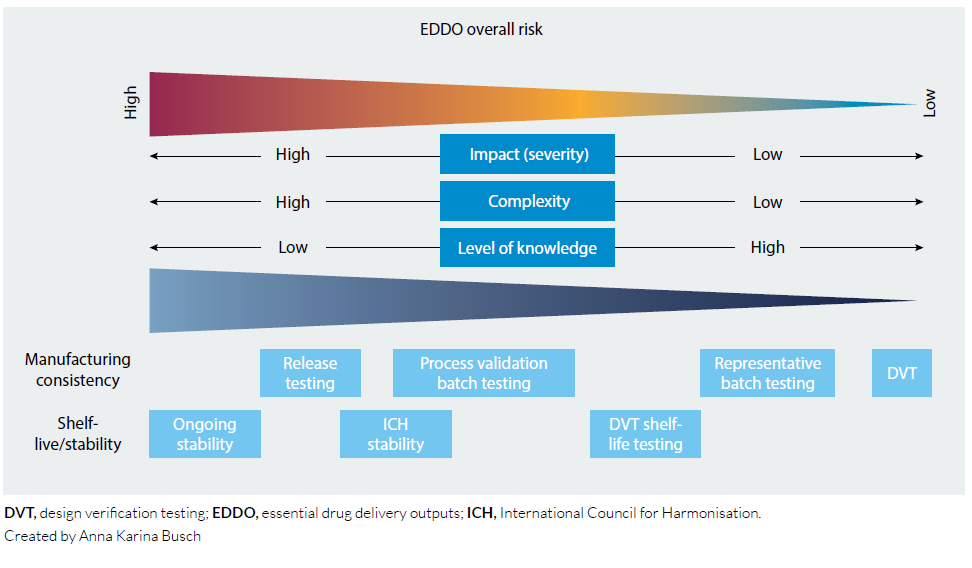
A risk-based strategy should be supported by data demonstrating consistent manufacturability and performance. Manufacturing consistency data typically involves direct measurement of the EDDO on the assembled product and is commonly provided in regulatory submissions (e.g., NDA and BLAs). The amount and type of data should be proportional to the EDDO’s risk level: for some low-risk device parameters, design verification evidence may be sufficient, whereas for higher-risk EDDOs, additional evidence may be drawn from process validation batches or other representative batches, such as clinical or stability batches. Where justified, data from similar devices may be leveraged.
Stability and shelf-life considerations also feed directly into the control strategy. Testing expectations depend on whether an EDDO is drug-agnostic or drug-dependent, and the extent of prior knowledge available from related products. Determining whether an EDDO is stability-indicating informs specification setting to ensure performance throughout shelf life. In select cases, ongoing stability may be considered. The following example of cap removal force (Figure 3) as an EDDO for a well-characterized platform pen-injector used for a weight-management drug demonstrated application of the risk-based approach.
Figure 3. Cap-removal force control strategy for the platform pen injector used for a weight-management drug
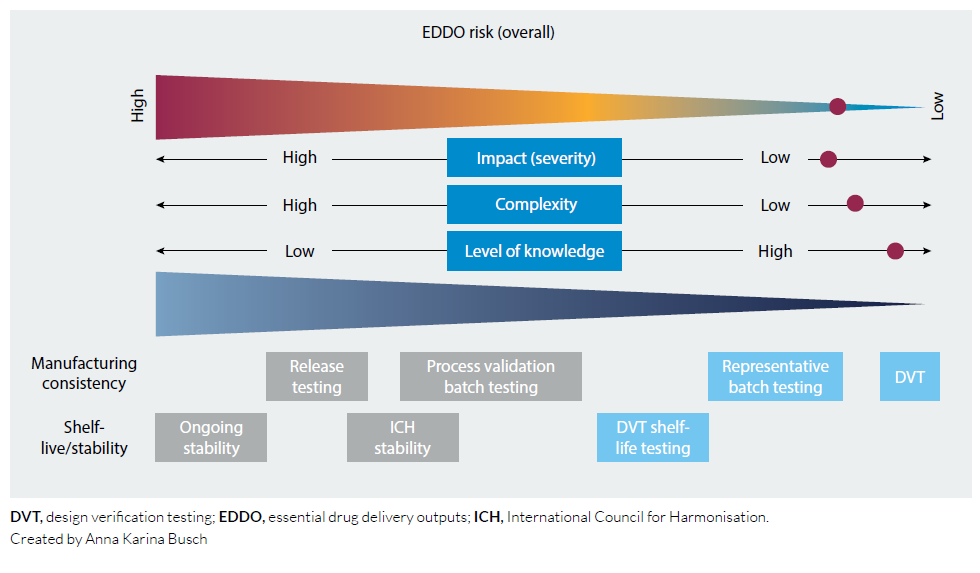
The drug in the example in Figure 3 is intended for weight management in a nonemergency setting; therefore, the potential impact on failure is considered low. The functional decomposition shows only a limited number of components, and the functionality is drug-agnostic, indicating low overall complexity. The pen-injector is based on a well-known and previously approved platform design, and consequently, the level of existing knowledge is high. Based on these considerations, the overall EDDO risk is considered low. The implemented controls may therefore be limited to:
- Design verification testing, including shelf-life testing;
- Representative batch testing for manufacturing consistency; and
- Upstream manufacturing controls.
Industry perspective: Industry experience in submission strategies
Drug-device combination products often require development and manufacturing in collaboration with third-party manufacturers. Based on recent author experiences, autoinjector manufacturing can become very complex due to multiple components, subassemblies, suppliers, manufacturing sites, and steps (Figure 4). The manufacturing complexity signaled the importance of communicating a more integrated, end-to-end control strategy in submissions so that health authorities are aware of all factors contributing to device performance.
Figure 4. Multiple steps and interfaces in the manufacturing of an autoinjector
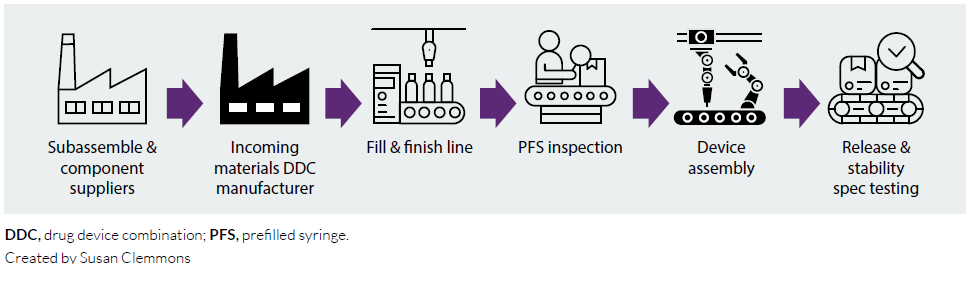
Sponsors need strong partnerships with third parties to identify the various controls and manufacturing steps that may impact EDDO performance. The accompanying Table summarizes examples of controls that may be present at different manufacturing steps or informed by third-party suppliers/manufacturers.
Table. Example controls for an autoinjector
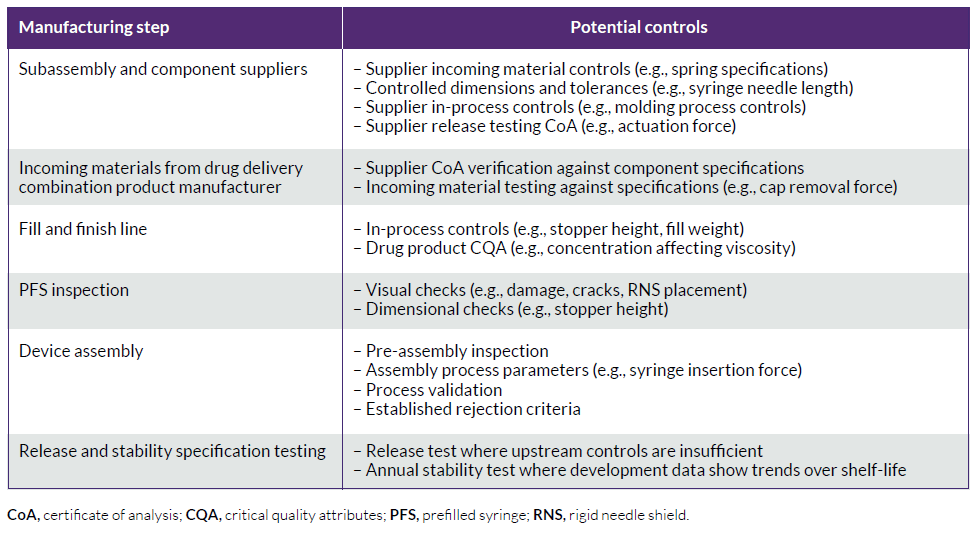
The potential controls available at each step in the accompanying Table are considered when determining appropriate release and stability testing strategies. General recommendations for this example (Figure 4, Table) included:
- Release tests – Appropriate when upstream controls were insufficient or significantly impacted (e.g., emergency use device or final assembly process impacts CQA); and
- Annual stability testing – Appropriate when development data show trends over shelf-life (e.g., where the attribute is stability-indicating).
As a submission best practice, it is critical in communications with health authorities to provide detailed information on the design and manufacture of your combination product, including manufacturing steps that may affect EDDO performance and supporting performance data, to align on a control strategy.
Industry perspective: Challenges in control strategy development
Across development, manufacturing, and regulatory submission activities, organizations are increasingly required to demonstrate coherent linkages between product design, human factors, risk management, and process controls (e.g., full traceability between user needs and design features; distinct risk categorization for every comprehensible failure type).
Design transfer to manufacturing. One of the most persistent challenges arises during design transfer to manufacturing, where translating design controls into robust, manufacturable specifications can be complex and time-consuming. Test method development and validation also extend timelines, while the need to align multiple suppliers, manufacturing sites, and laboratories adds operational complexity. These challenges are amplified when a single drug product is delivered using multiple device platforms, each with its own independently developed design history file. In such cases, risk management and human factors considerations must be evaluated to consider the specific patient or user population. However, learnings from new human factors assessments on the individual device level may be relevant to other user groups and, consistent with continuous improvement principles, applied across platforms to ensure consistent and appropriate control of delivery performance.
Integration of drug and device processes. Effective integration of drug and device processes represents another critical pain point. Organizational silos and unclear ownership, particularly when responsibilities are split across different companies, can hinder visibility and accountability for shared product attributes. For example, device component characteristics, such as syringe glide force, may directly influence system-level performance parameters, such as injection time, in an autoinjector. Limited visibility into supplier process capability and performance over time, coupled with fragmented quality management system responsibilities (including deviation and corrective and preventative action ownership), further complicates the establishment of a holistic control strategy. Incorporating device elements into established drug development processes, such as process performance qualification, shipping validation, and stability programs, requires clear differentiation between platform-level and product-specific data, as well as robust end-to-end change management spanning drug substance, drug product, and combination product elements.
Industry perspective: Evolving regulatory expectations
These technical and organizational challenges are occurring against a backdrop of new and evolving expectations from health authorities. Regulatory agencies are increasingly focused on how control strategies are justified and communicated. Sponsors face ongoing questions about validation strategies for multiple stock-keeping units, the timing of process performance qualification, and the acceptability of alternative or surrogate data. Inconsistent application of reporting categories, including the use of postapproval change management protocols, and uncertainty regarding the appropriate level and location of detail within submissions can further complicate regulatory review. A recurring theme is the need to clearly contextualize technical details within an overall control strategy.
Recent and proposed updates to international guidelines reinforce these expectations. An ICH final concept paper,4 endorsed in July 2024, called for revisions to ICH specification guidelines for chemical substances/ products (ICH Q6A)5 and biotechnological/biological products (ICH Q6B).6 This concept paper introduces a dedicated annex addressing combination products in accordance with ICH guidelines on pharmaceutical development (ICH Q8)7 and drug substance development (Q11)8 control strategy principles. It is important that revisions to ICH specifications guidelines for chemical and biological products (ICH Q6A/Q6B)5,6 align with established international device standards (e.g., ISO 13485,3 ISO 149719), appropriately scope out product types such as convenience kits where relevant, and allow scientific flexibility in the selection of test articles, including the justified use of mimic solutions.
Within this framework, a risk-based approach to attribute prioritization is increasingly central to the development of control strategies. Distinguishing between drug-dependent device attributes (those influenced by the drug or drug-device interactions) and drug-agnostic device attributes (where functional performance is independent of the drug) enables more focused and scientifically defensible control strategies. Other device characteristics, such as needle safety or biocompatibility, can often be adequately addressed through design controls, while certain delivery-related attributes may be managed through upstream controls supported by prior knowledge and platform experience.
Complementing these developments, updates to the ICH common technical document quality guideline, M4Q(R2),10 signal a shift in how quality information is assessed and presented. Module 2 of the common technical document is increasingly positioned as the primary basis for regulatory assessment, supported by detailed information in Module 3. New expectations emphasize clear articulation of overall product development and the overall control strategy, integrating quality target product profiles, CQAs, and end-to-end controls from starting materials through final drug product and packaging. Importantly, quality summaries are expected to extend beyond traditional drug substance and drug product content to include dedicated sections addressing medical device description, manufacture, control, and storage.
Taken together, these challenges and regulatory developments underscore a broader transition toward holistic, integrated control strategies for combination products. Success increasingly depends on early alignment across disciplines, clear ownership and governance models, strategic use of prior knowledge, and the ability to present a coherent, risk-based narrative that connects design intent to patient-relevant performance throughout the product lifecycle.
FDA perspective
The draft guidance recommends that sponsors develop and characterize product-specific EDDOs early and consult the FDA on proposed EDDOs and control strategies.1 The FDA also offered further advice on combination product submissions and effective engagement regarding control strategies based on experience since the release of the draft guidance.
Effective submission strategies for combination product control strategies center on several key expectations. The device constituent part control strategy can be incorporated within sections 3.2.P.7 and/or 3.2.R of the common technical document. However, the use of a reviewer guide is encouraged to clearly indicate the location and rationale of the proposed control strategy for the EDDO and articulate how it is controlled, with particular emphasis on justifying why release testing on the final finished combination product may not be necessary, where applicable. In line with the draft guidance, the FDA supports a risk-based control strategy informed by prior knowledge where appropriate and recommends that sponsors provide a statistical justification for release testing sampling approaches.
Engagement with the FDA can be tailored to the type of feedback requested and the maturity of the combination product’s design and manufacturing process. Alignment of the control strategy is ideally achieved at the pre-BLA/ NDA meeting or once the design is finalized and the manufacturing processes are reasonably understood. While routine parameters such as needle length may not require extensive discussion, more complex attributes involving multiple component functions often warrant earlier and more detailed engagement, especially for novel device designs. Sponsors with established device designs and manufacturing processes are encouraged to initiate discussions early, providing comprehensive information on each proposed control, whether upstream or tied to release testing, and the rationale supporting these controls.
It is important to note that the use of upstream controls, as described in the draft guidance, is consistent with established ICH Q8, Q9, and Q10 principles7,11,12 and is not a novel concept. Rather, the draft guidance provides greater specificity, and the FDA recognizes the need for ongoing clarity in this area. Consistent with ICH Q9 risk control methodologies, the draft EDDO guidance recommends that sponsors leverage manufacturing and design controls to reduce the risk of an EDDO failure through various risk-reduction measures, such as upstream controls or release testing. Fundamentally, EDDOs are grounded in design control principles that guide the development of combination products. While the FDA typically does not favor pre-IND meeting questions on topics already addressed in existing guidance, the agency remains open to discussions about new approaches outlined in draft guidance. Sponsors are encouraged to seek feedback on these emerging topics to ensure alignment and facilitate efficient regulatory review.
Conclusion
The draft guidance provides a structured submission approach grounded in design control and ICH principles, guiding industry in developing and presenting robust control strategies to ultimately ensure patient safety. This article highlights the value of a risk-based approach that leverages prior knowledge where appropriate and emphasizes the need for sponsors to clearly describe the EDDO and its controls, especially when justifying why final finished combination product release testing may not be necessary.
Effective communication of holistic control strategies, including rationale and location within regulatory submissions, remains essential for health authority engagement. The FDA encourages data-driven discussions and supports alignment on control strategies at key milestones, such as pre-BLA/ NDA meetings, particularly for novel device designs or complex EDDOs. As the industry continues to adapt EDDO control strategy concepts, the FDA is committed to clarifying expectations and ensuring alignment with ICH guidelines. Many of the considerations discussed are broadly applicable not only to EDDOs but also to other device functional attributes, as the underlying principles remain consistent.
Abbreviations
BLA, biologics license application; CQA, critical quality attribute; EDDO, essential drug delivery output; FDA, Food and Drug Administration; ICH, International Council for Harmonisation; IND, investigational new drug; ISO, International Organization for Standardization; NDA, new drug application.
About the authors
Ashley Boam, MSBE, serves as director of the Office of Policy for Pharmaceutical Quality in the Center for Drug Evaluation and Research (CDER) at the FDA, which is responsible for developing and clearly communicating science- and risk-based policies and standards related to drug quality, including application assessment and inspection. Prior to joining CDER in 2013, Boam spent nearly 20 years in the Office of Device Evaluation in the FDA’s Center for Devices and Radiological Health (CDRH). Boam holds a master’s degree in biomedical ethics from the University of Alabama, Birmingham. She can be reached at [email protected]
Anna Karina Busch, PhD, is a regulatory specialist and portfolio lead in regulatory affairs devices at Novo Nordisk, supporting regulatory strategies for combination products. She holds a PhD in human biology from the University of Copenhagen and has prior experience in the medical device industry, both as a development project manager and within regulatory affairs. She can be reached at [email protected]
Susan Clemmons, MS, is an associate director of CMC devices at GlaxoSmithKline, where she leads global regulatory strategies for device submissions supporting combination products and drug-delivery systems across multiple therapeutic areas. Clemmons also has experience with cross-functional collaboration and driving CMC compliance across global markets. She holds a master’s degree in pharmaceutical sciences from Temple University, Philadelphia. She can be reached at [email protected]
Shruti Mistry, MS, has worked at the FDA for 10 years and currently serves as the assistant director of the Injection Devices Team in the FDA’s CDRH. Mistry holds a master’s degree in biomedical engineering from the Johns Hopkins Whiting School of Engineering, Baltimore. She can be reached at [email protected]
Willy Liou, MS, is currently director of regulatory affairs at Amgen, overseeing global regulatory strategy for devices, combination products, and human factors across programs. He has experience in device and combination product development, regulatory affairs, and quality compliance. Prior to joining Amgen, Liou worked at a Johnson & Johnson medical device company, where he held positions in international regulatory affairs and quality compliance. Liou holds a master’s degree in biotechnology with a concentration in regulatory affairs from Johns Hopkins University, Baltimore. He can be reached at [email protected]
Rumi Young, MENG, is director of regulatory policy at Novo Nordisk, focusing on biopharmaceutical policies. Previously, she led Becton Dickinson’s regulatory policy team, leading reform in diagnostics and digital health. At the FDA, she was the assistant director for injection devices, overseeing technical and regulatory review practices for combination products. Young’s career also includes roles in R&D at Genentech and AstraZeneca. She holds a master’s degree in engineering from Cornell University, New York. She can be reached at [email protected]
Disclaimer This article is solely attributed to the authors and is not associated with their respective employment with Novo Nordisk, GSK, Amgen, or the FDA. The views expressed in the article are the personal views of the authors and may not be understood or quoted as being made on behalf of or reflecting the position of the regulatory agencies or organizations with which the authors is/are employed/affiliated.
Acknowledgment This article was adapted from a presentation by the authors at the 2025 Associations of Food and Drug Officials/Regulatory Affairs Professionals Society (AFDO/RAPS) Combination Products Summit in Providence, RI, on 17-18 October 2025.
Citation Young R, et al. Optimizing EDDO control strategies for drug/biologic combination products. RAPS Journal of Regulatory Affairs. 2026;1(5):15-24. Published online 15 September 2026. https://www.raps.org/resource/optimizing-eddo-control-strategies-for-drug-biologic-combination-products.html
References
All references were last checked and verified on 28 July 2026.
- Food and Drug Administration. Combination product definition combination product types. Content current as of 15 February 2018. Accessed 14 March 2026. https://www.fda.gov/combination-products/about-combination-products/combination-product-definition-combination-product-types
- Food and Drug Administration. Essential drug delivery outputs for devices intended to deliver drugs and biological products [draft guidance]. Issued 28 June 2024. Accessed 16 March 2026. https://www.fda.gov/media/179545/download
- International Organization for Standardization. Medical devices – Quality management systems – Requirements for regulatory purposes. Issued March 2016. Accessed 16 March 2026. https://www.iso.org/standard/59752.html
- International Council for Harmonisation. Final concept paper: Q6(R1) EWG: Maintenance of the ICH Q6A and Q6B guidelines. Dated 25 June 2024. Accessed 15 March 2026. https://database.ich.org/sites/default/files/ICH_Q6%28R1%29_Final_ConceptPaper_2024_0625.pdf
- International Council for Harmonisation. Specification: Test procedures and acceptance criteria for new drug substances and new drug products: Chemical substances – ICH Q6A. Dated 6 October 1999. Accessed 16 March 2026. https://database.ich.org/sites/default/files/Q6A%20Guideline.pdf
- International Council for Harmonisation. Specifications: Test procedures and acceptance criteria for biotechnological/biological products – ICH Q6B. Dated 10 March 1999. Accessed 16 March 2026. https://database.ich.org/sites/default/files/Q6B%20Guideline.pdf
- International Council for Harmonisation. Pharmaceutical Development– ICH Q8(R2). Dated August 2009. Accessed 16 March 2026. https://database.ich.org/sites/default/files/Q8%28R2%29%20Guideline.pdf
- International Council for Harmonisation. Development and manufacture of drug substances (chemical entities and biotechnological/biological entities) – Q11. Dated 1 May 2012. Accessed 17 March 2026. https://database.ich.org/sites/default/files/Q11%20Guideline.pdf
- International Organization of Standardization. Medical devices – Application of risk management to medical devices. Issued December 2019. Accessed 17 March 2026. https://www.iso.org/standard/72704.html
- International Council for Harmonisation. The common technical document for the registration of pharmaceuticals for human use: Quality M4Q(R2). Endorsed 14 May 2025. Accessed 17 March 2026. https://view.officeapps.live.com/op/view.aspx?src=https%3A%2F%2Fdatabase.ich.org%2Fsites%2Fdefault%2Ffiles%2FICH%2520M4Q%2528R2%2529_Draft_Guideline_2025_0514.docx&wdOrigin=BROWSELINK
- International Council for Harmonisation. Quality risk management – Q9(R1). Issued 18 January 2023. Accessed 17 March 2026. https:// database.ich.org/sites/default/files/ICH_Q9%28R1%29_Guideline_Step4_2025_0115_0.pdf
- International Council for Harmonisation. Pharmaceutical quality system – Q10. Issued 4 June 2008. Accessed 17 March 2026. https:// database.ich.org/sites/default/files/Q10%20Guideline.pdf