
Tarver: CDRH on a ‘recruiting tear,’ looking ahead to MDUFA VI
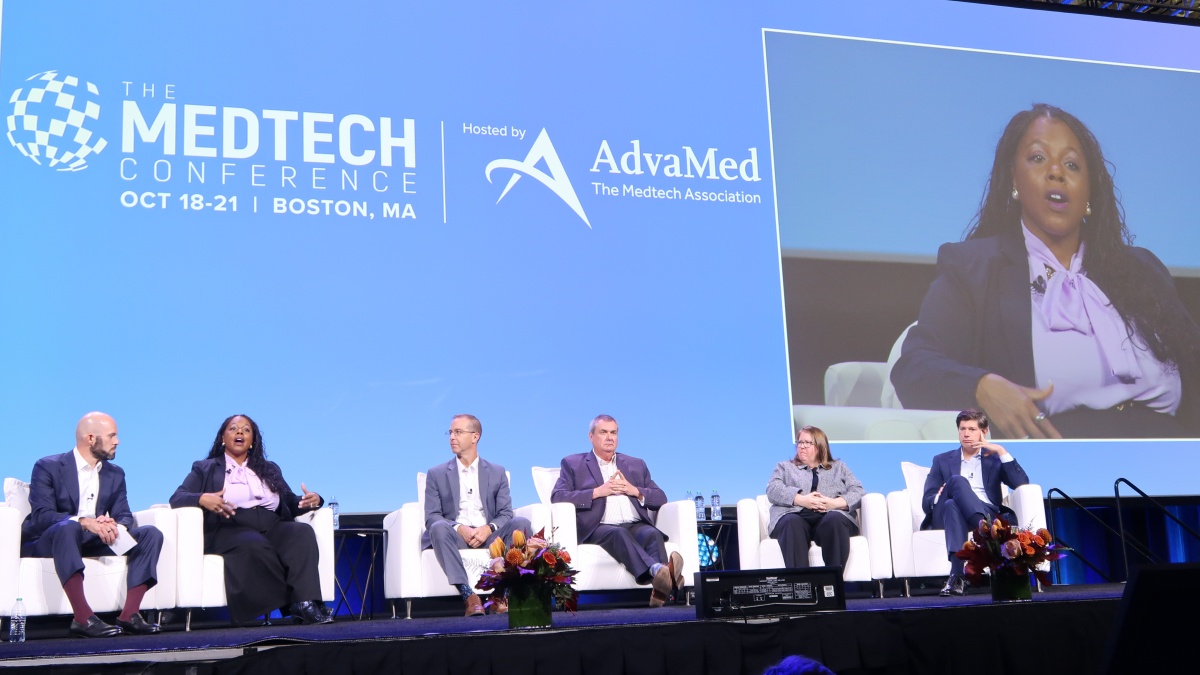
Left to right: Zach Rothstein, Michelle Tarver, Owen Faris, Ed Margerrison, Angela Krueger, and Rick Abramson. (credit: Ferdous Al-Faruque)
BOSTON – Top US Food and Drug Administration (FDA) medical device officials said they are focused on restaffing after last year’s reduction-in-force (RIF) and are optimistic about the Medical Device User Fee Amendments (MDUFA VI) agreement during a town hall panel at The MedTech Conference.
Staffing
Michelle Tarver, director for the Center for Devices and Radiological Health (CDRH), provided an update on the agency's ongoing restaffing effort. Over the past year and a half, CDRH has lost about 22% of its staff, and certain areas were hit harder than others, she said. She noted that the center has lost 30% of its reviewers and a significant number of its digital health and artificial intelligence specialists.
"We have been on a recruiting tear as you probably can imagine, you've seen a lot of USAJobs postings," said Tarver.
"We have actually exceeded our hiring for FY 2026 under the MDUFA commitment, which is a Herculean effort considering all the changes that have happened, as well as a testament to people recognizing how much that mission resonates with them,” she said, noting that the center hired 65 people based at the agency’s White Oak campus in Silver Spring, MD in FY 2026, exceeding the MDUFA V hiring goal of 63 for that year.
Tarver noted that 65 people were hired to the agency's main White Oak campus in Silver Spring, MD. She also emphasized the need to continue hiring more people, given that CDRH regulates more than 250,000 devices, oversees 222,000 manufacturing sites, and received more than 20,000 premarket submissions last year alone.
"That's a lot of work," said Tarver. "We need more hands to help us manage that work.
"Our center has continued to be empowered with respect to the strategic hiring plan that the agency put out," she added.
MDUFA VI
Tarver updated attendees on the proposed MDUFA VI agreement that FDA and industry recently agreed to, which will fund FDA’s user fee program for medical devices and diagnostics from FY 2028-2032. The measures in the draft commitment letter, Tarver said, signal investments in the people, processes, and scientific foundation of the FDA, and would improve review consistency, deepen international harmonization, and ensure long-term program sustainability.
"This is a real milestone, and the final agreement is now going through clearance and is targeted for submission to Congress by January of 2027," said Tarver. "My fingers are crossed that it will be a little sooner than that.
"We look forward to continuing this partnership with AdvaMed and the broader stakeholder community through the reauthorization process, and particularly presenting a unified message as Congress begins their work on reauthorization," she added.
One notable change from the current MDUFA agreement is that the MDUFA VI commitment letter does not include a claw-back provision. Owen Faris, principal deputy director of the Office of Product Evaluation and Quality (OPEQ), said FDA and industry stakeholders spent time discussing ways to optimally use user fee funds while improving review consistency across the center.
"I won't go into all the specifics today, but there was a lot of discussion about how to manage a reserve so that we would ensure the continuity of the program under different eventualities and ensure that there's a ceiling to that reserve and a floor to that reserve, and that there were mechanisms in place to ensure that we stay between that," he added.
Having participated in three MDUFA negotiations over his career, Faris noted that the MDUFA VI negotiations were the most collaborative, productive, and efficient he has experienced.
Faris highlighted several key aspects of the draft commitment letter, including a focused follow-up pre-submission process to allow faster response from regulators for certain focused questions, and improvements to the de novo review program.
"De novos are the lowest authorization of the program for marketing applications, some of that is structural, and we thought that we could develop some improvements to the program," said Faris.
He said the proposal includes scheduling a meeting within 30 days of receiving a de novo application to discuss steps to move forward so everyone is on the same page, and if a de novo is issued a negative outcome, the sponsor doesn't necessarily have to start the process all over again. Instead, they can work from where they left off to determine what they need to do to achieve a positive result.
MDUFA V performance
Tarver discussed CDRH's performance under MDUFA V, noting that as of 30 September, the device center is on track to meet nearly all its review goals, including a requirement that reviewers detail the reasons for issuing a deficiency letter in requests for additional information. She said that the requirement has made the review process more predictable and transparent.
"Fulfillment of our MDUFA commitment reflects continued strong performance, even as the volume and complexity of the submissions increase," said Tarver. "Beyond performance, MDUFA has enabled a number of very important program improvements, and some of the key accomplishments include strengthening the submission review through updated guidance, staff training, and digital infrastructure.
"It also includes expanding early engagement programs, including the Total Product Lifecycle Advisory Program (TAP), [...] more frequent strategic engagements with FDA, advancing efforts in digital health, real-world evidence, and international harmonization, strengthening the incorporation of the patient's experience and their perspective in regulatory decision-making, [...] maintaining transparency and accountability through regular reporting and independent assessments," she added.
Among the center's accomplishments, Tarver said that CDRH authorized 151 novel devices in FY 2026, a 300% increase compared to 2009. She said the agency has taken steps to take a more risk-based approach to biocompatibility requirements, promote the use of new approach methodologies (NAM) that can help reduce the need for animal testing, and support the use of predetermined change control plans (PCCP) that allow manufacturers to make pre-authorized validated changes to their devices.
"It's a win for everyone," said Tarver. "Manufacturers iterate faster, FDA still would use the plan upfront to ensure continued safety and effectiveness, and patients get access to improvements sooner."
Tarver said that as of 30 September, CDRH has authorized 240 PCCPs covering changes, including in manufacturing, common materials, and software. She also noted that the agency authorized 76% of PCCP requests for premarket approvals (PMAs), 50% of those for de novos, and 67% of those for 510(k)s.
Tarver noted that the TAP program has enrolled 159 products as of July 2026, and it is estimated to save companies between six to 12 months of development time and about $100,000.
Related to TAP, Tarver updated attendees on the Regulatory Alignment for Predictable and Immediate Device (RAPID) coverage program with the Centers for Medicare and Medicaid Services (CMS), which was proposed in April to increase coverage predictability for breakthrough devices. The program is intended to facilitate early engagement between FDA and CMS to discuss relevant clinical outcomes of a sponsor's product, allow CMS to issue a proposed national coverage determination (NCD) simultaneously with FDA authorization, and allow CMS coverage between one and two months, instead of the one year or more that it currently takes.
Tarver noted that only class II de novo medical devices in the TAP program or class III breakthrough medical devices are eligible for RAPID, and in vitro diagnostics are not eligible for the program. She noted that the agency has been working on developing the processes for RAPID so that, when finalized, it can be implemented immediately.
Tarver also highlighted the Technology-Enabled Meaningful Patient Outcomes (TEMPO) pilot program, which is intended to promote patient access to certain digital health technologies while manufacturers generate real-world evidence (RWE). FDA may exercise its enforcement discretion for TEMPO pilot products used in CMS's Advancing Chronic Care with Effective, Scalable Solutions (ACCESS) model, and so far, the program has added four participants. She noted that, after criticism from patients and providers that the agency wasn't communicating information about potentially faulty products quickly enough, CDRH implemented an early alert program that has reduced the public notification time for product warnings from about 40 days to about 7 to 11 days.