

The EAEU regulatory pathway: A practical guide for global applicants
Abstract This article examines the Eurasian Economic Union (EAEU) regulatory pathway following the completion of the transition period in December 2025, after which all medicinal products on the union's market must comply with unified registration rules. It provides a practical guide to the key regulatory institutions, the hierarchy of normative documents, registration procedures, and electronic common technical document (eCTD) dossier requirements. Particular attention is paid to document preparation, common applicant mistakes, and strategies to optimize the regulatory process. The recommendations are based on an analysis of the EAEU regulatory framework and the author’s extensive hands-on experience.
Keywords – EAEU, eCTD, generic drugs, orphan drugs, regulatory strategy
Introduction
The Eurasian Economic Union, comprising Armenia, Belarus, Kazakhstan, Kyrgyzstan, and Russia, is an integrated market with a population of approximately 185 million and a combined GDP exceeding $2.4 trillion.1 The union's pharmaceutical market demonstrates steady growth: by early 2026, the unified medicines register included over 11,500 marketing authorizations issued under EAEU rules.2 For international pharmaceutical companies, the EAEU remains one of the largest integrated markets, with a regulatory model harmonized with international requirements while retaining local specificities.
Medicinal product registration in the EAEU is governed by the Rules for Registration and Examination of Medicines for Medical Use, approved by the Eurasian Economic Commission (EEC) Council in November of 2016.3 The transition to unified regulatory standards for the union's member states was completed on 31 December 2025.4 By this deadline, marketing authorization holders had aligned dossiers for products previously registered under national procedures with the union's requirements. In May 2025, the EEC Council adopted additional simplifying amendments, which entered into force on 21 June 2025, aimed at optimizing registration procedures.
In 2026, the main focus for applicants is expected to be registering new medicinal products and introducing variations to existing dossiers as part of lifecycle management. This article aims to describe the main stages of the registration process in the EAEU and offer practical recommendations for optimizing the regulatory pathway for international applicants. The article will also systematically examine the EAEU’s organizational structure, regulatory framework, registration procedures, pre-registration strategy, requirements for dossier compilation in the common technical document format, and postmarketing obligations of the marketing authorization holder.
In the EAEU context, the term circulation of medicines refers to the entire regulatory lifecycle of a medicine, including development, marketing authorization, manufacturing and quality control, distribution, and postmarket surveillance. Expert examination refers to the scientific assessment of a marketing authorization application.
Organizational structure and regulatory framework
The regulation of medicinal products in the EAEU is carried out at two levels: supranational and national.³ At the supranational level, regulation is ensured by the EEC. Within its structure, the specialized divisions of the Technical Regulation and Accreditation Department, as well as advisory committees with representatives from national competent authorities, are responsible for the circulation of medicines. Expert examination is conducted by the Expert Committee on Medicinal Products, which includes heads of expert organizations from all member states.
At the national level, registration is carried out by each state’s ministry of health, and scientific assessments are carried out by the following authorized bodies of the member states:
- Russian Federation – Federal State Budgetary Institution Scientific Centre for Expert Evaluation of Medicinal Products;
- Republic of Belarus – Center for Examinations and Tests in Health Service;
- Republic of Kazakhstan – National Center for Expertise of Medicines and Medical Devices;
- Republic of Armenia – Scientific Center of Drug and Medical Technology Expertise; and
- Kyrgyz Republic – Department of Drug Provision and Medical Equipment.⁵
The interaction between the supranational and national levels is based on the principle of mutual recognition of expert reports issued by the member states.³
Hierarchy of normative documents
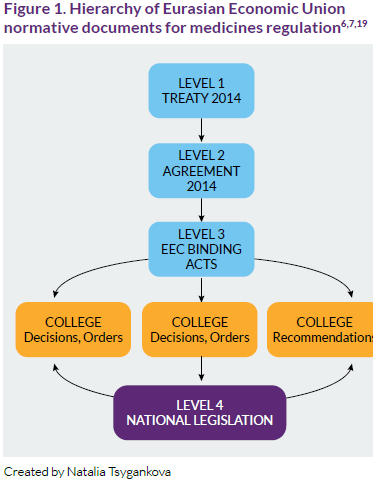
The regulatory framework of the EAEU for the circulation of medicines is structured according to a multilevel hierarchy, as illustrated in Figure 1.
The EAEU treaty of 2014 carries the highest level of authority.⁶ The EAEU’s agreement on common principles and rules for drug regulation has the second-highest level of authority.⁷ The EEC binding acts carry the next highest weight, and include:
- EAEU Decision No. 78, the core EAEU regulation establishing the procedures and requirements for marketing authorization;³
- Rules of good clinical practice,⁸ good laboratory practice,⁹ conduct of bioequivalence studies,¹⁰ good pharmacovigilance practice;¹¹ requirements for labeling¹² and for the summary of product characteristics and package leaflet;¹³
- College of the Eurasian Economic Commission decisions and orders, which detail requirements for the electronic dossier,¹⁴ stability testing,¹⁵ the classifier of dosage forms,¹⁶ and the guidelines on validation of analytical methods;17 and
- College of the Eurasian Economic Commission recommendations about unified approaches, such as those relating to pharmaceutical development.¹⁸
Finally, the national legislation of each member states applies, to the extent that they do not contradict the union's law.¹⁹
Regulatory documents are regularly updated, so applicants should verify the current versions on the official EAEU legal portal when preparing a dossier.²⁰
Marketing authorization procedures
The EAEU rules for marketing authorization establish two main procedures for bringing new medicines to the EAEU market: the mutual recognition procedure and the decentralized procedure.³ The applicant has the autonomy to select the reference state and, where necessary, the concerned states. The reference state is the lead country that conducts the primary scientific evaluation of the dossier, and the concerned states are other EAEU countries in which the applicant seeks approval. The application and dossier are submitted electronically with an electronic signature.
Mutual recognition procedure
The mutual recognition procedure involves sequential dossier submission: first to the reference state, and then to the concerned states. Marketing authorization in the reference state is granted within 140 working days. If additional materials are requested, the applicant has up to 90 working days to respond, with a possible extension (the total response period must not exceed 180 working days).³ In the concerned states, provided there are no disagreements, marketing authorization is granted no later than 60 working days from the date of access to the expert report. In practice, the mutual recognition procedure is the more commonly used procedure, and the reference state is typically Russia (Figure 2).

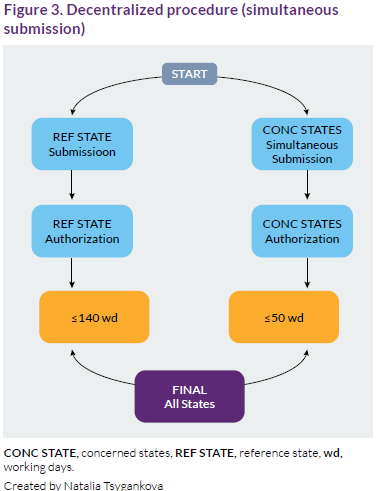
Decentralized procedure
The decentralized procedure involves the simultaneous submission of the dossier to all states selected by the applicant. The total procedure duration in the reference state does not exceed 140 working days, and in the concerned states, 50 working days.³ This procedure is used less frequently, primarily when a simultaneous product launch in several countries is required (Figure 3).
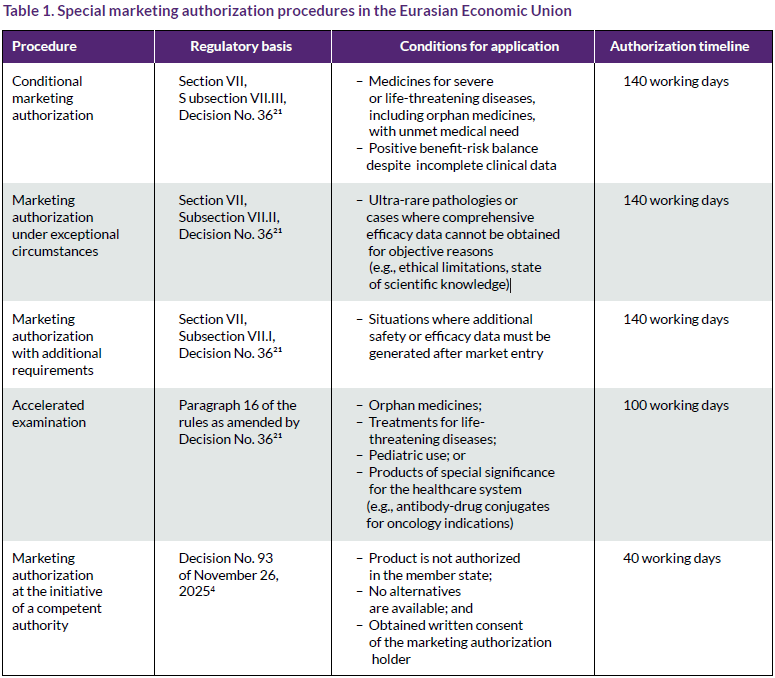
Section VII of the EAEU rules for marketing authorization provides for special procedures for orphan medicinal products, medicines for the treatment of life-threatening diseases, and other cases where the full set of data cannot be submitted at the time of application.³,²¹ A summary of each procedure is presented in Table 1. The validity of the marketing authorization for each procedure is valid for five years, though the validity of the marketing authorization for products under exceptional circumstances is subject to revocation.
Pre-registration strategy
Type and characteristics of the medicine
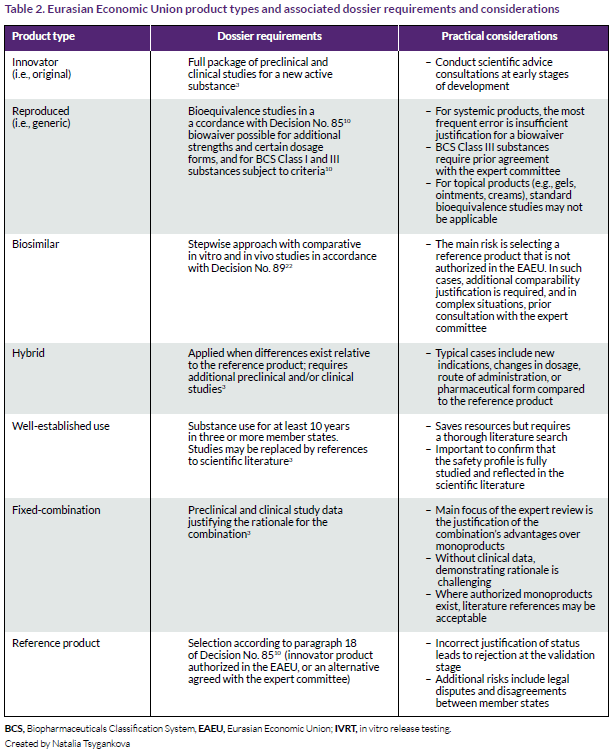
The type of medicine indicated in the marketing authorization application determines the composition and scope of the registration dossier, as well as the required studies. Selecting the appropriate product type directly affects the timeline for bringing the product to market and the likelihood of a successful expert examination. These requirements are detailed in Appendix No. 1 in the EAEU regulation establishing the procedures and requirements for marketing authorization.³
For reproduced medicines (i.e., generics), which are the most common application type, it is critically important to correctly identify the reference product and to do so consistently across all modules of the dossier. In practice, there are cases where applicants indicate different reference products across modules, which contradicts the requirements and leads to regulator inquiries.
For example, the author observed that during one expert examination, the applicant specified one reference product in Module 5 and another in Module 2. The expert committee subsequently designated the correct reference product, requiring substantial revision of a significant portion of the dossier and re-justification of the reproduced product status.
Table 2 describes the EAEU product types, dossier requirements, and practical considerations for applicants. Reproduced medicines, also known as generic medicines, are the most common application type. A stepwise approach is applied to reproduced medicines, aligning with the US Food and Drug Administration and European Medicines Agency. This stepwise approach, based on similarity in qualitative composition, quantitative composition, and microstructure, is supported by in vitro release testing (IVRT) and followed by assessment of therapeutic equivalence. IVRT data generated for other jurisdictions are generally acceptable.
Hybrid products typically receive more inquiries than average because they are a relatively new product type under EAEU rules, and the need for additional data often leads to more regulatory questions.
Recognition of international studies
Paragraph 36 of the EAEU regulation establishing the procedures and requirements for marketing authorization establishes the criteria for recognition of clinical studies conducted outside the EAEU.³
Studies completed before 2016 are recognized if they were conducted in International Council for Harmonisation (ICH) member states prior to 1 January 2016, and if the product based on these studies is authorized in ICH countries.³ Studies initiated after 2016 are recognized, subject to the condition that at least one clinical study is conducted fully or partially in the EAEU territory, and that all studies (including those conducted outside the EAEU) are performed in accordance with ICH good clinical practice standards, which are harmonized with EAEU law.³
In practical terms, for products under development, it is necessary to plan for the inclusion of EAEU research sites within the clinical development program.
Orphan medicinal products
In the marketing authorization application, orphan status is indicated as a separate item, regardless of the product type. For products intended for the treatment of rare diseases, the EAEU rules provide for special provisions.³ In accordance with Section VII of the rules (as amended by Decision No. 36), orphan medicinal products may be eligible for conditional marketing authorization, marketing authorization under exceptional circumstances, and accelerated examination.3,21 A key limitation applies where an orphan indication is included in the list of rare diseases of only one member state; in such cases, the product is authorized exclusively for circulation in the market of that state.3
Trade name
When selecting a trade name, the requirements of the EAEU’s guideline on the selection of trade names for medicinal products must be considered.25 The proposed name must not be confusingly similar to an already authorized product, particularly a product with a different composition and action. Failure to comply may result in the refusal of marketing authorization, or a requirement to change the name during expert examination.
A practical example observed by the author in 2025 involved an application that required changing the trade name due to visual and phonetic similarity with an authorized product of a different composition, which posed a risk of prescribing errors. Changing the name during the expert examination required revising a significant portion of the dossier (including Module 1, package mock-ups, the summary of product characteristics, and the package leaflet), adding several months to the authorization timeline.
Selection of the reference state
The applicant independently selects the reference state.3 Russia remains the largest market and is the most frequently chosen. Alongside Russia, applicants also select Belarus and Kazakhstan, particularly when focusing on local markets, due to their market commercial potential, regulatory capacity, and manufacturing site location.
Risk assessment and gap analysis
The outcome of marketing authorization is largely determined by decisions made prior to dossier submission. Gap analysis should therefore not be limited to checking dossier completeness but should also assess the compliance of each document with current EAEU requirements. Identifying gaps at this stage helps reduce regulator inquiries and can significantly shorten overall review timelines. Particular attention should be given to Module 3 (quality), which typically generates the highest number of regulatory comments. Typical dossier gaps are shown in Table 3.
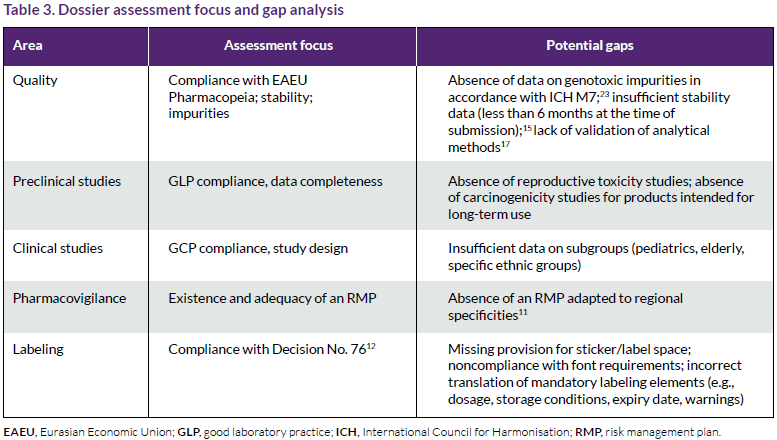
For example, during the registration of a reproduced product, the author observed that the applicant received a request for additional justification of the impurity profile and for validation of the analytical methods, even though the original dossier contained a standard set of data. Preparing the response took several months, which significantly increased the overall registration timeline. Systematic analysis of comments from completed registrations helps identify typical errors and adjust the approach to preparing new dossiers.
Scientific advice
Scientific advice is provided by the competent authorities of the member states, not at the level of the Eurasian Economic Commission, and is of a nonbinding, explanatory nature.10 Its conclusions may or may not be taken into account during subsequent expert examination of the registration dossier. Scientific advice should be regarded as a supportive, rather than a guaranteed, tool for mitigating regulatory risks. It is recommended to document any scientific advice received and include it in Module 1 of the registration dossier; however, there is no guarantee that it will be considered during expert examination.
Registration dossier preparation
The EAEU has adopted the common technical document (CTD) format, which corresponds to the ICH CTD structure. Modules 2-5 are harmonized with international requirements, while regional specifics are concentrated in Module 1.3 Since 2021, dossiers have been submitted exclusively in electronic format as eCTD (version 3.2.2, harmonized with ICH).14 The structure and specific EAEU requirements are outlined in Table 4.
Table 4. Structure and requirements of the Eurasian Economic Union registration dossier
Practical recommendations by module
The following section summarizes practical recommendations for each module of the registration dossier, based on regulatory requirements and observed best practices.
Module 1
If a manufacturing site inspection is scheduled during expert examination, the regulator may request the inspection results. The absence of a valid good manufacturing practice (GMP) certificate may suspend the procedure.
At the time of submission, it is sufficient to provide a GMP certificate from the country of manufacture and a package of documents in accordance with paragraph 30 of the rules of marketing authorization. Since 21 June 2025, amendments have entered into force that allow manufacturers to undergo inspection for compliance with EAEU GMP requirements within three years after product registration, rather than prior to dossier submission.26 Failure to comply with the three-year deadline may result in the revocation of the marketing authorization.
Changes to the package leaflet during the expert examination stage may require additional user testing if they affect the design or layout. The summary of product characteristics (SmPC) and package leaflet should follow the structure and content of the reference product's documents, as unjustified discrepancies in indications are a common reason for queries.
Module 2
In Module 2, translation quality is a critical factor, as errors in the summaries may lead to additional questions and delays in expert examination. Based on the author's experience, it is recommended to engage professional translators with regulatory expertise. Automated tools should not be solely relied upon alone, as they often fail to capture context, nuance, or the specific regulatory terminology of the EAEU.
Module 3
The most common reasons for Module 3 queries include noncompliance of specifications with EAEU Pharmacopeia requirements, incomplete method validation (especially the absence of a full description of chromatographic columns, such as manufacturer and catalog number), absence of data on genotoxic impurities in accordance with ICH guidelines on assessment and control of DNA reactive impurities,23 insufficient stability data (less than six months at the time of submission),15 and absence of photostability data. Ensuring these elements are adequately addressed will reduce the likelihood of regulatory queries.
Module 4
For Module 4, if a preclinical study was conducted outside the EAEU, the applicant should ensure that a GLP certificate recognized in the Union is available. Compliance with GLP standards is required to confirm the validity and acceptability of nonclinical study data for regulatory assessment.9
Module 5
For clinical studies after 2016, at least one study involving patients from the EAEU is mandatory.3 It is recommended that the inclusion of local study sites be planned at the protocol development stage.
- For bioequivalence studies, the reference product must be authorized in the EAEU (per paragraph 18 of Decision No. 85).10 If a different reference product is used, applicants should allocate budget and time for a bridging study.
- For biowaivers, the analysis should begin with verification of compliance with the criteria set out in Appendix No. 4 to Decision No. 85.10 For Biopharmaceutical Classification System Class III substances, applicants should allocate time for prior agreement with the expert committee.
- For biosimilars, the choice of a reference product authorized in the EAEU is a critical decision affecting the entire scope of the program. When planning studies, the requirements for immunogenicity data for the EAEU population must be considered. If the study is conducted globally, a justification for extrapolation should be provided.
- For topical products (e.g., gels, ointments, creams), standard bioequivalence studies measuring plasma concentration are often not applicable. It is recommended to incorporate a stepwise approach based on similarity in qualitative composition, quantitative composition, and microstructure, supported by IVRT, and followed by assessment of therapeutic equivalence (Appendices No. 11–13 to Decision No. 85).10 IVRT data obtained for the European Medicines Agency using validated methods are generally accepted.
Overall, early alignment of study design with EAEU regulatory expectations is essential to reduce the risk of additional requirements during expert examination.
General recommendations
The following recommendations complement the module-specific considerations outlined above and highlight additional cross-cutting procedural and technical requirements applicable to EAEU registration dossiers.
For foreign applicants, the appointment of an authorized representative within the EAEU territory is mandatory.3 The authorized representative must be registered in the same state where the application is submitted and must have documented authority to act on behalf of the applicant. Their responsibilities include submitting documents, interacting with regulatory authorities during expert examination, and obtaining the marketing authorization. When selecting a representative, it is recommended to consider their experience with product registration in that state, knowledge of local documentation requirements, and technical readiness to work with the eCTD system.
The pharmacovigilance system master file is submitted with the first product, while for other dossiers, a brief description of the system is sufficient.11,14 In addition, strict adherence to the eCTD submission chronology is required. The sequential order of dossier versions throughout the product lifecycle must be maintained. Failure will result in validation errors in the XML dossier and, as a result, make it impossible to submit to the regulatory authority.
Postmarketing obligations
Renewal of the marketing authorization
For initially authorized products, the marketing authorization is issued for five years.3 An application for renewal must be submitted no earlier than 140 working days before the expiry date of the authorization in the reference state, but no later than the expiry date itself.3 Upon successful renewal, an unlimited validity marketing authorization is issued.3 For products authorized under special procedures, the five-year cycle is maintained with the possibility of re-issuance.
Simultaneous variation submission with renewal
Paragraph 144 of the EAEU rules on marketing authorization allows the combination of renewal and variation procedures in a single application, provided that the variations are classified as type IA, IAIN, or IB in accordance with Appendix V to Annex No. 19.3 In the EAEU variation system, type IA and IAIN correspond to minor changes that can usually be implemented with postimplementation notification, while type IB variations are minor changes necessitating notification and regulatory acknowledgment prior to implementation.
This combined approach is particularly relevant where commitments from a previous assessment include minor variations (types IA, IAIN, or IB). The classification of variations is therefore critical, as it determines whether they can be carried out within the renewal procedure or will require a separate application.
The classification of variations is critical, as it determines whether a variation can be included in the renewal application or will require a separate procedure. Reference to Appendix V is therefore essential for correct procedural planning. An important distinction is that if variations affect product quality and are classified as type II (i.e., a major change variation), they will require a separate submission. However, parallel processing of renewal and type II variations is permitted, but requires special attention to document version control to avoid conflicts between the submitted versions.
Prior to the submission of a renewal application, it is recommended that applicants:
- Verify the validity of all licenses and GMP certificates of manufacturing sites (otherwise, the expert examination may fail even with formal compliance);
- Confirm the existence and correctness of periodic safety update reports;
- Ensure compliance of the SmPC and package leaflet with current requirements (taking into account the latest amendments to Decision No. 88); and
- If there are commitments from expert authorities, check whether they relate to variations of types IA, IAIN, or IB in order to include them in the renewal application (paragraph 144 of the EAEU rules).3
When applied correctly, this combined procedure reduces administrative burden and speeds up marketing authorization maintenance across the EAEU.
Variations to the registration dossier
Throughout the product lifecycle, the marketing authorization holder may introduce variations to the registration dossier. The classification of variations (types IA, IB, II) and associated submission procedures are established by Section VIII of the EAEU rules.3 Detailed lists of variations are provided in Appendix V.3
The following is a list of other key considerations regarding variations to the registration dossier:
- When multiple variations are submitted in a single application, the review timeline is determined by the most complex variation.3
- A significant simplification introduced by Decision No. 34 is the possibility to initiate variations to the registration dossier both before and during the mutual recognition procedure in the member states.26 Previously, such actions required a separate procedure and significantly delayed product entry into the markets of the concerned states.
- Since December 2025, minor technical corrections, such as the correction of typographical errors, may be permitted provided they do not affect product quality, safety, or efficacy. Such corrections must be justified in the cover letter.3
- With regard to pharmacovigilance documentation, the pharmacovigilance system master file is submitted with the first product of the marketing authorization holder and is subsequently maintained within that dossier as a type IB variation. For other dossiers, a brief description of the pharmacovigilance system is sufficient, and changes to this system are submitted as type IAIN variations.11
- Although the applicant determines the type of variation, the regulator may reclassify it. In the case of uncertainty, scientific advice is recommended.
For example, the author observed an applicant who included several amendments in a variation application, considering them to be technical amendments, but did not explain their nature in the cover letter, and did not confirm that they did not affect product quality. The regulator regarded them as unsubmitted variations and rejected the application.
Pharmacovigilance
Requirements for the pharmacovigilance system are established by Decision No. 87.11 The following obligations are imposed on the marketing authorization holder:
- Ensure the functioning of the safety monitoring system;
- Designate a qualified person for pharmacovigilance;
- Develop and maintain a risk management plan and periodic safety update reports at a frequency established by the regulator; and
- Interact with national pharmacovigilance centers.
The risk management plan must contain EAEU-specific risk minimization measures. For high-risk products, it is advisable to consult the regulator on the draft plan prior to dossier submission.
For example, in one observed case, the applicant submitted a risk management plan that did not describe routine risk minimization measures in detail, particularly how risks were reflected in labeling and the SmPC. As a result, the regulator requested revisions, which added two months to the expert examination timeline.
Conclusion
The transition to unified EAEU registration rules, completed on 31 December 2025, has formed a new regulatory environment for pharmaceutical manufacturers.3,4 In 2026, the primary focus of regulatory work is on the registration of new products and the lifecycle management of already authorized medicines.
Experience from regulatory practice confirms that registration success is largely determined at early development stages. The choice of product type, reference state, and timely gap analysis directly impacts time-to-market. Studies conducted outside the union are recognized, subject to compliance with EAEU requirements.10 The largest number of regulatory queries continues to relate to Module 3, particularly concerning data on impurities, stability, and method validation.15,17,23 Overall, the EAEU registration system is predictable with proper preparation, as reflected by the more than 11,500 marketing authorizations currently in the unified register.1,2
Looking ahead to 2026-2028, further digitalization of document flow is expected, in line with the approved EAEU development roadmap to 2030, which includes measures for digital transformation in technical regulation and product labeling.26 Continued harmonization with international standards, including implementation of ICH guidelines, is also anticipated. In parallel, attention to pharmacovigilance and oversight of postmarketing obligations will increase, as evidenced by ongoing training programs for regulators.27
AbbreviationsAPI, active pharmaceutical ingredient; BCS, Biopharmaceutics Classification System; CEP, certificate of suitability to the European Pharmacopoeia; CTD, common technical document; EAEU, Eurasian Economic Union; GCP, good clinical practice; GLP, good laboratory practice; GMP, good manufacturing practice; ICH, International Council for Harmonisation; INN, international nonproprietary name; MA, marketing authorization; MAH, marketing authorization holder; PL, package leaflet; RMP, risk management plan; SmPC, summary of product characteristics.
About the authorNatalia Tsygankova, MS (Pharm), is cofounder and deputy CEO of ConPharm LLC, and director of regulatory affairs. She has over 20 years of experience in regulatory affairs, specializing in medicinal product registration in the EAEU. She has managed regulatory strategy and product registration under EAEU rules, including preparation for the transition period and postmarketing lifecycle management. Tsygankova earned her master’s degree in pharmacy from Kazan State Medical University in Russia. She is a RAPS member and can be reached at [email protected]
Conflict of interest The author declares no conflict of interest. The company where the author works, ConPharm LLC, provides consulting services for medicinal product registration.
Citation Tsygankova N. The EAEU regulatory pathway: A practical guide for global applicants. RAPS Journal of Regulatory Affairs. 2026;1(3):14-25. Published online 4 May 2026. https://www.raps.org/resource/the-eaeu-regulatory-pathway-a-practical-guide-for-global-applicants.html
ReferencesAll references were last checked and verified on 21 April 2026.
- Eurasian Economic Union. About the union. Not dated. Accessed 5 March 2026. https://www.eaeunion.org/?lang=en
- Eurasian Economic Commission. Concept for developing a common market of medicines within the Eurasian Economic Union. Approved 15 August 2025. Accessed 6 March 2026. https://eec.eaeunion.org/en/news/prinyata-kontseptsiya-razvitiya-obshchego-rynka-lekarstvennykh-sredstv-v-ramkakh-eaes/
- Eurasian Economic Commission. On the rules of marketing authorization and assessment of medicinal products for human use. Published 3 November 2016. Accessed 5 March 2026. https://docs.eaeunion.org/upload/iblock/8d8/bl3sxd9cwdrdr1f16277rtb80ahbi7i4/cncd_21112016_doc.pdf
- [In Russian] Eurasian Economic Commission. [On amendments to the rules for the registration and examination of medicines for medical use]. Published 26 November 2025. Accessed 20 April 2026. https://www.alta.ru/tamdoc/25sr0093/
- Scientific Centre for Expert Evaluation of Medicinal Products of the Ministry of Health of the Russian Federation. About the center. Not dated. Accessed 5 March 2026. https://www.regmed.ru/about/centre/
- Eurasian Economic Union. Treaty on the Eurasian Economic Union. Adopted 29 May 2014. Accessed 5 March 2026. https://docs.eaeunion.org/upload/iblock/3b2/0aq0urjrfygepanpcxgllxg9x68ce6bd/itia_05062014_doc.pdf
- Eurasian Economic Union. Agreement on common principles and rules for the circulation of medicines within the Eurasian Economic Union. Adopted 23 December 2014. Accessed 5 March 2026. https://docs.eaeunion.org/upload/iblock/378/hq2zq9oemikhx26fzr95d5qt0ihuy09s/itia_24122014_doc.pdf
- Eurasian Economic Commission. On approval of the rules of good clinical practice of the Eurasian Economic Union. Published 3 November 2016. Accessed 5 March 2026. https://docs.eaeunion.org/upload/iblock/82c/ga8jy0u7x972gwyjgldrlz7vwgjj705d/cncd_21112016_doc.pdf
- [In Russian] Eurasian Economic Commission. [On approval of the rules of good laboratory practice of the Eurasian Economic Union]. Published 3 November 2016. Accessed 20 April 2026. https://docs.eaeunion.org/en/documents/306/2588/
- [In Russian] Eurasian Economic Commission. [On approval of the rules for conducting bioequivalence studies of medicinal products within the Eurasian Economic Union]. Published 3 November 2016. Accessed 5 March 2026. https://docs.eaeunion.org/en/documents/306/2592/
- Eurasian Economic Commission. On approval of the rules of good pharmacovigilance practice of the Eurasian Economic Union. Published 3 November 2016. Accessed 5 March 2026. https://docs.eaeunion.org/en/documents/306/2594/
- Eurasian Economic Commission. On approval of the requirements for labeling of medicines for medical use and veterinary medicinal products. Published 3 November 2016. Accessed 20 April 2026. https://docs.eaeunion.org/upload/iblock/fcf/ujdswa5vjb0xmi72qv4mk51ivbvyesop/cncd_21112016_doc.pdf
- Eurasian Economic Commission. On the adoption of the requirements for the medication guide and summary of product characteristics of medicinal products for human use. Published 3 November 2016. Accessed 5 March 2026. https://docs.eaeunion.org/upload/iblock/eab/9y5hi22ky0kltf2tyzf6oznhb5z6335i/cncd_21112016_doc.pdf
- [In Russian] Eurasian Economic Commission. [On requirements for the electronic form of the registration dossier]. Published 30 June 2017. Accessed 20 April 2026. https://eec.eaeunion.org/upload/medialibrary/2e7/Reshenie-Kollegii-_-79-ot-30-iyunya-2017-g.pdf
- [In Russian] Eurasian Economic Commission. [On approval of the requirements for stability studies of medicinal products and pharmaceutical substances]. Published 5 October 2018. Accessed 5 March 2026. https://docs.eaeunion.org/documents/253/3632/
- [In Russian] Eurasian Economic Commission. [On the classifier of dosage forms]. Published 22 December 2015. Accessed 5 March 2026. https://docs.eaeunion.org/documents/292/2060/
- Eurasian Economic Commission. On approval of the guidelines for validation of analytical methods for medicinal products testing. Published 17 July 2018. Accessed 5 March 2026. https://docs.eaeunion.org/upload/iblock/ec3/1ul2txud9ikwqdl8jt1i4zyv3nm5eb1m/clcd_20072018_113_doc.pdf
- Eurasian Economic Commission. On the guidelines for pharmaceutical development. Published 11 November 2025. Accessed 20 April 2026. https://eec.eaeunion.org/upload/files/deptexreg/LSMI/Guidelines%20on%20Pharmaceutical%20Development%20of%20Medicines.pdf?utm
- [In Russian] Federal Law of the Russian Federation. On circulation of medicines. Adopted 12 April 2010. Accessed 20 April 2026 https://www.unodc.org/cld/uploads/res/document/rus/federal-law-on-circulation-of-medicines_html/Russian_Federation_Federal_Law_On_Circulation_of_Medicines_61-FZ_EN.pdf
- Eurasian Economic Union. Legal portal [webpage]. Not dated. Accessed 5 March 2026. https://docs.eaeunion.org/
- [In Russian] Eurasian Economic Commission. [On amendments to the to the rules for registration and examination of medicines for medical use]. Published 18 March 2022. Accessed 5 March 2026. https://docs.eaeunion.org/documents/401/6507/
- [In Russian] Eurasian Economic Commission. [On approval of the rules for conducting research on biological medicinal products of the Eurasian Economic Union]. Published 21 November 2016. Accessed 20 April 2026. https://docs.eaeunion.org/documents/306/2596/
- [In Russian] Eurasian Economic Commission. [On approval of the requirements for conducting studies (tests) of medicinal products for the assessment and control of impurities content]. Published 7 October 2022. Accessed 5 March 2026. https://docs.eaeunion.org/documents/399/6967/
- [In Russian] Eurasian Economic Commission. [On the pharmacopoeia of the Eurasian Economic Union]. Published 13 August 2020. Accessed 5 March 2026. https://docs.eaeunion.org/documents/247/5266/
- [In Russian] Eurasian Economic Commission. [On the guidelines for the selection of trade names of medicinal products]. Published 30 January 2019. Accessed 6 March 2026. https://docs.eaeunion.org/documents/337/4180/
- [In Russian] Eurasian Economic Commission. [On amendments to the decision of the Council of the Eurasian Economic Commission No. 78 of November 3, 2016]. Adopted 22 May 2025. Accessed 7 March 2026. https://docs.eaeunion.org/documents/447/10009/
- [In Russian] Eurasian Economic Commission. [The transition period in the EAEU common medicines market is coming to an end: news release]. Published 21 November 2025. Accessed 8 March 2026. https://eec.eaeunion.org/news/zavershaetsya-perekhodnyy-period-na-obshchem-rynke-lekarstv-eaes-/