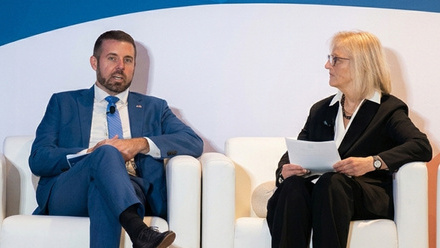
Convergence: Achieving representative enrollment in clinical trials
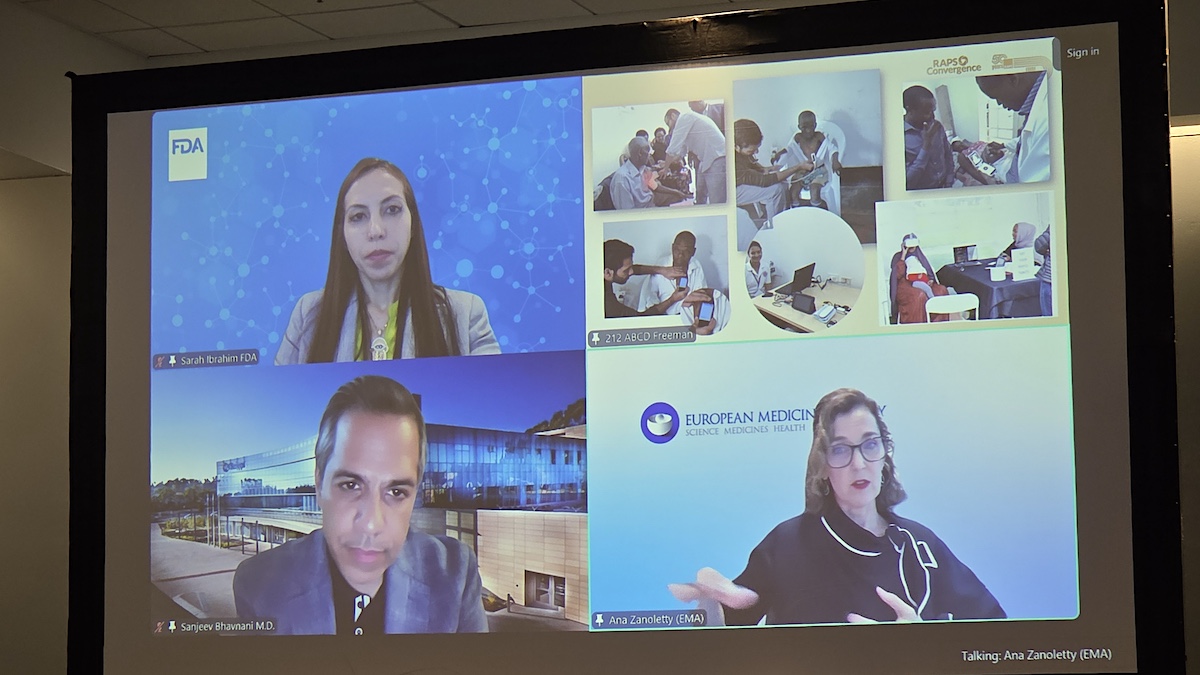
Sarah Ibrahim (top), Sanjeev Bhavnani, and Ana Zanoletty (Credit: Jeff Craven)
CHARLOTTE, NC — Officials from the US Food and Drug Administration (FDA), the European Medicines Agency (EMA), and industry representatives offered advice for considering and developing clinical trials that achieve representative enrollment of patient populations.
Junyang Wang, session moderator and director, global regulatory policy and science at EMD Serono, told attendees at RAPS Convergence 2026 that the field has moved towards generating evidence quality, and away from simple awareness of trial populations not reflecting patients who use products and planning programs such as diversity action plans (DAPS) to create greater accountability.
“I think that the synthesis here is that population reflective trials are not about changing the terminology, they’re really not about counting enrollment alone, but they're about designing global development programs that really understand the variability as well as generate evidence that, for patients, will actually be used in their therapies,” Wang said.
Assessing relevant patient data
Sarah Ibrahim, deputy center director for regulatory programs at FDA’s Center for Drug Evaluation and Research (CDER), said that data relevance for specific patient populations is not an abstract property of data sets, but a relevance for particular use. CDER considers how elements such as the patient studies, clinical settings, treatment context, endpoints and duration of observation are aligned with patient populations and use in an application, Ibrahim explained.
Other considerations by FDA are whether the application has identified important sources of variability and if the program developed has enough information for the agency to understand how it impacts benefit and risk. Sponsors should explain why a study that evaluates a product for a particular population informs the disease, biology, drug pharmacology, and what remaining certainties exist with the product. The trial design and analysis should address these uncertainties, she noted.
Ibrahim noted that FDA’s final guidance document on enhancing clinical trial participation states broader baseline characteristics may be a better indicator of whether a patient is likely to use an approved drug.
“The key point is that representativeness is not a box to check—it’s a part of the evidentiary argument,” she said. “The question is whether the totality of evidence—a term we always use—supports a reliable interpretation of safety and effectiveness for the patients who are likely to use that drug.”
Ana Zanoletty Perez, head of clinical trials transformation at the EMA, said EMA’s approach is “very complementary” to FDA’s in considering clinical evidence generation. In EMA’s vision for clinical evidence to 2030 document, clinical evidence generation centered around patients from the beginning.
“[W]hen we define the intended patient population, I think we need to start with the clinical question rather than thinking about recruitment, feasibility—that comes at a later stage,” she said.
This means considering which patients will be taking a medicine, what their characteristics are, and what factors could affect the benefit-risk profile and applicability of clinical evidence, Zanoletty said.
Clinical trials should also not be evaluated in isolation, Zanoletty explained. “We should be looking at all other evidence sources that we can, that we can collect in defining the research question,” she said.
“Our vision to 2030 for clinical evidence gives us permission to think beyond the single trial to look at the evidence sources that we have. The heterogeneity of the European population shouldn't define, but should influence, and we have to put the patient at the center,” she added.
Designing participation in clinical trials
Sean DeYoung, chief operating officer of the Community Liver Alliance, told attendees it is important to identify patients who might benefit from a product and the trusted organizations that will help you engage with that patient population as early as possible.
“Go find these people. There’s a cost to that that is often overlooked,” DeYoung said.
Madhumitha Rengasamy, regulatory program director at Genentech, said that conducting inclusive and representative clinical trials “is an imperative for clinical drug development.”
“A change in mindset is needed, is essential to make inclusive research a non-negotiable standard to be met,” Rengasamy said. “When we talk about embedding inclusive research strategies, this has to be end-to-end and start as early as the drug discovery and preclinical phase, where sponsors should ensure that data [are] collected.”
Fit-for-purpose innovative digital technologies
Zanoletty said that digital and decentralized data are not “inherently less reliable” than data from a trial site. However, the data do need to be fit-for-purpose for that endpoint.
EMA looks at how a technology measures what it is supposed to measure, risks associated with decentralization, who is collecting the data under what conditions, what occurs if there is poor connectivity, and how a sponsor identifies and mitigates risks, Zanoletty said.
Ibrahim emphasized that digital health technologies (DHTs) are not a different evidentiary standard.
“The same fundamental expectations still apply, whether it's participant application protection, protocol adherence, data integrity, and the results that can actually be interpreted reliably,” she said. “The regulatory question is whether the decentralized element is fit for purpose and whether its use changes, who could participate, and how the endpoint is measured, or the probability that the data will be missing or systematically different across groups.”
Ibrahim said sponsors should explain why DHTs are appropriate for a clinical measure, how it was verified and validated for intended use, how data capture and data transfer occur and if performance changes across patient populations as they use a product.
She noted that while some decentralized approaches could improve access to care and reduce travel burden, it might inadvertently create a new participation barrier if it requires a fast internet connection or requires a specific device.
“Sponsors should identify that risk prospectively and build alternatives into the protocol rather than discover the problem after enrollment begins,” she said.
Late engagement on design considerations
For sponsors it might be too late to change course if a problem is identified during enrollment because “many of the determinants of the study population are almost locked in,” Ibrahim said.
If elements such as the trial strategy, country, site, model, eligibility criteria, visit schedule, endpoint, and technology have already been selected, waiting until a final protocol review could be too late, she explained.
She encouraged early discussions with FDA on these points to avoid potential pitfalls.
“The purpose is not to obtain a regulatory guarantee—and I want us to steer away from that mindset—it’s to surface assumptions very early, especially where the sponsor proposes an innovative design, a decentralized element of an unusual data source, or a global enrollment strategy that may affect the applicability to US patients,” Ibrahim said.
Rengasamy said her company has built relationships with trial sites to aid in enrolling underrepresented patients in the US and has expanded this initiative to other countries like Africa. However, she said her company has seen a difference in how different FDA reviewer divisions respond—or don’t respond—to DAPs.
“Whereas the oncology and hematology reviewer divisions have been very encouraging and supportive of submission of diversity action plans prior to the federal mandate, we’ve seen non-oncology divisions inform us that they saw little utility in the review of DAPS, or did not provide comments on them,” Rengasamy said.
“From a sponsor perspective, it would be really helpful if we have consistent engagement across all review divisions, because then that would help us build a centralized process to implement those strategies,” she added.
Need for harmonization
Both Ibrahim and Zanoletty pointed to the ICH’s guideline E17 on planning and design of multi-regional clinical trials as a common framework for development of a global medicine or product.
“I think that from a regulator standpoint, we can substantially harmonize around the scientific foundations: the clinical question, the endpoints, the estimates, the principles for trial design, the quality and integrity of the data, the protection of participants, and the need to prospectively consider the factors that could affect the applicability of the results,” Zanoletty said.
Zanoletty added that there are “avenues for dialogue beyond formal scientific advice offerings,” and noted that EMA has the ability to contact FDA and “and raise the need for dialogue between the regulators.”
In specific regions, there are considerations for differing disease characteristics, background treatments, and standards of care. But the ICH E17 document can serve as a guidepost for sponsors here.
“It doesn't ask for every region to be identical, it asks sponsors to be prospectively thinking about those factors that will create the regional differences and incorporate them into the design … and consider them in the analysis,” she said.
Ibrahim said that FDA and EMA are in daily contact and noted that while parallel scientific advice is not a per se regulatory agreement, it is a place where FDA can identify blind spots that need to be addressed.
“I would echo and encourage that when designing a development program, you’re thinking of the end user or the patient, but always make sure that the regulatory framework fits for the agency you are seeking approval for,” Ibrahim said. “That needs to be very early in your drawing board.”
For FDA, that means the data should be applicable to patients and practices based in the US.
“The solution is not to retreat from global trials, it is to play in the regional contribution prospectively, enroll enough relevant patients where needed, and justify pooling and interpretation scientifically, rather than treating geography as an afterthought,” Ibrahim said. “It’s global efficiency with regional interoperability.”