Convergence: EU regulators offer tips for innovative product development
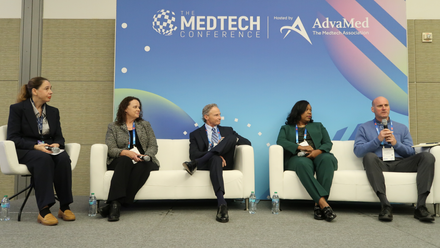
PITTSBURGH — European regulators provided a roadmap for efficiently developing innovative products and fielded questions about priority status, pricing and burdensome bureaucracy during a panel at RAPS Convergence 2025 on Wednesday.Presenters outlined a wide range of platforms and committees involved in assessing medical products and accelerating development when warranted by novelty and applicability to areas of unmet medical need.
Alberto Gañan Jimenez, PhD, head of committees and quality assurance at the European Medicines Agency (EMA), highlighted noteworthy programs, including the EU Innovation Network (EU-IN), EMA Innovation Task Force (ITF), the Priority Medicines (PRIME) scheme, and the EU expert panels on medical devices and in vitro diagnostics.
“We hope that we will be able to, in the future, broaden the support that the agency is providing to the sector,” Gañan said.
Gañan noted that the European Commission is working on a framework for breakthrough medical devices and IVDs that are novel and have a significant impact on treating a life-threatening or irreversibly debilitating disease, in areas of high unmet need. This may be piloted as early as by the end of 2025, he added. Furthermore, the agency is looking to provide more support for developers of combination products – medicines with companion diagnostics and medicines with medical devices – a challenging area of regulatory approvals, Gañan said.
Presenter Andrea Laslop, MD, former head of the Scientific Office at the Austrian Medicines and Medical Devices Agency, explained the functions of the EMA’s Committee for Advanced Therapies (CAT), which assesses advanced therapy medicinal products (ATMPs), provides health technology assessment (HTA) advice in in parallel with the US Food and Drug Administration (FDA), and fields eligibility questions for the PRIME program.
Laslop was asked by an attendee to explain how the EMA defines an advantage over an existing treatment when considering PRIME eligibility requests. Laslop explained that there are different entry criteria. Small and medium enterprises (SMEs) and academics need to show early proof of principle and later on a proof-of-concept path is open to all developers.
“In principle, what we are requesting for a very early entry stage is an extremely convincing pathological mechanism of action of the drug in order to expect the desired effect to really be possible,” Laslop said.
Having some good tolerability data is also very helpful, Laslop added.
Session speaker and moderator Sabine Haubenreisser, PhD, principal scientific administrator in EMA communications, noted that attendees can also take advantage of a pre-submission meeting for the PRIME program for priority medicines.
“If you're in doubt about eligibility and you want to get a bit of guidance, you can contact our colleagues and get some reassurance,” Haubenreisser said. “And if they have other questions, they will also guide you to give you all the chances to be successful in the application.”
Attendees also queried low use of the program for parallel scientific advice from the EMA and FDA. Laslop had noted during her presentation that benefits of parallel advice from the two agencies include the ability to optimize product development, share information and increase convergence – yet this process has been underused, with only 15 requests between 2021 to 2024.
“We are wondering too about this really low pickup of that procedure, because, as I indicated, I would think it is very useful – very beneficial – for an applicant,” Laslop said.
Possible reasons for the reluctance include concern about prolonging the approval process and fear that giving information to two difference agencies might end in increased requirements. But the agencies are exchanging information regardless of whether a parallel consultation is requested.
“The benefit of the parallel consultation would be that you are then also on the table. So, then it's not only the two agencies discussing amongst each other, but you could contribute,” Laslop said. “You could bring your justifications … your arguments – you could change the mind of the regulator possibly with your good reasoning. So, I could only recommend to you to use that.”
“We know each other well. We work together well. And to actually be part of the exchange of scientific opinions, questions and considerations, is really insightful for industry,” added panelist Corinne de Vries, PhD, EMA liaison official to FDA.
The European panel was also asked to address burdensome bureaucracy that presents hurdles for smaller companies and developers of expensive cell and gene therapies. One noted that his company was daunted by the clinical trial requirements and an ultimate expected price tag only 1/3 of the US.
“When we have limited resources, does it make sense to go to Europe, or does it make sense for us to optimize our product for the US to fund our clinical development pipeline?” the attendee asked. “And right now, we're just not seeing the payoff of even going here [Europe]. That's probably what our decision is going to be, and it's unfortunate.”
Laslop responded that the 27 different member countries of the EU have very different budgets.
“I would expect that there are countries who can afford more than others. So, in the end, it would not be necessary that you put the product on the market in all of those individual member states, although I must say that would be in our interest – and our goal – in order to achieve equitable access [across] all the European populations,” Laslop said.
Other presenters pointed out that there is an SME designation for micro, small and medium size enterprises, which offers fee incentives, regulatory assistance and tailored support. And orphan drug status could be helpful for cell and gene therapy developers as well.
“We will definitely take some of your feedback back home and see what we can do better,” Haubenreisser said as the session closed.