eCTD v4.0 analysis based on first experiences in the US and Japan
Keywords – eCTD v4.0, ICH regulatory submissions, interoperability, forward compatibility, pilots
Introduction
The pharmaceutical industry is currently facing uncertainties and challenges in planning and preparing for the transition of eCTD v3.2.2 to 4.0, both from a regional and global perspective. The industry relies heavily on eCTD vendors and their technical understanding of available ICH guidance and regional guidelines. In some cases, the implementation guidelines are interpreted differently by regulators, vendors, and the pharmaceutical industry.To address this gap, the ICH’s M8 Implementation Working Group (IWG) is developing a vendor engagement plan and has reconvened a standing vendor group. (The ICH M81 document provides specifications for submission formats for eCTD.) The IWG’s objective is to establish an ongoing forum to raise eCTD v4.0 implementation questions, including specification details, implementation status across regions, and new requirements. It also provides training materials and promotes awareness and understanding of the current availability and interoperability of eCTD v4.0 tools (e.g., publishing, validation, and viewing tools). Participation in the forum is limited to eCTD vendors and members of the ICH M8 IWG, which includes trade association representatives and regulators. In addition, regulating agencies, including the PMDA, have set up Q&A sessions to resolve guidance questions. Some regions (e.g., the US, EU, Canada, Japan, Brazil, and Australia) are also preparing to publish regional regulatory guidance documents.
Given that the ICH has endorsed the eCTD as the exchange standard for submissions, eCTD v4.0 will serve as the foundation for future developments and enhancements of submission delivery and data exchange. For example, updates to the ICH M4Q (R2) quality guideline,2 which provides a harmonized structure for presenting chemistry, manufacturing and controls (CMC) information in a drug application dossier, will ultimately define the subsequent transition toward data-centric approaches with a combination of documents and files with applicable formats, including datasets, PDF documents, and videos. The forthcoming structured product quality submission will be dependent on M4Q R2. It will standardize and digitize the way companies submit quality-related data, including manufacturing, stability, and control information, to agencies. The M4Q (R2) guideline, currently under public consultation, establishes the location and structure of quality information for registration applications of medicinal products for human use. The guideline applies to both initial marketing authorization and postapproval submissions.
This article is written from a business perspective; no regulatory authorities or vendors have been engaged. The authors conclude that concerns about eCTD v4.0 may stem from differences in how vendors and regulators interpret and implement global and regional implementation guidelines. It is expected that experience and knowledge gained will assuage these initial concerns. Therefore, this article presents a single point-in-time analysis. The challenges and issues described here may be resolved as more is learned during the upcoming technical pilots in other regions and from voluntary FDA use of version 4.0. Due to the limited experience with implementing eCTD v4.0 thus far, dialogue between regulators, industry, and vendors is necessary.
Background
In November 2010, the ICH steering committee endorsed the establishment of the ICH M8 Expert Working Group (EWG), which was tasked with drafting and delivering a technical standard and implementation guide for eCTD v4.0. The group is composed of regulatory and industry experts from ICH members. (In general, ICH EWGs develop new guidelines or revise existing ones.) eCTD v4.0 is an electronic-document‒driven submission approach that enables the exchange of modern data standards and message formats. It is based on the Health Level Seven (HL7) version 3 data exchange standard for regulatory product submission to regulatory authorities. HL7 v3 no longer supports regulatory product submissions and has been superseded by the Fast Healthcare Interoperability Resources standard. However, in 2019, a joint ICH M2/M8 EWG analyzed the impact of the limited HL7 support for the RPS and concluded it was acceptable and manageable. (The M2 EWG was established in 1994 to evaluate electronic standards for the transfer of regulatory information for pharmaceutical companies and regulatory authorities.3)The ICH M8 Implementation Working Group agreed to defer all CTD changes to the eCTD v4.0 implementation. Therefore, all future requirements, such as revision of the CTD quality sections in Modules 2 and 3 currently being developed by the ICH M4Q (R2) EWG, will be incorporated into eCTD v4.0 only, and not into version 3.2.2. The ICH M8 IWG has requested that the ICH management committee elevate the M8 guidelines (i.e., the eCTD v4.0 implementation package) to Tier 2, which is not considered foundational but is important as a next step to harmonization and more specialized or technical in nature. If the ICH assembly endorses this request, the guidelines will be implemented by ICH members with urgency per the ICH context of prioritization. The context of prioritization refers to the framework the ICH uses to evaluate, select, and prioritize new guideline proposals. It ensures that resources are focused on initiatives that deliver the greatest global regulatory and public health impact.
The joint ICH M2/M8 EWG is working on a plan to support the incremental transition to a more data-centric approach, for example, securing a standardized technology platform for exchanging regulatory information between pharmaceutical and medical device company sponsors and regulators (as proposed by the ICH Pharmaceutical Quality Knowledge Management Task Force). In addition, a new ICH Structured Product Quality Submissions Working Group will be formed after the step two sign-off on the revised draft ICH M4Q (R2) guidelines in 2025 to standardize and structure product quality data.
As an example of the need for global harmonization of eCTD v4.0 guidelines, the Swiss draft implementation package has an additional envelope element called submission reference value, which is in neither the global ICH guidelines nor the regional guidelines provided by the US, EU, or Japan. Health authorities, including the European Medicines Agency (EMA), must be advised on region-specific topics. It is not clear if the region-specific implementation topics – usually administrative information in the regional Module 1, but also including region-specific controlled vocabularies, established lists of standardized terminology used in indexing and retrieving information, and validation criteria – will affect efforts toward global harmonization of submission packages.
The eCTD v4.0 technical pilots
Technical pilots are tests for assessing whether the implementation of a new or updated product – in this case, eCTD v4.0 – will align with the technical specification. Participant feedback on these sample submissions allows for changes to be made before eCTD v4.0 submissions are accepted into the production environment.4 The PMDA pilots took place from May to July 2021, and the FDA’s from June 2022 to April 2023. The pilots took place when the availability and readiness of vendor tools to publish, view, and review eCTD v4.0 messages were quite limited. Participant feedback from these pilots forms the basis of this article.The EU technical pilot began in the fourth quarter of 2024. The EU implementation team is currently defining the scope of the EU pilots in terms of test cases, test environment, duration, and eCTD v4.0 functionalities to be tested. The start dates for other pilots are:4
- Health Canada, 2025
- Swissmedic, 2026
- Australia’s Therapeutic Goods Administration, 2025
- Brazil’s ANVISA, 2025
Regional implementation guides and validation criteria are currently being revised. Each region has different requirements for M1 and M2 of the eCTD, and these must be factored in.
eCTD v4.0 benefits5
Although eCTD v4.0 has challenges, it also has unique benefits, which include:- More flexibility for implementing CTD changes. CTD and regional structure updates will be based on controlled vocabularies, resulting in fewer system updates. By contrast, eCTD 3.2.2 is hardcoded and requires document type definition file updates for changes in the CTD, causing version management challenges and significant time in updating the document type definition files.
- Introduction of a harmonized submission unit, comprising a single XML backbone combining regional and index.xml files. These were separate in eCTD v3.2.2. (An XML backbone is a file in extensible markup language providing submission metadata.)
- Enhanced control of dossier, which would include numerous new or improved elements:
- Use of universally unique identifiers (UUID) for each element to avoid file duplication;
- Greater ability to reuse documents previously submitted across applications (by referencing the UUID) independently of how submissions are stored at the agency;
- Modification and correction of metadata (i.e., keywords/attributes) so that changes (e.g., drug substance/product names, manufacturers, dosage forms, indication, excipient, group title) can be applied without resubmitting the physical files or the context of use element; and
- Explicit definition for document display order within a section (e.g., priority numbers).
- Enhanced document lifecycle functionality, including:
- The context-of-use concept allows for advanced lifecycle management operations;
- The granularity of documents can be changed while maintaining lifecycle relationship (e.g., replacing one document with many, many documents with one, or many documents with many);
- The context of use and keyword combination will create a group of documents, and these group titles can be used for combining multiple documents (this replaces node extensions and study tagging files);
- Lifecycle operators have been changed to active, replace, and suspend (previously new, replace, delete) – the append operator has been omitted from eCTD v4.0; and
- Study ordering explicitly defines the display order for studies within a dossier.
eCTD v4.0 risks and challenges
While all ICH M8 parties, including the FDA, European Commission, PMDA, Health Canada, and Swissmedic,6 advocate for eCTD v4.0, this is not without inherent challenges and risks, especially around implementation.Overlapping milestones
Implementation of the new version will begin with voluntary use and, after a transition period that will vary by region, the regulatory bodies will mandate submissions in eCTD v4.0 format. So far, only the PMDA has started to accept voluntarily eCTD v4.0 messages. It will mandate submissions in eCTD v4.0 format in April of 2026. Although implementation timelines vary across regions, the voluntary and mandatory milestones for implementation are planned to overlap across regions.4 The FDA will soon announce the start date for voluntary use of the eCTD v.4.0, with a transition period until 2029. This phrased approach would help regulators and industry gain experience and build knowledge while offsetting the challenges presented by divergent regional timelines.
Divergent regional timelines
Regional implementation timelines have been delayed several times during the past year, meaning that one regulatory agency risks mandating submissions in eCTD v4.0 format while others have not yet started voluntary use. This presents many challenges and the need for additional efforts by applicants process and manage version 3.2.2 and 4.0 formats in parallel. However, regional authorities will most likely implement eCTD v4.0 in a phased approach, meaning new applications will be accepted in the version 4.0 format, and the transition of existing applications from 3.2.2 to 4.0 will occur later during the transition phase. This phrased approach would help regulators and industry gain experience and build knowledge while offsetting the challenges presented by divergent regional timelines.
Implementation uncertainty
One of the major challenges for applicants beginning their preparation is the limited availability of eCTD v4.0-ready publishing tools. This gap also affects the opportunity to engage technical pilots.
Regulating agencies that are not members of the ICH M8 IWG have implemented eCTD v3.2.2 or plan to transition from paper or non-eCTD electronic submissions to eCTD format. Many do not have a roadmap for the transition to eCTD v4.0 or are undecided about whether to implement eCTD v4.0 directly or start with eCTD v3.2.2. They cite the stability of version 3.2.2 as an anchor to experience with electronic submissions. To mitigate the need to transition again to eCTD v4.0 later, the ICH M8 IWG recommends agencies go directly to eCTD v4.0 and not start with eCTD v3.2.2.4
Limited interoperability
Some of the advantages of eCTD v4.0, such as document reuse, require that applications reside in the same server environment. This will be a challenge for the FDA’s Center for Drug Evaluation and Research and Center for Biologics Evaluation and Research and for the EU regarding centrally versus nationally authorized products. Centrally authorized products in the EU are medicines that have received a single marketing authorization from the European Commission, making it valid across all EU member states. They use a single server environment unlike nationally authorized products where each member state does a separate review.
The limited interoperability between vendor solutions requires testing and evaluation between vendor publishing tools and the connected electronic document management system (EDMS) or regulatory information management (RIM) system at health authorities or within the industry. The 2025 EMA pilots are focused on interoperability between vendor tools for regulators and sponsors. Sponsors must conduct internal testing, particularly in the context of alliances, partnerships, and acquisitions, to ensure confidence in the solutions.
Lack of transition experience
The transition of existing applications from eCTD v3.2.2 to version 4.0 format is described as forward compatibility. The transfer process has not yet been tested in the technical pilots, so user experience with the process is currently very limited. Accordingly, applicants may choose to wait to transition their electronic dossiers until after the start of voluntary use. Similarly, applicants cannot provide feedback to the working group about grouped submissions, as the functionality has not been tested.
Strain of maintaining two versions
Companies must maintain two versions of the eCTD for a specific period to meet global requirements. They must therefore train staff from affected functional areas in both versions of the eCTD, which could create budget, training, and resource issues. The complexity of maintaining two versions could negatively impact document authors. For example, authors would need to manage differing levels of document granularity and leaf title strategy, which is flexible with version 3.2.2, but not 4.0. The cloning of submissions from one version to another also presents a challenge, even within version 4.0. The analysis section of this article will propose remediation strategies for specific challenges, including viewing tools and compatibility with the identification of medicinal products (IDMP) framework and other data standards.
Analysis based on industry experience
From an applicant’s perspective, readiness and preparation for implementing eCTD v4.0 are closely related to the regional implementation timelines and vendor readiness to provide eCTD v4.0 publishing, validation, and viewing tools. Each iteration or update of eCTD v4.0 guidelines creates work for health authorities, vendors, and the pharmaceutical industry. In addition, regions must test, train staff, educate authors and reviewers, maintain eCTD v3.2.2 and eCTD v4.0 tools and systems concurrently to support regional transition phases, and prepare global dossiers for different markets.For one participant in Japan, the initial preparation of eCTD v4.0 submissions took twice as long as those for eCTD v3.2.2. However, those timelines have been shortened with gaining knowledge and experience, and subsequent eCTD v4.0 submissions took the same time to prepare as the eCTD v3.2.2 submissions. In general, preparation times become shorter as vendors gain experience with the new version.
Impact on document writing
Functional regulatory writing must factor in the coexistence of eCTD v3.2.2 and eCTD v4.0 for global regions. The reduced granularity in folders necessitates unique and meaningful file naming to avoid the overwriting of documents and keep them organized in the output folders. Implications of a global dossier must be assessed relative to the different versions of eCTD that will coexist with them. Authors must write content to accommodate global submission needs when adding callouts or references to ensure minimal alteration in the document authoring when the dossier is submitted across different regions with variation in eCTD v4.0 implementation.Authors, depending on the organization, should be aware that content could be grouped in a CTD section using group title keywords. The applicant assigns the group title and priority number to specify how the content should appear together in a particular order. This process replaces the eCTD v3.2.2 regional use of node extensions or study tagging files. Although this eases the burden of formatting a complicated dossier, it can create additional work or the need to maintain separate structures to cater to the regions that only accept paper or eCTD v3.2.2 submissions.
It is suggested that the stricter approach be used to accommodate the variation in granularity and avoid rework. Vendors are encouraged to allow flexibility in choosing the granularity level in the published output. During the US pilot, the FDA confirmed that additional subfolders under the module folders are allowed. This flexibility may be useful for sponsors. Applicants should continue to follow the folder structure in the M4 and M5 guidelines cited in the FDA study data technical conformance guide.7
Document reuse
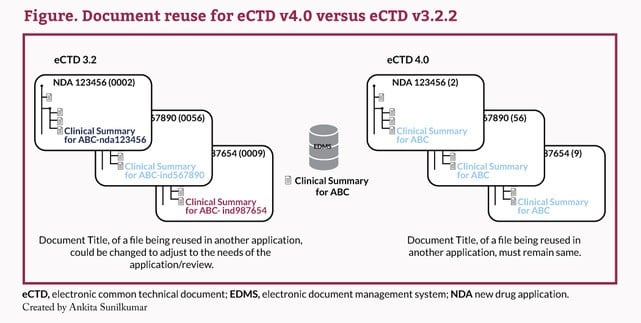
In eCTD v3.2.2, the same documents are submitted in different applications and sequences. In eCTD v4.0, documents are tracked using UUIDs. These are unique IDs for each document used by the health authority and sponsor to identify and reference a document globally. Based on the experience during the pilot, vendors chose different ways to implement these unique IDs for documents (e.g., the EDMS ID vs the eCTD UUID).
A submission ID or related sequence links submissions within a regulatory activity, such as an initial application (i.e., sequence 1) and subsequent responses (i.e., sequence 2 and beyond). In eCTD v3.2.2, these relationships were easy to identify. During the FDA eCTD v4.0 pilot, the agency used a tool that required a long alphanumeric code in the item root of the submission unit XML, meaning that the publisher had to find this code in both the original and response sequences and make sure they matched. With no way to automate the check of the lengthy codes, this manual process was prone to errors. Attention may be needed if these codes must be manually entered into each submission. Software vendors should address this issue in future releases to enable a seamless, automated way to quickly and easily cross-reference between sequences.
The cross-application reference in eCTD v4.0 is a very helpful functionality that eliminates the need to resubmit a file in another sequence or application. It allows the user to refer to a previously submitted document within the XML. eCTD v4.0 uses UUID to enable this cross-reference. This is critical for promotional compliance submissions in the US, where product labels must be provided with every submission.
This functionality could not be tested by the industry during US pilots of eCTD v4.0, and currently, vendor tools may have various approaches to implement this functionality. Since UUID is assigned after a submission is published, vendor tools need a mechanism to read data from the EDMS and identify if it is the same file and version prior to assigning the same UUID. If there is no direct integration between EDMS and the publishing tool, then EDMS file titles may be used by the publishing tool to identify file reuse scenarios. There may be conflicts between internal names of documents and specific terms in eCTD v4.0 that may not be revealed, as some companies keep internal naming of documents confidential. The accompanying Figure demonstrates that the document reuse concept in eCTD v4.0 does not allow alternate document titles related to specific content.
eCTD v4.0 metadata
The initial implementation of eCTD v4.0 contains metadata very similar to that in eCTD v3.2.2, which is based primarily on controlled vocabularies or free text (e.g., a tag or identifier, and not a link) and is not linked to other data sources such as IDMP. Further updates by the ICH and regulators may provide direct links to data models. Although eCTD v4.0 and IDMP are not entirely aligned, they have some data overlap in areas such as drug product, drug substance, and organizational data. Relevant stakeholders, including regional regulators, sponsors, the ICH, and vendors, should define the strategy and processes for using and lifecycle metadata for eCTD v4.0. In eCTD 4.0, the metadata lifecycle refers to the ability to track, manage, and reuse metadata (e.g., document titles, context of use, keywords, and identifiers) across multiple submissions and sequences. This is a major upgrade from eCTD v3.2.2, where metadata was static and tied to individual sequences. As implementations mature, users should consider connecting eCTD v4.0 to external data sources.Initial findings from the FDA pilot indicate that vendor tools for eCTD 4.0 may not be publishing keywords accurately. As such, they should ensure that metadata are managed correctly and only inserted into relevant sequences. Given this issue, the FDA’s Electronic Submissions Gateway, a secure, agency-wide system used to transmit electronic regulatory information to the agency, must be set up so that it can handle keywords and dictionaries properly. Similar submission gateways for all regions must also conform with the keywords and dictionaries. This presents a challenge because metadata entry is a manual process and therefore prone to errors and inconsistencies.
Standardization and structuring of controlled vocabularies are encouraged globally and within health authority divisions to promote interoperability and facilitate data exchange.
Priority numbers
Priority numbers determine the order in which documents are displayed in a specific CTD section. They are a new functionality to eCTD v4.0. These numbers allow the applicant to reorder or insert submission content over time. However, priority numbers are implemented in different ways depending on the publishing tool and based on the submission structure. As a result of learning from the technical pilot, the FDA advised applicants to follow the ICH recommendation to use four-digit instead of two-digit numbers for easy insertion of documents or changing the display priority. The four-digit numbers anticipate large files. From the applicant perspective, it would be beneficial if the eCTD publishing tools managed the assignment of priority numbers automatically, and users could simply rearrange documents to display in the desired order.
Priority numbers within a section or subsection can be dynamic so as to reorder documents within a section by updating metadata, grouping related documents more logically for reviewers, and maintaining consistency across multiple submissions without duplicating content. It is essential to understand how the vendor tool views, displays, and arranges the priority numbers. Although the numbers should be in the submission unit XML, it is not clear whether all vendor tools will display them. Some vendor tools allow users to add priority numbers in the publishing tool. The experience during the FDA pilot revealed that some vendor tools automatically generated priority numbers, but the numbers could be overwritten manually. Other vendor tools allowed manual entry. In any event, applicants will not be able to view the priority numbers without a proper viewing tool for the submission unit XML.
Grouped submissions
It is unclear how grouped submissions will work without FDA envelopes, which are digital containers encapsulating submission content and intended to support two-way communication. It is not clear how grouped submissions will be tracked and published in eCTD v4.0. Pilot participants were unable to test group submissions as many of their eCTD vendors did not have this functionality to test use cases.
The practical implementation of grouped submissions in eCTD v4.0 must follow specifications in the ICH and US implementation guides.4,8,9 It is worth reiterating how essential vendor tool readiness is. The FDA eCTD v4.0 implementation guide8,9 contains some information about grouped submissions. Vendors are encouraged to interpret and implement the guidance in the eCTD v4.0 test publishing software tools, which sponsors will gladly test.
While grouped submissions in eCTD v4.0 share a conceptual foundation across regions, their implementation and regulatory expectations differ between the FDA and EMA. A grouped submission for the FDA allows sponsors to submit a single package that applies to multiple applications (e.g., NDAs, INDs, BLAs) when the content is identical or closely related. In the EU, grouped submissions are used primarily for centralized procedures involving multiple marketing authorizations under a single regulatory activity. Vendors should develop testing scenarios and compare the FDA test scenarios (e.g., promotional and CMC) with the EMA test scenarios so that sponsors can test internally to prepare for real eCTD v4.0 submissions.
Validation rules
There are specific and additional technical validation criteria (ICH and regional) for eCTD v4.0. Publishers and agency reviewers will need to familiarize themselves with these new validation rules. The anticipation of potential validation issues requires experience and in-depth knowledge of the validation criteria.
Two-way communication
eCTD v4.0 will allow for two-way communication, which is intended to facilitate regulator communications to sponsors (e.g., information requests, dossier questions, assessment reports) within the same environment and lifecycle as the submitted dossier. Although eCTD v4.0 can facilitate two-way communication, its implementation would be part of the regional implementation activities because it is not planned for inclusion in the initial releases. Several regulators have other mechanisms or portals in place for communication with the industry, so two-way communication may not be a near-term priority for inclusion in regional implementations.
The absence of two-way communication within regional implementation means that existing communication channels for each regulator will continue to be used alongside eCTD v4.0. With evolving technologies, two-way communication will eventually be possible. However, it may not be possible within eCTD v4.0, as initially envisaged, and may need to be through another format or mechanism.
Transitioning to eCTD v4.0: Forward compatibility
The forward compatibility process should allow seamless integration and ongoing use of version 3.2.2 content by linking to its documents and files, called leafs (linking and exploring authority files), using unique identifiers. Object identifiers will be used to indicate version 3.2.2 submission content (i.e., high level), and leaf identifiers will reference version 3.2.2 leafs, the specific files within the submission. However, this process of forward compatibility was out of scope for the PMDA and FDA technical pilots and may not be a part of the start of the technical pilot in Europe. Therefore, there is currently almost no experience to learn from regarding this process. It is not clear how labor intensive and error prone the process will be from the applicant perspective, and how it will be implemented within the publishing, validation, and reviewing tools. Unless the transition from eCTD v3.2.2 to eCTD v4.0 is automatic, the industry will be burdened with a massive undertaking for legacy submissions.
Vendor readiness
Sponsor readiness is closely related to vendor readiness. Sponsors may be committed to vendors whose tools are still inadequate. Health authorities have imposed different implementation timelines, which creates challenges. Regulators will likely accept new applications initially to gain experience and then transition existing applications from version 3.2.2 to 4.0 later to enable a phased approach and gradual knowledge building. (After submitting new applications in the 4.0 format, the entire lifecycle of those submissions must remain in that format.)
Vendor engagement has become a priority for the ICH M8 EWG. The industry faced limited tool availability and functionality during the technical pilots and must find vendor tools that will deliver eCTD versions 3.2.2 and 4.0 in parallel and be able to clone submissions from one format into the other. The industry will also become increasingly dependent on eCTD v4.0 viewing tools because of the inability to manually edit the XML of the published output.
For data models and data exchange, two versions of the eCTD must coexist and be interoperable within one environment. That sponsor/regulator environment also contains related regulatory information management systems and electronic document management systems, and master data management systems. Each tool can provide standard document title naming, which can be modified as needed. The tool should not take the title information from the document management system name/title (unless an applicant company specifically wants to do it this way). There are numerous factors sponsors and vendors should consider when addressing readiness:
- Potentially time-consuming technical adjustments and processes are required to resolve variances in the delivery of versions 3.2.2 and 4.0. For example, eCTD v4.0 has options for increasing the granularity of data through controlled vocabulary maintenance, which allows the addition of metadata through new keyword definitions. Similarly, each eCTD v4.0 document (content) submitted to a regulatory agency has a unique UUID, whereas eCTD v3.2.2 content has to be resubmitted. Tools must be robust and allow this conversion.
- Strategies for managing regional differences during eCTD v4.0 implementation must be developed either for the vendor or by the sponsor.
- Software updates (e.g., group functionality) may require process updates, which will require training for vendor tool users, whether regulators or sponsors.
- Allocating resources for tool implementation at both the regulatory authority and sponsor should include financial considerations for additional resources.
- Clear timelines and road maps from the ICH and regional regulators are essential for vendors to plan correctly.
- There should be a mechanism for vendors to engage with health authorities that are undecided about using the eCTD v4.0 or who have not yet delivered eCTD submissions. An ICH M8 Vendor Group has been created to discuss the issues with vendors. This should be expanded to all health authorities implementing eCTD v4.0.
Viewing tool for submission unit XML
Viewing tools for the eCTD v4.0 are being developed along with comprehensive validation and checksum tools. (A checksum is a string of numbers generated through an algorithm and used to verify the integrity of the file.) Viewing tools should be able to display submissions, metadata, and the submission lifecycle. The FDA confirmed during its technical pilot that the validation criteria in validation tools may not be interpreted correctly and could lead to errors in setting up the viewing tools.
Validation of the eCTD often requires advanced troubleshooting and manual operations on XML and other published components to fix submission errors resulting from missing or broken features in the test software. Wrong checksums will result in the submission being rejected by the health authority. Therefore, vendors should consider offering test versions of the tool so that sponsors can recalculate checksums manually after postpublishing changes.
eCTD v4.0 publishing results in a single XML backbone (submission unit XML), combining all former eCTD v3.2.2 XML files, such as study tagging files, index, and regional XML files. Considering that the eCTD v4.0 message (i.e., the XML-based submission unit) is designed for machines, and not humans, to read and process, there is a need for dedicated tools to view and review the published output. A simple XML reader is not suitable for viewing the more complex eCTD v4.0. For example, users may be confused by leaf operations in the submission unit XML since it is a new concept not in eCTD v3.2.2. At the time of writing, the authors were not aware of such a dedicated viewing tool.
In addition, ICH and US codes, such as ICH Document Type 1 (for preclinical study reports) or US form Type 2 (for the 1571 form in US submissions), are not intuitive. A viewer tool for eCTD v4.0 would help the user to decipher these codes.
Global and regional cloning
Software vendors must prepare for forward and backward compatibility. Backward compatibility is when an eCTD v4.0 gets retrofitted into an older version of the eCTD v3.2. Each eCTD v4.0 vendor tool should be able to clone eCTD v4.0 submissions for reuse in other regions that use eCTD v3.2.2, and vice versa. The eCTD v4.0 publishing tool must support mapping content and granular structure from 3.2.2 to align with the 4.0 format. Ideally, this functionality should be available within the build tool.Summary of recommendations
Strategic and meaningful planning and preparation is essential for the implementation of eCTD v4.0. While health authorities recommend initiating submissions in eCTD v4.0 format and using the new features early in the transition phase, sponsors can implement these changes incrementally to reduce the burden of the transition. The industry would welcome a planned harmonized global transition to eCTD v4.0, with aligned voluntary and mandatory implementation timelines across major regions.The industry is not required to adopt all the eCTD v4.0 features immediately. The transition of legacy applications from eCTD v3.2.2 format into version 4.0, including metadata management, can be retained. The authors anticipate that eCTD v4.0 will evolve to leverage standardization and structuring data, including harmonization of metadata with the EU’s Substance Management Services, Product Management Services, Organization Management Services, and Referential Management Services, and standards published by the International Organization of Standardization.
Many of the issues and challenges discussed in this article should be addressed at cross-vendor meetings such as those for the ICH M8 Vendor Group where vendors can bring open issues to regulators for resolution. The industry must also continue providing helpful feedback and questions to health authorities and tool providers through all available channels. Vendors and sponsor organizations should report any problems and discrepancies in their implementation and interpretation of guidance to the ICH and health authorities affected by eCTD v4.0.
While both versions of the eCTD will have to be retained for some time, eCTD v3.2.2 will not be supported by ICH indefinitely. Timing is critical for health authorities, such as the African Medicines Agency, that are debating whether to adopt eCTD v3.2.2 or eCTD v4.0. The implementation of eCTD v4.0 will be recommended to all regions once major ICH member authorities such as the FDA and EMA have fully implemented version 4.0 and have sufficient experience using it.
Vendor reliance is critical. Industry and health authorities should communicate with vendors and share their expectations for readiness and functionalities of tools. Alignment between RIM, EDMS, and publishing tools on delivering and viewing eCTD v4.0 messages is essential. The industry is encouraged to participate in optional technical pilots offered by the health authorities in different regions. Health authorities are encouraged to accept test submissions beyond the duration of the pilots to facilitate the evolution of features of vendor tools and to encourage knowledge building. The authors also anticipate and recommend additional voluntary and mandatory production pilots during implementation phases.
Further, the authors recommend:
- Making the best use of industry collaboration to influence and transition to data-centric submissions within the eCTD v4.0 framework, establish best practices, workarounds, and discuss testing of forward compatibility.
- Aligning the industry with vendors to translate technical details into business value. Technology teams need to be aligned with vendors to understand the vendor solutions.
- Ensuring compatibility and interoperability of vendor tools, especially with growing collaboration efforts.
- Developing use cases and scenarios for exceptions for file reuse, document assignment during publishing, and interoperability with EDMS relative to long checksums (unique identifiers), which restrict publishers from updating file titles.
- Using regional trade associations (e.g., the European Federation of Pharmaceutical Industries and Associations; Pharmaceutical Research and Manufacturers of America) to share knowledge and experiences and to discuss challenges. Encourage trade association representatives in the ICH working groups to address these topics.
- Participating in regulator/sponsor and vendor forums and clarifying the guidelines with Q&A.
- Work with vendors to assure publishing tools are flexible.
- Initiating a thorough analysis, including transitioning of version 3.2.2 metadata and ensuring eCTD v4.0 references previous eCTD v3.2.2 content.
In addition, vendors are encouraged to disassociate the UUID from the EDMS document title to allow for independent file naming in EDMS and the publishing tool/published output. The publishing tool can support file reuse by linking documents to an existing UUID, similar to cross-referencing. Sponsors should test the functionality relative to the EDMS system and check for validation errors. Using EDMS titles to capture file reuse may not be appropriate, as these titles are used for internal identification within a company. Vendors providing both EDMS and publishing solutions need to develop recommendations for linking the solutions.
Conclusion
At the time of writing, eCTD v4.0 was not mandated. Most of the industry will move to eCTD v4.0 when mandated for the FDA between 2026 and 2029. Japan’s PMDA is set to mandate eCTD version 4.0 starting 1 April 2026. Differences in implementation timelines across regions necessitate interoperability between versions. When sequences are submitted on a voluntary basis, sponsors and regulators will gain valuable experience.The authors recommend that sponsors prepare the transition to eCTD v4.0 as soon as possible. Implementing eCTD v4.0 is the foundation for future developments and enhancements to eCTD. The ICH M8 EWG has agreed to defer all CTD changes to eCTD v4.0 implementation. Any new requirements are incorporated into eCTD v4.0. Given that eCTD v4.0 will eventually become mandatory, sponsors should focus on determining how best to implement it, both from a technical and a business perspective. Future evolution of the eCTD must leverage advances such as real-world evidence and data, dynamic regulatory assessment, advanced analytics, cellular and gene therapies, harmonization of standards, shared content environments, and enabling eCTD messages to reference external content.
Guidance may be interpreted differently by vendors and industry, and the authors highlight businesses' heavy reliance on vendors of eCTD v4.0 tools for their interpretation of ICH eCTD guidances. The forthcoming ICH M8 Vendor Group will be useful in harmonizing guidance interpretation. The PMDA has released a detailed Q&A document, and other health authorities are expected to do the same. The implementation of eCTD v4.0 will be incremental but is ultimately expected to become the standard global format for electronic submissions. Health authorities will gain knowledge and experience through their exposure to eCTD v4.0 over time and especially as collaboration and shared reviews are gain prominence. The industry will need to carefully consider how and when to start using eCTD v4.0 and will need to initiate projects to oversee process changes and updates to impacted systems.
If the industry's tools do not provide automation, converting version 3.2.2 and legacy submissions to eCTD v4.0 will be a massive undertaking. For example, the strategy for maintaining the lifecycle of submissions across different versions of the eCTD needs to be tested and articulated.
eCTD v4.0 provides unique identifiers that enable document reuse across applications. In version eCTD v3.2.2, one can cross-reference within the same application and across applications for the FDA if applications follow the correct naming conventions and are within the same division of the FDA. The document does not have to be resubmitted to the health authority if it is stored on the same server or repository.
Document reuse is required for promotional compliance submissions. Although document reuse in eCTD v4.0 is straightforward from one application to another within the publishing tools, there are challenges when content was submitted in another application at a different time. For example, since the UUID is created during the publishing process, after the EMDS manipulations for files, reconciliation of file versions could be a problem. The FDA’s Center for Biologics Evaluation and Research and Center for Drug Evaluation and Research environments must be merged to take advantage of document reuse where applicable. In the EU, document reuse across applications and procedure types is even more challenging, considering the 27 member states' national legal requirements and the existence of national repositories.
For reviewers, functional authors, and submission operations, educational efforts will be required for eCTD v4.0. Investigating how eCTD v4.0 can be used to create, view, and manage a global dossier must be considered, compounded by the challenge of the coexistence of versions 3.2.2 and 4.0. Workshops, training initiatives, and open discussions with vendors, industry, and health authorities are required for a smooth transition to eCTD v4.0 and parallel eCTD v3.2.2.
Abbreviations
CMC, chemistry, manufacturing, and controls; FDA, Food and Drug Administration [US]; eCTD, electronic common technical document; EDMS, electronic document management system; EFPIA, European Federation of Pharmaceutical Industries and Associations; EMA, European Medicines Agency; EU, European Union; HL7, Health Level 7; ICH, International Council for Harmonisation; IDMP, identification of medicinal products; PMDA, Pharmaceuticals and Medical Devices Agency [Japan]; RIM, regulatory information management; UUID, universally unique identifier.
About the authors
David S. Ross, MBA, MEM, is regulatory affairs senior director, global digital policy and advocacy at AstraZeneca. He works on cross industry collaboration efforts, including real-world data and decision making, M11 protocol structured authoring, eCTD v4.0, and the evolution of the EU CTR and CTIS. He has been involved with the following enterprise-wide projects at AstraZeneca: end-to-end labelling; CMC, including the PhRMA PQ/CMC Pilot and nonclinical SEND. Ross was the business implementation lead for the RIM systems at AstraZeneca. He implemented a cross-functional, clinical study report (CSR) initiative consolidating CSR (and narrative) knowledge with process improvements. He led the AstraZeneca CTA quality improvements for clinical studies 2020 and the first eCTD implementation at AstraZeneca for development and product teams. Ross leads the GSO IRISS Topic Group, represents AstraZeneca on the PhRMA IT Knowledge Group, and currently represents the Biotechnology Innovation Organization on the ICH PQKM Technology Task Force. He has bachelor’s degrees in chemical engineering and biochemistry and master’s degrees in business administration and engineering management. He can be reached at [email protected]
Ankita Sunilkumar, MSRA, MPM, is a senior manager in regulatory operations at Otsuka, with more than a decade of experience in the pharmaceutical industry. In her current role, Sunilkumar ensures system and tool readiness for various submissions and formats, including eCTD v4.0, across new and existing markets. She identifies business needs that can benefit from automation (robotic process automation) and artificial intelligence, driving innovation and efficiency within the organization. Sunilkumar holds a bachelor of pharmacy degree and two master of science degrees in regulatory affairs for drugs, biologics, and medical devices and in project management. She can be reached at [email protected]
Ewa Dankowska, MSE, MS, is a regulatory submission management director at Gilead Sciences, where she has advanced global regulatory submissions for pharmaceuticals and biologics since 2015. She specializes in planning and executing regulatory submissions and submission-management‒related projects, overseeing and streamlining the end-to-end submission process from dossier preparation, through publishing and health authority delivery. Dankowska has a bachelor’s degree in management and holds two master of science degrees, in engineering (biotechnology) and in international management. She can be reached at [email protected]
Tim Powell, BSc (Hons), is director, submission sciences global delivery management systems, process and regulatory intelligence at Biogen. He is active in EFPIA, PhRMA, and cross-industry forums focusing on the future of submission delivery, the evolution of the eCTD v4.0. Powell can be reached at [email protected]
Faizan Rahim, MSc, is a senior regulatory submission manager at Roche with more than 15 years of experience in global regulatory operations. With his recent appointment in emerging technology, he is championing the adoption of EverydayAI to enhance daily work and boost productivity. His skills include developing and executing global filing strategies for both eCTD, non-eCTD countries, and leading the eCTD v4.0 US pilot. He holds a master's degree in biotechnology and can be reached at [email protected]
Jason Ruby, BBA, is the director of external partnerships within the innovation, content and execution team at Gilead Sciences. He has more than 20 years' experience in regulatory affairs/operations leading multiple global filings and most recently led global dossier strategy. Ruby has a bachelor of business administration. He can be reached at [email protected]
Bernd Misselwitz, PhD, is an independent expert and consultant specializing in eCTD tools, publishing, and submission management services. With over 30 years at Schering and Bayer, he served as senior director and EU regional head of regulatory submission management, leading teams to ensure health authority compliance for small-molecule and biotech projects. An internationally recognized expert in telematics, he played a pivotal role in developing and implementing eCTD v4.0 as industry subject matter expert for the EMA and EFPIA, and as EFPIA’s topic lead in the ICH M8 EWG. He holds a PhD and can be reached at [email protected]
Ayako Okayasu, MSc, is senior Japan regulatory lead, at Japan AstraZeneca. She has led submission publishing and regulatory management projects in Japan and worked extensively in the EU (Sweden) to bridge requirements and learn about harmonization efforts. Okayasu is a member of the Japan Trade Association and is actively engaged in RAPS Convergence, and cloud solutions for the industry and for regulators. She can be reached at [email protected]
Disclaimer This analysis should be read as a snapshot of the eCTD v4.0 experiences in time. The analysis is business-driven based on the applicant's input. The suggestions are business-oriented and not from a vendor perspective. During the pilot testing, the authors identified some limitations relating to the tools' preparedness. Regional implementation issues should be separated from global issues, which should be addressed by the ICH.
Citation Dankowska E, et al. eCTD v4.0 analysis based on first experiences in the US and Japan. RF Quarterly. 2025;5(3):4-18. Published online 30 September 2025. https://www.raps.org/News-and-Articles/News-Articles/2025/9/eCTD-v4-0-analysis-based-on-first-experiences-in-t
References
All references were last checked and verified on 22 August 2025.
- International Council for Harmonisation. ICH M8 – specification for submission formats for eCTD. Last updated June 2021. Accessed July 2025. https://www.ich.org/page/ich-m8-specification-submission-formats-ectd
- International Council for Harmonisation. Concept paper: M4Q(R2) common technical document on quality guideline. Endorsed 15 November 2021. Accessed July 2025. https://database.ich.org/sites/default/files/ICH_M4Q-R2_ConceptPaper_Endorsed_2021_1115.pdf
- International Council for Harmonisation. M2 recommendations & technical references. Most recent update May 2024. Accessed July 2025. https://www.ich.org/page/m2-recommendations-technical-references
- International Council for Harmonisation. ICH electronic common technical document – eCTD v4.0. Last updated July 2025. Accessed July 2025. https://www.ich.org/page/ich-electronic-common-technical-document-ectd-v40
- International Council for Harmonization. Orientation material for M8: eCTD EWG eCTD v4.0 implementation package v1.6. Not dated. Accessed July 2025. https://admin.ich.org/sites/default/files/inline-files/eCTDv4_0_Orientation_Material_v1_6_0.pdf
- International Council for Harmonization website. Last updated August 2025. Accessed July 2025. https://ich.org/
- Food and Drug Administration. Study data technical conformance guide – Technical specifications document [guidance]. Current as of 27 March 2025. Accessed July 2025. https://www.fda.gov/regulatory-information/search-fda-guidance-documents/study-data-technical-conformance-guide-technical-specifications-document
- Food and Drug Administration. eCTD submission standards for eCTD v4.0 and regional M1. Current as of 14 May 2025. Accessed July 2025. https://www.fda.gov/drugs/electronic-regulatory-submission-and-review/ectd-submission-standards-ectd-v40-and-regional-m1
- Food and Drug Administration. Electronic common technical document (eCTD) v4.0. Current as of 19 September 2024. Accessed July 2025. https://www.fda.gov/drugs/electronic-regulatory-submission-and-review/electronic-common-technical-document-ectd-v40