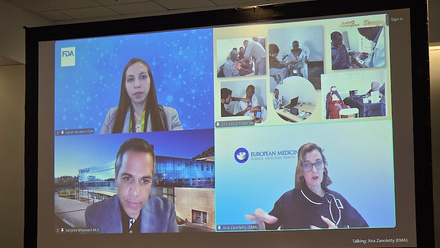
EMA adopts reflection paper on AI/ML in drug development
The European Medicines Agency (EMA) has adopted a reflection paper (RP) on using artificial intelligence (AI) in drug development after considering feedback from scores of stakeholders who asked for clarifications and more information on the document's scope during the consultation period. The agency said the updated paper also includes changes based on the recent EU AI Act.On 30 September, EMA announced that its Committee for Medicinal Products for Human Use (CHMP) Methodology Working Party drafting group had reviewed the feedback on its AI reflection paper from 66 stakeholders, including regulatory bodies and public consortia. Based on the 1,342 comments received, the agency has decided to update key parts of the paper. (RELATED: EMA details lifecycle approach to AI/ML drug development in new reflection paper, Regulatory Focus 20 July 2023)
"On a general note, several comments have raised topics or asked for a level of prescriptive detail that could not be accommodated in these initial reflections on the use of AI," said EMA. "These comments will instead be taken into consideration in the future drafting process of formal EMA scientific guidelines in the field of AI."
"In line with comments, technical terms and definitions have been harmonized wherever possible and are supported by an expanded glossary," the agency added. "In addition, the scope of the reflection paper has been further clarified, not to exclude shallow machine learning technology which may share many of the features and challenges addressed in the RP."
Shallow machine learning (ML), often called traditional ML, uses fewer levels of abstraction in a neural network than deep ML. Shallow learning models are used for simpler tasks, unlike deep ML that are used to recognize more complex relationships in the captured data.
The paper uses the definition of AI developed by the Organisation for Economic Co-operation and Development (OECD), which states that "an AI system is a machine-based system designed to operate with varying levels of autonomy and that may exhibit adaptiveness after deployment and that, for explicit or implicit objectives, infers, from the input it receives, how to generate outputs such as predictions, content, recommendations, or decisions that can influence physical or virtual environment. In this reflection paper the term AI/ML is used to cover all models developed through the process of ML, regardless of the specific model architecture."
EMA also noted that it had reworded the definition of risk in AI products after Annex 3 of the AI Act included specific language for how to define high-risk AI. More specifically, the agency has replaced the phrase "high risk" with "high regulatory impact" and "high patient risk" to clarify that most AI regulatory requirements pertinent to the reflection paper is based on EU legislation.
For instance, in the section on developing AI models, the paper now states that if third-party AI models or services are used within the medicinal product lifecycle with high regulatory impact or high patient risk, the software developer is expected to use a methodology qualification process that provides the specific context of use.
"In response to comments, further clarification has been provided regarding requirements on availability of data used in modelling, use of third-party AI systems, and need for prospective testing of machine learning models," EMA said. "The key message in the RP remains, that while acknowledging that AI technology holds the potential to improve many if not all aspects of the medicinal product lifecycle, trustworthiness for regulators, payers and patients alike must not be compromised by the introduction of new technology."
Updated reflection paper