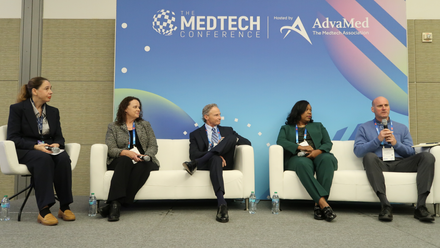
FDA biostatistician recommends transparency, early conversation with reviewers
WASHINGTON – Better and earlier communication with the agency can help sponsors streamline their premarket review experience, said Gregory Alexander, a biostatistician at the US Food and Drug Administration (FDA). He also said industry often maintains certain myths about the agency that may prevent them from engaging with regulators more effectively.Alexander, who is also a division director at the Center for Devices and Radiological Health (CDRH), spoke at the FDA/AdvaMed Medical Device Statistical Issues Conference on 2 April. He tried to dispel some myths sponsors may hold when they approach the agency. As a former biostatistician for Grail and Genomic Health, he said he understands the frustration sponsors often feel when interacting with the agency because he, too, felt it could be overly burdensome.
There are certain terms and requirements FDA uses that may be misunderstood by industry, according to Alexander. For instance, when FDA asks about the benefit-risk profile of a product, it's not just a simple matter of ensuring the study design accounts for type 1 error but rather that the data submitted, regardless of its flaws, will get a full evaluation. He also said that the agency does accept uncertain and flawed data, and evaluates it based on the totality of the evidence.
Alexander noted that sponsors often also misunderstand FDA's mandate to offer the least burdensome regulatory approach to get products to market.
"Least burdensome doesn't mean it's going to be the least costly," he said. "Even though the goal is to speed the time to evaluate the device, it may not minimize the time that you need to bring strong data forward because there's a constraint [to provide] the least amount of data that you need to make the decision."
He added that fulfilling FDA's least burdensome approach really means not requiring superfluous data.
According to Alexander, sponsors often come to the table with a misunderstanding that FDA is hindering innovation by sticking to precedence. However, he said that the agency's focus is less about precedence and more about ensuring it is applying its regulations consistently.
"We want to evaluate consistency across teams and across devices in the same class," he said. "It's a way for us to ask if we are applying consistent principles and if not then we [have to] adjust, that's what precedence is about.”
"Every context is different, every device is different, the risk profiles are different," he added.
Alexander said that sponsors may think FDA's requests are superficial and go against precedence, but the agency must be fair and consistent in how it applies its regulations to ensure it is able to get the right evidence to make its decision based on the device, its intended use, the situation it will be used in, and other factors.
While sponsors can spend months, if not years, understanding their product, they tend to come to FDA with several pages of information about their device and expect reviewers to understand the product at the same level in a very short period, according to Alexander.
"I want you to appreciate it doesn't quite work like that. I'm sorry, but my team members, they're really good, but they're not that good,” said he added. “Sometimes it takes coming in with a pre-submission, stating your case and stating it again and stating it again."
He said sponsors should be persistent, ask to talk to the statistician on the review team and ensure the lead reviewer knows that they want to discuss statistical issues. He added that CDRH is very open to using innovative statistical methods to evaluate products and noted that there are many working groups on any given device area who are interested and constantly reading up on such issues and present on them.
"I find [CDRH] to be very thoughtful in a field where it's very difficult to know everything and it's very important to be careful, which is why you almost never get in a sponsor meeting the answer that you want but keep asking the questions anyway," said Alexander.
Alexander noted that when sponsors submit an investigational device exemption (IDE), the main concern for FDA's review team, which comprises of statisticians, epidemiologists, biologists, and other subject matter experts, is to ensure the device is safe to use in a clinical trial. He added that statisticians will ask the sponsor to respond to a myriad of questions about the study design that may feel burdensome but understanding those questions ultimately puts the sponsors in a better position.
"If we didn't ask you ahead of time and then you learned this later on, that would not be the best help to you, our customers," said Alexander. "It's much better that we raise these concerns early even if we don't have the answers."
He noted that sponsors may feel frustrated that FDA comes back with even more questions, but the agency’s goal is to address as many issues as possible before sponsors get ahead of themselves.
"As statisticians, you want to get comfortable with that, that is the nature of engagement with the FDA," said Alexander. "But in realizing that while we're doing that, we are also [as invested] to bring devices to market as you are... What we're trying to do is give you the best shot of bringing an evidence package forward that would allow a positive regulatory decision."
Alexander encouraged attendees in the medtech ecosystem to act as watchdogs and raise the alarm if they see any issues where companies may be acting in bad faith, and singled out now-defunct Theranos as an example.
He also recommended that sponsors consider using FDA's Q-Submission (Q-Sub) program to engage with regulators early on, as well as programs such as the Breakthrough Devices and Safer Technologies Program (STeP) to potentially expedited the review process.
Based on his personal experience in the private sector, Alexander also noted that sponsors are often reticent about disclosing all their problems to the agency for fear of slowing down the review process. He said instead they tend to hide the issues or hold off on disclosing them until the end with the hope of fixing them later down the road.
"Please don't do that," said Alexander. "I really invite you to come to the FDA and be very forthcoming about the questions that you have."