FDA investigator, experts seek to dispel misperceptions around 483s

PHILADELPHIA – Adhering to quality by design (QbD) principles and employing risk-based monitoring strategies should reduce the likelihood of clinical investigators or sponsors receiving a Form 483 following a bioresearch monitoring inspection.
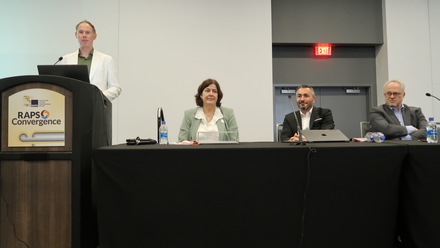
That was the message conveyed by a panel of clinical research experts and a US Food and Drug Administration (FDA) investigator at the DIA annual global meeting on 17 June.
There are many misperceptions around 483s, but many are “not grounded in reality,” according to David Burrow, director of the Office of Scientific Investigations (OSI) in the Center for Drug Evaluation and Research (CDER).
“We can’t underestimate the impact that 483s can have on people and development programs and the livelihood of people involved in research,” Burrow said. Yet “483s are just lists of observations, and it is the very best communication tool that an inspected entity has with the agency.”
He added that “the perception is that if you get a 483, you will not get any more studies from a clinical investigator. We need to try to nip that in the bud. 483s tend to get a bad rap, and that is not at all how they should be perceived.”
Moderator Erin Brown, director of industry intelligence for the Association of Clinical Research Organizations (ACRO), asked the panel to share their thoughts on best practices for conducting clinical studies.
Burrow said that implementing QbD strategies and prioritizing risk-based monitoring are critical steps to avoid a Form 483.
“You have to all remember that quality in clinical research is the absence of errors that matter, it is not the absence of all errors, because perfection is unattainable,” he said. “We also have to remember that the blueprint for quality is the protocol, and as we continue to advance the principles of quality by design and set that on top of a risk-based quality management system, we have the opportunity to minimize the amount of 483 observations.”
Cris McDavid, senior director of GCDO for Parexel International, agreed that a risk-based approach to monitoring clinical research sites is a proactive way to keep sites under control.
McDavid also noted that “we see people go in that are ultra cautious and want to do 100% of everything all the time. That is not reality. Instead, take a practical approach and identify the critical data and focus your energy there. There is an argument that should be made that you should be leaning more into risk-based approaches and focusing on the data that matters.”
Nicole Stansbury, senior vice president of global clinical operations for Premier Research, said, "It is important to ensure critical processes are carefully evaluated and to allow time in your monitoring strategy to fix the issues that are identified.”
Brown then asked the panel to comment on the role of clinical research associates (CRAs) and whether they are responsible for problems uncovered during inspections.
“I don’t think we have a CRA problem. When the site receives the 483 for the monitoring, the CRA is the first one to blame,” Stansbury said. “I think that leads to re-monitoring, which is probably not the most productive use of anyone’s time. We are blaming the CRA on the overall execution of the protocols at the site, but it is ultimately the principal investigator who is responsible for the execution of the protocols.”’
Burrow added that CRAs cannot dictate where sponsors or contract research organizations (CROs) follow the QbD approach, nor can they manage staffing, training, or oversight. Presenting these issues as problems solely pertaining to CRAs is misguided. He said that “framing the issues as CRA-related problems is a misstep.”
Stansbury mentioned that CRAs face an impossible task of being asked to do too much. “If you think of a field of corn as a study, each row of corn represents a group of patients, and each stalk on the row symbolizes an individual patient. Each kernel on the cob is a data point. What we are asking the CRA to do is to analyze every kernel on every cob of every stalk in every row of the cornfield. I mean, how absurd does that sound? Then we criticize them when they miss seven kernels of corn out of a billion kernels.”