FDA officials offer CMC advice for gene therapies at OTP town hall
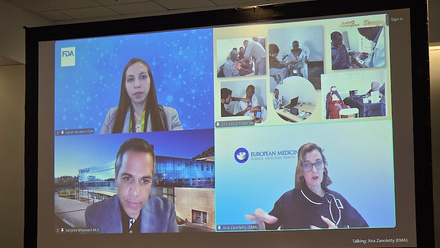
Officials from the US Food and Drug Administration’s (FDA) Office of Therapeutic Products (OTP) within the Center for Biologics Evaluation and Research (CBER) urged developers of gene therapies to avoid implementing manufacturing process changes during later pivotal studies to avoid problems later, such as products being out-of-specification (OOS).So asserted Graeme Price, a team lead for the Gene Therapy Branch 1 within OTP, who spoke at a virtual town hall on 25 April to answer stakeholder questions related to chemistry, manufacturing and controls (CMC) for gene therapy products as part of investigational new drug applications (INDs) and licensure applications.
The meeting also addressed differences between characterization and release testing, when assays need to be qualified, empty capsids and FDA’s expectations for potency testing.
OTP was formerly called the Office of Tissues and Advanced Therapies (OTAT) and was renamed last September and reorganized to a “Super Office” to meet its growing workload and new commitments under the Prescription Drug User Fee Act (PDUFA VII) agreement. (RELATED: FDA elevates OTAT to “Super Office” within CBER, Regulatory Focus 30 September 2022)
Manufacturing changes
Officials were asked to specify whether the agency will allow sponsors to implement manufacturing process changes during pivotal trials for gene therapy products. Price responded that these changes should be avoided.
“Manufacturing changes made during late-stage studies are a major concern leading up to [biologics license application] BLA submissions and during BLA review. While we understand the need to introduce manufacturing changes for scale up and scale out in preparation for commercial manufacturing, our experience is that this can lead to challenges down the road. A clinical assessment of product safety and effectiveness labels is made much more complicated when these changes are introduced during pilot studies,” said Price.
Price added that an additional risk with making these changes so late is that the specifications for the product, which were made earlier on, may not reflect the later changes and this may lead to a higher number of out-of-specification products. “For this reason, we strongly urge to use you to not make changes to the process when these studies are underway.”
Another consideration is that later changes may lead to more complex comparability studies, assessing comparability between pre-change and post-change products increases at each phase of development, and modifications made in later studies need “more robust” comparability studies than changes made earlier on.
Price added that “if you can’t demonstrate comparability, then additional clinical studies may be required. So therefore, we recommend that you consult with the review team before implementing manufacturing changes … We strongly recommend that you avoid making these changes.”
Assay development
Officials were also asked at what stage of clinical development do release assays need to be qualified. FDA officials said the earlier the better.
“Many experienced gene product sponsors actually qualify their assays at the start of clinical studies, and this aligns with our general advice to begin with the end in mind,” said Andrew Harmon, a team lead for Gene Therapy Branch 1.
“In general, you have to have non-compendial assays qualified before initiating any studies that are designed to obtain primary efficacy data for a license,” he added, noting that in the rare disease space “a pivotal study can sometimes occur before a conventional phase 3 study would.”
Difference between characterization and release testing
Officials were also asked to address the differences between characterization testing and release testing. Price said that the purpose of characterization testing is “to gain information on the product whereas release testing is to demonstrate that the product is of an acceptable quality for use and should be reported on the product’s [certificates of analysis] COA.”
Both test results should be recorded and submitted in an IND or a BLA at relevant places in Module 3 of the Common Technical Document (CTD).
Potency testing
FDA officials were questioned on the agency’s expectations for potency testing during various stages of clinical development.
“Potency testing and potency assay development may be challenging; the purpose of potency testing is to assure the product can perform its intended functions when administered to patients. Because products vary widely m there is not one size fits all potency assay. Potency testing has to be specifically designed for each product,” Price said.
Capsid cut-offs
FDA was also asked to address whether the agency has a preferred method for determining whether capsids for adeno-associated virus vector (AAV) products are considered full, partial or empty.
In response, Harmon said that “this is very important topic and there is a lot of exciting work going on in the field on capsid contents and what constitutes a full, partial or empty capsid. What I can say is that FDA is not prescriptive on the particular analytical methods you use to assess full capsids. We also cannot give you a magic number of percent of full capsid that would be considered acceptable.”
Town Hall