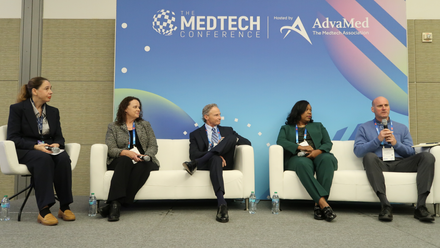
Shuren: At-home technologies must be fit-for-purpose
The head of the US Food and Drug Administration’s (FDA) device center believes that moving medical technologies from the clinical setting into the home may reduce costs and improve patient care; however, he cautioned that any medical technology used at home must prove that it is fit-for-purpose.Jeff Shuren, director of FDA’s Center for Devices and Radiological Health (CDRH), spoke with Focus earlier this week about his vision for at-home medical technologies.
Shuren recently said he wants to focus on helping get people preventative care in their homes with the aid of digital health technology that allows for at-home diagnosis, monitoring and treatment. (RELATED: Shuren: Getting QMSR out by year’s end a ‘high priority’, Regulatory Focus 23 May 2023)
Following those comments, FDA published a list of questions for public feedback on what the agency can do to encourage development of at-home technologies and what factors should be considered when such technologies come to market.
“The reality is we're seeing a push for using technologies at home, and that's in part to expand access and it's partly for reducing cost of care that typically is going to occur in a clinical setting,” said Shuren. He added healthcare institutions are increasingly using at-home technologies in areas such as oncology and dialysis care. In some cases, technologies are being used to support earlier patient discharge so that some of their care can be provided at home.
The pandemic played a significant role in bringing more health technology into the home, Shuren said, especially as people became more comfortable performing at-home diagnostic tests.
“There already was a movement afoot prior to COVID, but it was accelerated with the pandemic because people didn't have ready access to their providers and to healthcare facilities, particularly earlier in the course of COVID, when you had lockdowns,” said Shuren. “That's one of the reasons why we put in place a number of flexible policies to facilitate modifications to devices to have digital remote capabilities to help move care to the home or in some cases, even the development of technologies without prior FDA review to be able to facilitate care in the home, some of the adjunctive, behavioral therapies, for example.”
He also noted that at-home care can help achieve FDA’s strategic objective of improving health equity by increasing access to care and lowering costs.
“One of the big drivers for increased costs is when it's provided within your brick and mortar healthcare facility simply because those institutions providing care are more expensive,” said Shuren. “If you're able to do that without the need for all the people and facilities, you can help support cost savings.”
A key concern when asking patients to take care of themselves at home using the technology available to them, is whether they can do so without the oversight of healthcare professionals. While moving technologies from the clinical setting to the home won’t change FDA’s safety and efficacy requirements, Shuren said, sponsors need to think about the setting the technologies will be used in and who will be using them.
“Any time you have a technology, you're always assuring it's fit-for-purpose for the intended use in the intended users,” he said. “If you have technology that's going to be available for use in the home, then it's got to be designed such that consumers can use it safely.”
FDA often requires human factors testing especially when there is concern about proper use of the product, and such testing may be required for at-home technologies to show that patients are able to use the products safely and effectively.
“That's pretty typical for technology in the home,” said Shuren. “Human factors are even considered when devices are used by providers in some cases where there may be issues around safety, or performance concerns when used inappropriately.”
“I don't think the fundamental considerations change because you always have to think about safety and effectiveness in the context of the user that it is fit-for-purpose, and here you're dealing with the lay user,” he added.
There is also concern that patients may not adhere to treatments as well at home, compared to when they are being treated in clinical settings by healthcare professionals. However, Shuren said he thinks there is greater opportunity to ensure patients adhere to their treatments today, thanks to advances in technology.
“It's one of the reasons why you see pharma companies very interested in digital technologies to be able to better support adherence to administration of medications,” he said. “Technology does provide that opportunity to further support better adherence to treatments.”
That said, Shuren wants stakeholders to think about at-home technologies a bit differently. He said at-home technologies are not going to be as effective if they are “one-off technologies” and patients end up having to interact with several technologies at once to manage their health.
“At the end of the day, people aren't going to tolerate having dozens of technologies in the home for use in their care or wellness, it's just overwhelming,” said Shuren. “Healthcare providers also can't handle that … It becomes too much.”
Shuren urged developers to consider what the home setting should look like to allow people to have to have certain interventions, diagnostics and screening capabilities. He said those technologies should be baked into the home setting or have plug-and-play capability so they are easy to use.
Shuren also noted the trend in consumer product companies expanding the use of their products to include regulated health functions. Not only does this movement have implications for moving treatment from the clinical setting to the home, according to Shuren, it also has important implications for clinical trial capabilities.
“If you kind of move to this idea of wellness prevention care in the home setting, at the same time you should be thinking about the opportunities for data collection and evidence generation, facilitating participation in clinical studies,” said Shuren.