DIA: FDA officials discuss trends in AI, RWE in submissions
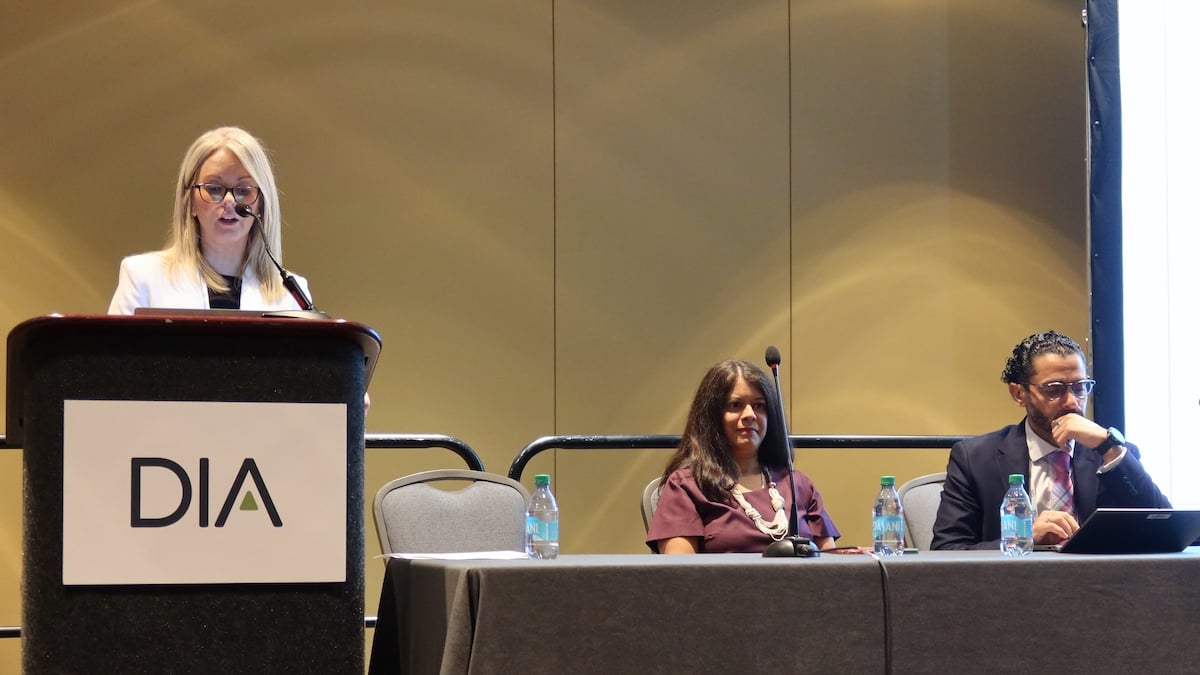
Philadelphia – Officials from the US Food and Drug Administration (FDA) discussed strategies for integrating artificial intelligence (AI) with real-world evidence (RWE) to advance drug development during a panel discussion at the DIA Global Annual Meeting on Tuesday. The officials noted there have been an increasing number of submissions that utilize both AI and RWE.
“We really want to advance AI and RWE as complementary tools to advance drug development,” said Marie Bradley, senior advisor for RWE in the Office of Medical Policy in the Center for Drug Evaluation and Research (CDER), who spoke on a panel with other FDA officials
“Where does the convergence lie in how AI can strengthen RWE?” Bradley asked her colleagues.
Hussein Ezzeldin, a senior policy advisor in the Office of Medical Policy at CDER discussed the capabilities of AI stating, “What is AI l good at? It is good at finding patterns in the data. This is an area where you can see a lot of progress, you can go through a large amount of data and extract certain features. Patient identification is another area where you can expedite patient enrollment. Also signal identification can be another area.” He added that AI is also good at phenotyping.
When asked to describe the limitations of AI, he said that AI models “are really good at finding patterns; they are not good at finding rare events. Using AI to find a rare event, you may not get what you are asking for.”
The officials also discussed the growth in AI and real-world data (RWD) programs at FDA. The number of new drug applications (NDAs) and biologics license applications (BLAs) that incorporate RWE increased from four applications in FY 2023 to ten in FY 2025, according to a recent report on FDA’s website. This report was prepared under the Prescription Drug User Fee Act VII (PDUFA) agreement, where FDA committed to reporting the number of RWD submissions to CDER and the Center for Biologics Evaluation and Research (CBER).
Bradley noted that on 23 September 2025, the FDA also published a compilation of examples demonstrating how RWE has been utilized to support regulatory decisions in CDER and CBER since 2011. This includes instances of product approvals, labeling changes, and assessments where no regulatory action was deemed necessary. An update was published on 3 June 2026 that includes more recent examples and expanded coverage to include the Center for Devices and Radiological Health (CDRH), reflecting the breadth of RWE use across the centers.
Anindita Saha, associate director for strategic initiatives at the Digital Health Center of Excellence within CDRH, noted that CDER and CBER have received over 1,000 submissions that incorporate AI elements, a significant increase from just one submission in 2016. The majority of these submissions are in the field of oncology, followed by gastroenterology, neurology, and psychiatry. In clinical trials, AI is utilized to establish endpoints, select patients, and predict outcomes.
“We are seeing a lot of AI in the nonclinical research and in the manufacturing and post marketing space,” Saha said.
Bradley asked Saha to discuss some of the comments they are getting on the draft guidance on the use of AI in regulatory decision-making for drugs and biologics that was issued in January 2025.
“We heard loud and clear that industry wants practical examples and practical use cases,” Saha said.
She was also asked by a member of the audience whether the FDA plans to make any information public on the 1,000 submissions they have received that incorporate AI elements.
Saha stated that some of this information is confidential and proprietary, which means the agency cannot share all of it. However, she added that “we are trying to figure out the best way for disseminating this information.”