

FDA issues warning letters for false advertising, CGMP violations, and more
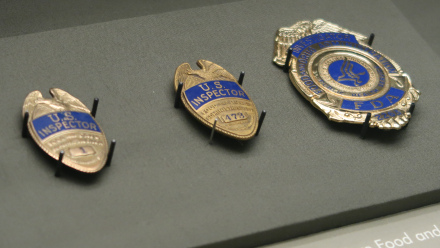
FDA inspector badges at its headquarters in Silver Spring, MD. (credit: Ferdous Al-Faruque)
The US Food and Drug Administration (FDA) has warned an oncology drug company for repeatedly overstating the efficacy of its drug in advertisements while failing to adequately disclose the associated risks. The agency also issued several warning letters to companies for violations of current good manufacturing practices (CGMP) and for marketing products for non-approved indications.
ImmunityBio
The FDA Office of Prescription Drug Promotion (OPDP) issued a warning letter to California-based ImmunityBio for making false and misleading statements about its bladder cancer drug Anktiva (nogapendekin alfa inbakicept-pmln). The agency said it had reviewed a TV ad and a podcast in which company representatives made unsupported claims that violated federal regulations, and that it received complaints about the direct-to-consumer (DTC) promotional materials through its Bad Ad Program.
“The TV ad and podcast provide evidence that Anktiva is intended for new uses for which it lacks approval, and for which its labeling does not provide adequate directions for use,” FDA wrote. “In addition, the podcast was not submitted at the time of initial dissemination or publication as required by 21 CFR 314.81(b)(3)(i).
“These violations are concerning from a public health perspective because the promotional communications create a misleading impression that Anktiva, a treatment for a certain type of bladder cancer, can cure and even prevent all cancer,” the agency added.
Anktiva in combination with Bacillus Calmette-Guérin (BCG) is indicated to treat of adults with BCG-unresponsive nonmuscle invasive bladder cancer (NMIBC) with carcinoma in situ (CIS) with or without papillary tumors.
This isn't the first time that FDA has raised concerns about how Ankita is marketed. The agency notes that it previously sent untitled letters to Altor BioScience, an ImmunityBio subsidiary, in September 2025 and January 2026, regarding similar promotional information. In those letters, investigators raised concerns that the efficacy of Anktiva was overstated on the product’s healthcare provider- and consumer-branded websites.
“OPDP is concerned that, despite receiving these previous Untitled Letters, ImmunityBio continues to promote Anktiva in a similarly misleading manner,” said FDA.
In the most recent instances in which the company overstated the drug's efficacy, the FDA said the company had misleadingly suggested that all NMIBC patients treated with Anktiva would be cancer-free in the long term, even though that has not been proven. The agency also said the company had misleadingly suggested Anktiva was effective as a single agent and that a company representative stated the drug “can treat all cancers.”
“In addition, the representation in both the TV ad and podcast that Anktiva is a cancer vaccine is false and is further compounded by the claim in the podcast that Anktiva is ‘the therapy to prevent cancer if you were exposed to radiation,’” said FDA. “Anktiva is not a vaccine, and we are not aware of data showing that Anktiva has a preventative effect in patients without cancer, including patients who have been exposed to radiation.”
Investigators also noted that the TV ad did not give viewers sufficient indication that it would present risk information about Anktiva and failed to communicate any risk information in the podcast.
CGMP/QSR Violations
The FDA sent several companies warning letters for CGMP and QSR violations, including Chinese drugmaker Yangzhou H&R Plastic Daily Chemical, an over-the-counter (OTC) drug contract manufacturer. The company was cited for failing to adequately test its final products before releasing them to market. It was also cited for failing to adequately test the components used to make its drugs, including the active pharmaceutical ingredients.
"Your firm failed to conduct adequate identity testing on incoming components, including active pharmaceutical ingredients, used in the manufacturing of your drug products," said FDA. "Additionally, you relied on your suppliers’ certificates of analyses (COA) without establishing the reliability of each of your component suppliers’ analyses at appropriate intervals.
"Without adequate testing and confirmation of reliability of supplier test results, you lack scientific evidence that the components conform to appropriate specifications prior to use in the drugs products you manufacture," the agency added.
Additionally, Yangzhou was cited by FDA for failing to have written procedures and process controls to ensure its drugs met specifications and was told its quality control unit (QU) did not do its part to ensure it complied with CGMP. Ultimately, regulators said its quality systems were inadequate.
FDA also issued warning letters to IsoTis OrthoBiologics and Longhorn Vaccines and Diagnostics, both based in the US. The companies were cited for failing to establish and maintain proper procedures to implement corrective and preventive actions.
IsoTis, which manufactures resorbable calcium salt bone void filler devices, was also cited for failing to revalidate a validated process when changes or deviations were made and for failing to establish proper risk analysis procedures. Additionally, Longhorn, which manufactures devices used to transport pathogens, was cited for failing to properly maintain a product complaint system, including failing to review complaints to evaluate whether further investigation is needed.
In addition to the CGMP violations, Longhorn was also cited for marketing its PrimeStore MTM (Molecular Transport Medium) device without marketing authorization. While the device has de novo authorization to handle nasal washes that may contain Influenza A virus RNA, FDA noted that the company's website states it is intended for additional microorganisms.
"Your website and product brochure also show an intent to market the device for the detection of antimicrobial resistance (AMR) genes," said the agency. "These statements and representations constitute major changes or modifications to the device’s intended use, for which your firm lacks clearance or approval."
Yangzhou H&R, IsoTis OrthoBiologics, Longhorn Vaccines and Diagnostics
4U Health
FDA inspectors sent South Carolina-based 4U Health a warning letter for selling a human immunodeficiency virus (HIV) serological diagnostic dried blood spot (DBS) card self-collection kit on their website without marketing authorization.
"Based on our review of these materials, your firm offers its HIV DBS card self-collection kit for delivery to individuals and intends for these individuals to use the kit to self-collect DBS samples and ship those samples to laboratories for HIV testing," FDA wrote. "FDA has not authorized your firm’s HIV DBS card self-collection kit for use in HIV serological diagnostic testing."
While FDA sent 4U Health the warning letter on 17 March, the issue has been going on for at least a year. The agency wrote that it notified the company in a letter on 31 March 2025 of its concerns, to which the company responded that it does not sell self-collection testing kits but rather facilitates access to professional medical services, where physician consultants order the tests and oversee the testing process. The company also said it does not diagnose, treat, or cure any disease on its own.
FDA disagreed with the company's characterization and provided examples and rationale why the company and its tests fall under its regulatory oversight.
"The violations cited in this letter are not meant to be an all-inclusive list of violations that may exist in connection with your products," FDA wrote. "FDA requests that your firm immediately cease any activities that result in the misbranding or adulteration of your HIV DBS card self-collection kit.
"Your firm should take prompt action to address the violations identified in this letter," the agency added. "Failure to adequately address this matter may result in regulatory action being initiated by FDA without further notice."
