MDUFA VI deal promises to boost domestic priorities, review consistency
US Food and Drug Administration (FDA) officials said the next iteration of the Medical Device User Fee Amendments (MDUFA VI) will focus on improvements in consistency during the review process and promoting domestic priorities, rather than pursuing shorter review timelines compared to MDUFA V.
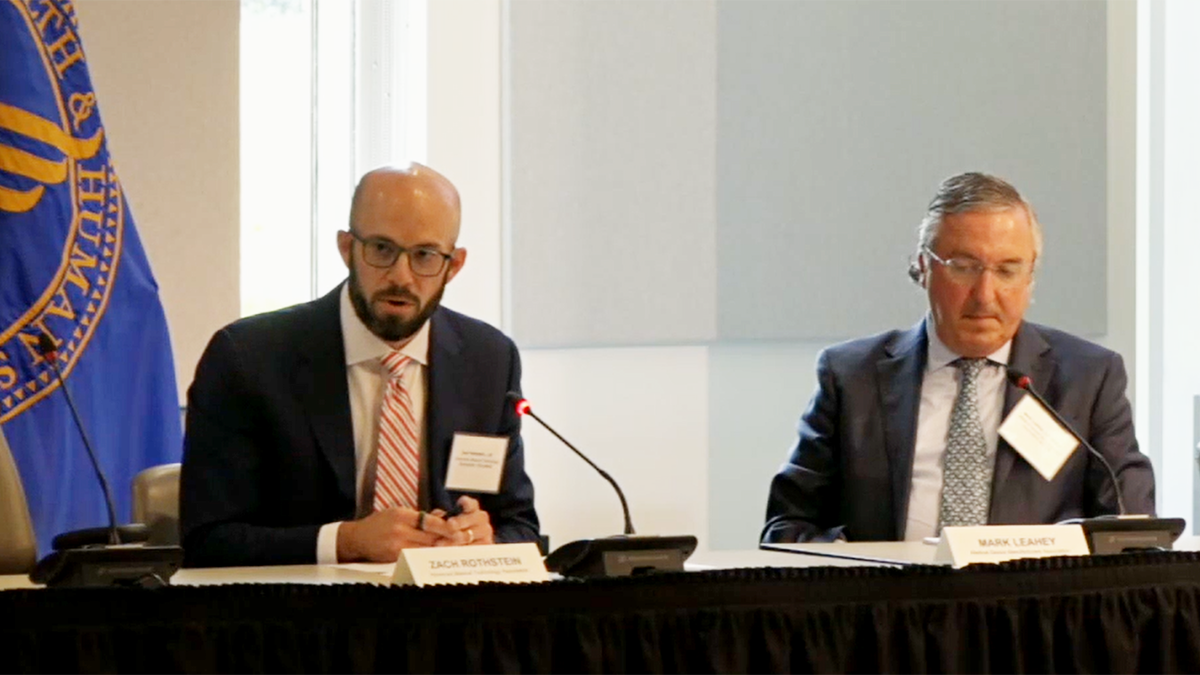
FDA, representatives of the medtech industry, as well as consumer and patient advocates, met at the agency’s headquarters on 5 August to discuss the recently proposed MDUFA VI deal.
‘America First’ approach
In his opening remarks, FDA acting Commissioner Kyle Diamantas said the proposed MDUFA VI deal will improve the pre-market regulatory review process, while emphasizing that fees will remain relatively flat or even decrease for some American companies. He emphasized that the proposal would enhance the competitiveness of American medtech companies "by asking foreign companies to pay their fair share for the important benefits they get from access to the US market," and improve market entry for startups and small US businesses, while only allowing small business fee waivers to companies that have US tax returns. (RELATED: MDUFA VI: Draft commitment letter details enhancements, performance goals, Regulatory Focus 8 July 2026)
Diamantas also noted that the deal is intended to help products with artificial intelligence, digital health technologies, and domestic manufacturing, while also collaborating with the Centers for Medicare and Medicaid Services (CMS) to align on the review processes and create a more predictable path to market for novel devices.
"These MDUFA commitments dovetail with FDA's broader commitment to removing barriers that delay or limit Americans' access to safe, effective, and affordable medical products," said Diamantas. "Through a more aligned and better coordinated Department of Health and Human Services, I'm also pleased with the efficiency that the MDUFA team and really all of our user fee teams this cycle proceeded with the industry negotiations and stakeholder consultations.
Center for Devices and Radiological Health (CDRH) Director Michelle Tarver reminded attendees that it was the 50th anniversary of the Medical Device Amendments, which created the modern medical device regulatory system, and emphasized that the past two decades of the MDUFA program have focused on continuously improving how FDA carries out its public health mission. She highlighted how collaborative the MDUFA VI negotiation process was and thanked FDA and industry negotiation teams for their professionalism and collegial spirit to complete the negotiations efficiently.
Tarver noted that the deal ultimately reached strengthens FDA's core review fundamentals by enhancing review consistency, improving pre-submission interactions, making the de novo process more efficient, enhancing the quality of deficiency communications, and building reviewer expertise. She said the deal will also improve the quality of the review process by investing in FDA's modernization efforts and improving transparency and accountability by providing sponsors with more communication and clarity throughout the process.
"Taken together, these three themes reinforce one another," said Tarver. "Strong review fundamentals support higher quality regulatory interactions, better regulatory experiences improve transparency and predictability, greater transparency strengthens accountability and public confidence.
"Together, they create a regulatory ecosystem that is more resilient, more efficient, and better prepared for the future," she added.
Refinements over speed
During a panel discussion with agency officials, Eli Tomar, deputy director of CDRH, noted that shorter review timelines were frequently sought during past MDUFA negotiations. The MDUFA VI proposal largely retains the same review goals as the current MDUFA V program.
This is largely because the agency has reached a limit on how quickly it can turn reviews around, said Barbara Marsden, deputy director at the Office of Policy at CDRH.
“We have iterated on these goals for decades, [and] we're finally in a place where most goals are at 90% or higher,” said Marsden. “This is realistically as high as we can go with our performance goals, so in MDUFA VI, we will focus on maintaining those goals rather than chasing higher numbers.”
She emphasized that this doesn’t mean the FDA will sit still; rather, it will focus its efforts on issues such as review consistency, transparency, and a newly proposed pre-submission pathway.
“All of those goals have real room for improvement,” said Marsden. “To say it another way, we've created a well-oiled machine, and we will be focusing on optimizing that machine in MDUFA VI.”
MDUFA VI: Promise and challenges
Marsden said the proposed focused follow-up pre-submission pathway (FFP) will likely be the most impactful enhancement to the MDUFA program but will be the most challenging to implement. The new pathway allows applicants to submit a pre-submission request with a 45-day timeline and receive focused follow-up questions for a recently submitted pre-submission request. Despite its potential to significantly speed products to market, Marsden said the pathway faces several challenges.
First, the implementation deadline is 30 December 2027, which means FDA must make significant IT updates and create new processes and procedures to implement the FFP in a short timeframe. She also noted that it will be challenging for reviewers to adjust to the new review-goal timeline and maintain consistency within the new pathway.
Marsden noted that despite implementing new tools such as FDA's Smart Template, eSTAR, and Focal Point to improve review consistency, the agency has faced criticism about its consistency. She said the reviewers can't keep asking the same questions on every submission, given that they review a variety of medical devices with different indications and use very different technologies.
"Appropriately consistent means that we are going to use a risk-based framework, along with our science standards, [and] use them to develop the evidence that we need for each submission that we review, and when that evidence is not consistent, we will be able to explain why," said Marsden. "We are going to use an iterative, data-driven approach, similar to the approach we used for the deficiency commitment in MDUFA V, and we're going to expand it to review consistency.
"That means that we're going to identify high-priority areas to work on each year, we're going to develop metrics for each of those areas, and we're going to use our quality management system to drive improvements," she added. "Transparency and collaboration are going to be key to making this commitment a success."
Focusing on fundamentals
Tomar, who served as FDA lead negotiator on the agreement, noted that the negotiations centered on two major goals: strengthening core review fundamentals and optimizing transparency and accountability. He reiterated that the financial footprint between MDUFA V and MDUFA VI is proposed to be nearly flat, and the latest iteration includes no major new initiatives, focusing largely on strengthening existing initiatives.
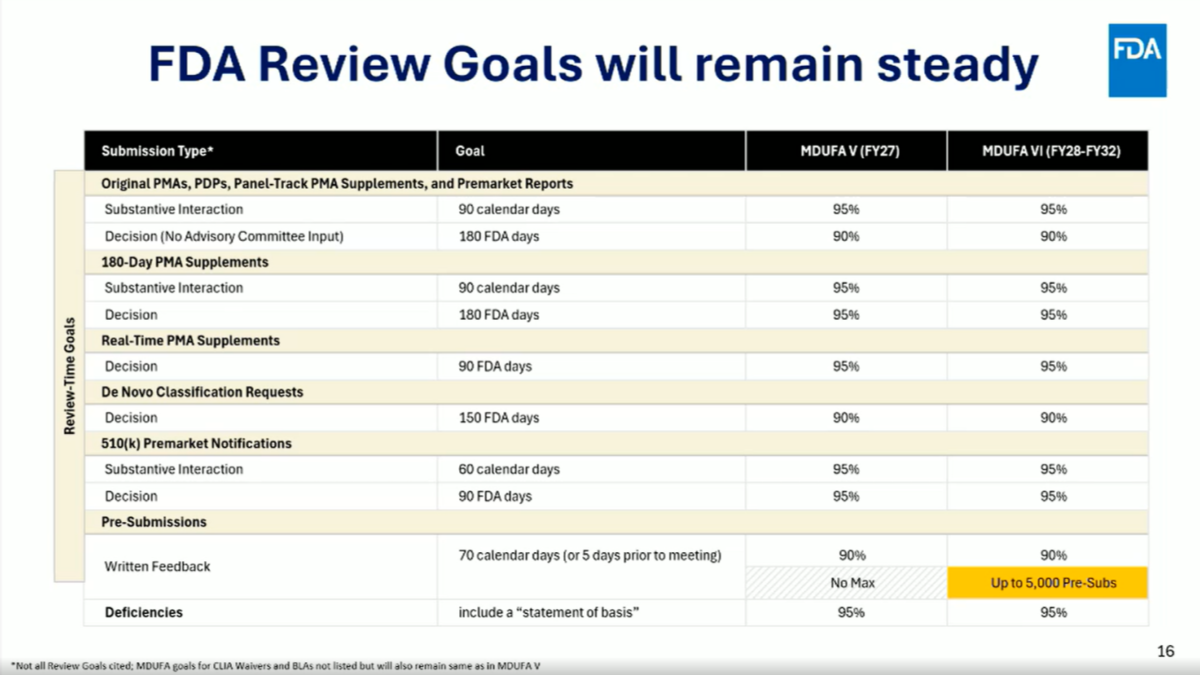
"In MDUFA VI, FDA review goals will remain mostly the same as they are at the end of MDUFA V, with a stability of uniformly high performance," said Tomar and presented the table below detailing the agency's review goals under MDUFA VI.
Regarding the pre-submission process, he noted that the agency will institute a $2,000 fee for certain initial pre-submission requests, which will be credited toward future marketing submission fees. He also noted that pre-submission sponsors will be able to request a new focused follow-up within 45 days, request a supervisory review to address potential inconsistent feedback, and ask for clarifications on informal communications.
For de novo submissions, Tomar said sponsors will receive an introductory meeting within 30 days, ineligible devices will be eligible for a fee waiver or reduction, and the agency will offer a de novo-specific pre-submission template. MDUFA VI also proposes creating an interactive navigator tool for regulators and external stakeholders, an improved customer collaboration portal, automating submission intake and routing, and strengthening the current deficiency improvement program and improving review consistency.
Tomar said the proposed MDUFA VI program will provide clearer expectations and meaningful engagements with updates to the fee structure, refining reserve levels to ensure program stability, ensuring appropriations and user fee funding are balanced depending on the agency mechanism, and identifying staff needs to ensure the agency can meet its user fee goals.
"We are recommending reforms to the statutory appropriations and spending triggers to ensure an appropriate balance between user fees and appropriations, and building in some flexibility for the agency and budget-setting processes when congressional budgets are tight," said Tomar. "Specifically, the appropriations trigger requires that the congressional appropriations threshold be met in order to continue our authority to collect fees, and the spending trigger requires minimum spending from congressional appropriations on MDUFA activities.
"New investments in resource capacity planning and management will help project future demands and better align staffing with workload demands and performance goals," he added. "These enhanced analytics, forecasting, and reporting capabilities will support data-driven staffing and resource allocation decision-making."
Overall, Tomar noted the proposed MDUFA VI package would net the agency $580M annually, which is about $9M, or 1.5%, above the baseline. He also presented an estimated fee table comparing MDUFA V fees and MDUFA VI fees below:
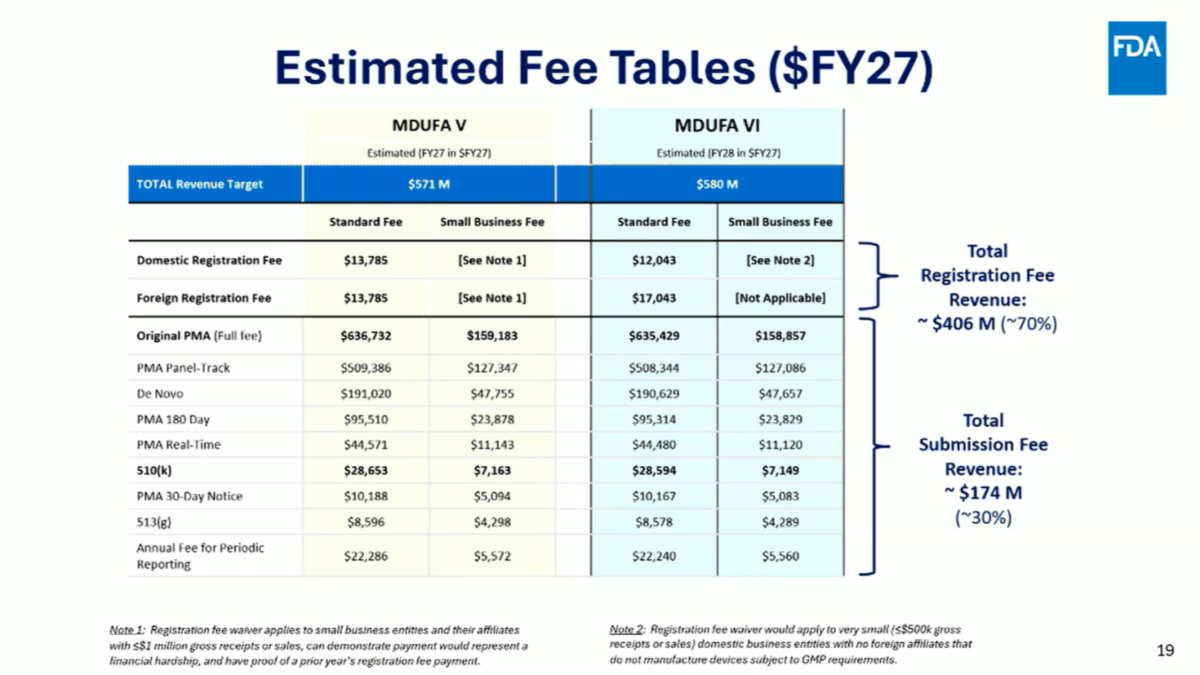
"Firms with a US presence can expect to see a modest decrease in their fees relative to inflation, and as you can see, more than two-thirds of the revenue comes from our registration fees," said Tomar, echoing Diamantas, and pointing to the estimated fee table. "Among marketing submissions, approximately half of US firms can be expected to pay a small business fee equal to 25% of the total fee amount."
Industry hopes for stronger FDA workforce
Mark Leahey, CEO of the Medical Device Manufacturers Association (MDMA) and a lead industry negotiator, also spoke at the meeting and said that, based on his experience with past MDUFA negotiations, this was the most transparent, collaborative, and productive. He alluded to the recent mass firings and resignations at FDA and the effect those actions have had on FDA’s MDUFA V performance goals.
Leahey said that the medtech industry understands the recent uncertainties the agency has faced and wanted to ensure it was well-resourced to provide stability for the next five years. He also noted that the fruits of their labor were to ensure CDRH was on a sound financial footing to build the dedicated professional workforce it needs, rather than just throwing money at the agency and hoping to improve regulatory processes.
"Industry was candidly surprised that starting in 2024 ... there were issues around budget and hiring and travel, so that was kind of a flashing red light, and then, obviously, in 2025, there were further dynamics associated with the workforce," said Leahey. "From our perspective, this is a five-year agreement, and how do we create the foundation that hopefully, when things settle down ... FDA has the resources to build the workforce, get those experts in where they're needed, build that team that doesn't necessarily drive things faster... [but rather] how do we enhance the interactions, and drive consistency.
"I think at this stage of MDUFA V, we expected more bodies to be in seats doing the pre-market review," he added. "We're hopeful that that tide has turned, and really thinking of MDUFA VI as kind of providing that runway to get back to that capacity that's needed to achieve the objectives to drive the consistency, but also with some guardrails in place that if those [ramp ups] don't happen at the same timeline that we expect, that that money just doesn't accumulate in a carryover balance, that there's ways in which those funds could be credited back."
Zach Rothstein, executive vice president of Digital and Diagnostic Technologies at AdvaMed and another lead industry negotiator, also spoke about his organization's work in helping draft the proposed MDUFA VI deal. He praised CDRH for managing a large and increasingly complex workload during the MDUFA V timeframe and meeting nearly all its performance goals.
"Rather than creating major new initiatives, [MDUFA VI] focuses on strengthening programs that are already working and making the best possible use of the resources supporting them," said Rothstein. "A strong and efficient FDA review helps keep the United States the best place to develop, invest in, and launch the next generation of medical technology."
Next steps
The MDUFA VI agreement still must be reviewed and approved by Congress and signed into law before the current program expires on 30 September 2027. However, FDA isn’t waiting around for approval to start preparing for its implementation.
"We have begun going through the commitment letter line by line and trying to identify IT needs, procedural updates, training needs, and we think with this granular analysis and planning that we're doing ahead of time, that will allow us to identify dependencies across the commitments, so that we're not caught flat-footed when we do begin implementation after the authorization," said Marsden. "Looking ahead, we need to establish a governance board, we need to assign project leads, we will need to create project plans, we need to create a dashboard to monitor our progress.
"But with all of these steps, I believe we will move forward in a successful implementation of MDUFA VI," she added.
Jonathan Sauer, associate director at FDA's Office of Finance, Budget and Acquisition, said the MDUFA VI deal will simplify CDRH's overall financial structure and provide more stability and predictability to the program.
"I think the changes are also going to help to mitigate some of that uncertainty that we see that comes along with the annual appropriations process, helping to make sure that we're able to maintain an appropriate reserve amount that's going to carry forward from one fiscal year to the next, [and] have a mechanism to replenish that, if need be," said Sauer. "I think those are really going to help to protect the program and also to minimize any potential impacts there might be as we go from one fiscal year to the next."