
Convergence: Thinking past GCP compliance for regulatory acceptability of foreign trial data
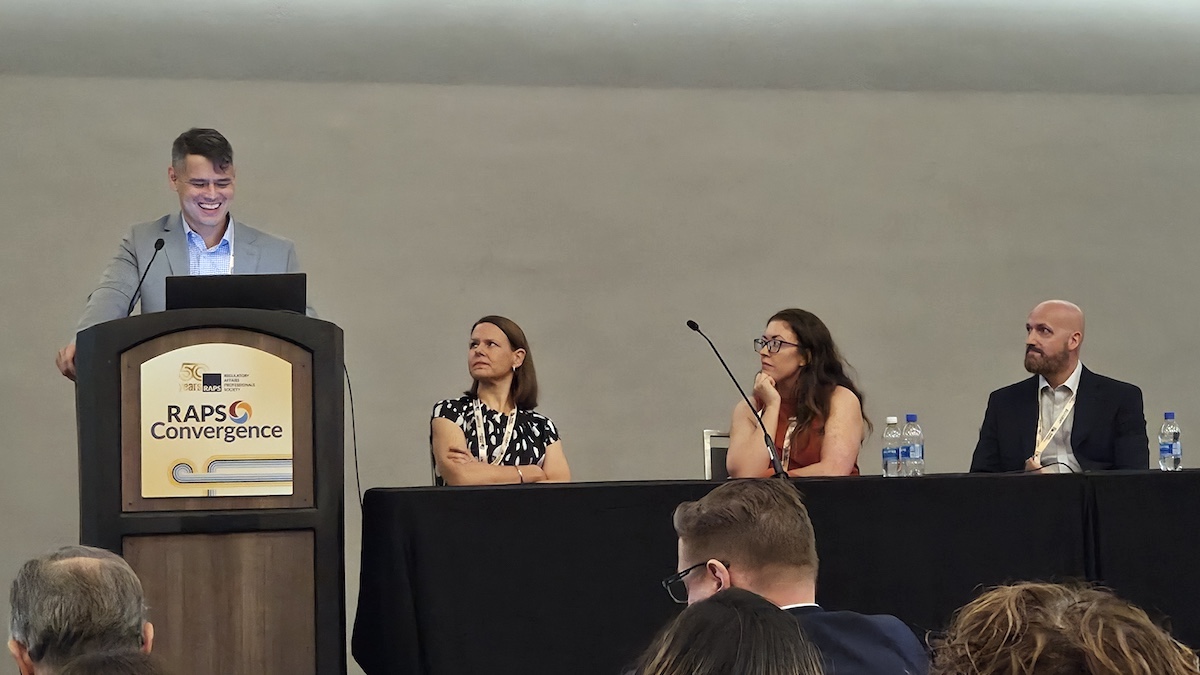
Left to right: Daniel Caños, Leslie Hammermueller, Jessica Addison, and Richard Holborow. (Credit: Jeff Craven)
CHARLOTTE, NC — Whether the US Food and Drug Administration (FDA) will accept clinical evidence from outside the United States (OUS) depends on if the investigations followed good clinical practice (CGP) regulations, but the data should also be applicable for regulatory purposes.
“[C]onsidering the global nature of clinical trials or regulations outlined prior to patients for acceptance of those data, in order for FDA to accept OUS clinical data in a premarket submission, the sponsor should demonstrate that the data were obtained in accordance with GCP, including review by an ethics committee and obtaining informed consent,” Daniel Caños, director of the office of clinical evidence and analysis within the office of product evaluation and quality at FDA’s Center for Devices and Radiological Health (CDRH), told attendees at RAPS Convergence 2026.
Caños defined GCP as a “standard for design conduct, performance monitoring and auditing, reporting analysis, and clinical investigations, providing that assurance that the data and results are credible and accurate, that the rights and safety and well-being are protected.”
That includes an independent ethics committee (IEC), initial review and approval, and continuing review as well as documentation of “freely given informed consent” for an investigation’s participants, Caños said.
The regulations for GCP that apply to OUS data are 21 CFR 812 for investigational device exemptions, 21 CFR 50 describing informed consent for protection of human subjects, and 21 CFR 56 for institutional review boards. Depending on whether a sponsor has an investigational device exemption, premarket approval, 510(k), De Novo, product development protocol, or humanitarian device exemption, 21 CFR parts 807, 812, 814, and 860 may also apply, while 21 CFR 812.28 contains information on data acceptance considerations specific for clinical investigations outside the United States, Caños said.
“We’ve also had an FDA guidance issued on the acceptance of clinical data to support medical device applications and submissions, which also contains an FAQ,” he explained. “I would also refer folks to our public webinar that followed the issuance of that guidance for further information.”
Compliance with requirements
For investigations conducted outside the US, “sponsors must provide a statement that each investigation was conducted in compliance with applicable requirements and parts 21, CFR 56 and 812,” Caños said.
If the investigation was not in compliance, sponsors need to submit a brief statement explaining the reasoning behind the non-compliance.
“In our guidance, we also go further and say that the sponsor should also provide a description of steps taken to ensure that the data and results are credible and accurate, and that the rights, safety, and well-being of subjects have been adequately protected,” Caños said.
Sponsors are also required to provide supporting information to show performance of GCP, he added. A sponsor or applicant’s risk determinations will inform the required supporting information necessary.
“Sponsors or applicants should maintain documentation of their rationale for their determination,” Caños said. “Also, information requirements vary for clinical investigations based on the risk. Requirements are not intended to be duplicative with information already included in submissions and may be cross-referenced in the submissions to the FDA.”
Examples of required information could be the names and addresses of investigators and/or research facilities, the qualifications of the investigators, protocol study result summaries, device descriptions, and data discussions, among others. An adequately constituted IEC and a summary of the IEC decision to approve or modify a clinical investigation is also required.
Caños noted that sponsors should also provide descriptions of how the study the study was monitored, the circumstances under which participants gave informed consent and what incentives they received, and investigator training and commitments should also be documented.
In addition, sponsors need to show not only GCP compliance, but also that the clinical data are applicable for regulatory purposes.
“If there are differences in standard of care or patient populations, that could impact the ability of data to the US population and medical practice,” Caños said. “We recommend discussing such differences in a Pre-Sub to assess the impact on the interoperability of the data for the proposed indication. Early discussion through Q-submissions will better position both parties to identify and address data integrity, human subject protection, and related issues prior to application review.”