Regulators agree to AI/ML PCCP guiding principles
US, Canadian and British regulators have published a list of guiding principles that medtech developers should consider when developing artificial intelligence/machine learning (AI/ML) products that use predetermined change control plans (PCCP).The US Food and Drug Administration (FDA), Health Canada and the Medicines and Healthcare products Regulatory Agency (MHRA) in the UK published a joint document on 24 October 2023 that sets a harmonized foundation for machine learning-enabled medical devices (MLMD) that use PCCPs. The document lists five guiding principles for MLMD sponsors and is based on the 10 guiding principles for Good Machine Learning Practices (GMLP) that the agencies published in 2021 (RELATED: Regulators release 10 principles for good machine learning practice, Regulatory Focus, 27 October 2021).
“According to the guiding principles document, the foundational characteristics of PCCPs relate to being focused, risk-based, and evidence-based, as well as having a high degree of transparency and considering total product lifecycle management,” Troy Tazbaz, director of the Digital Health Center of Excellence in FDA’s Center for Devices and Radiological Health (CDRH), said in a statement. “These key characteristics help to support safe and effective implementation of PCCPs for machine learning-enabled medical devices.”
The MLMD guiding principles laid out by the three regulatory agencies take a total product lifecycle (TPLC) approach to regulated products, emphasizing transparency and the need to factor in risks while continuously gathering evidence to support changes based on their PCCP.
While FDA has a history of allowing products on the market with PCCP, Congress explicitly gave the agency the authority in the 2022 Food and Drug Omnibus Reform Act (FDORA). Tazbaz noted that while the guiding principles presented in the document specifically address PCCPs for AI/ML-enabled medical devices, they may be helpful when considering PCCP applications for other medtech products.
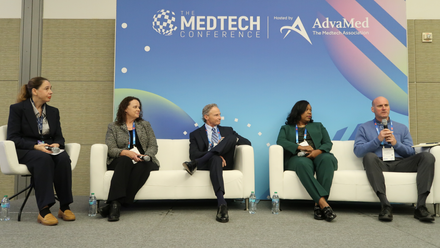
Angela Krueger, deputy director for regulatory policy at CDRH, recently spoke at a panel at the 2023 MedTech Conference where she noted the agency is continuing to work on figuring out the limitations of PCCPs beyond AI/ML products and asked stakeholders to engage with the agency to discuss where those limitations may be (RELATED: Figuring out the limits of predetermined change control plans, harmonizing regulations, Regulatory Focus, 19 October 2023).
Another key takeaway from the same panel is that industry stakeholders want regulatory agencies to harmonize their efforts to develop PCCP frameworks for AI/ML products. Medtech sponsors said that they are concerned that a nonharmonized system could increase administrative burdens by requiring them to duplicate work across jurisdictions. US, Canadian and UK regulators seem to have acknowledged that concern in the guiding principles document.
“International harmonization and stakeholder consensus on the core concepts of PCCPs will help support the advancement of responsible innovations in the digital health space,” the document states.
Tazbaz noted that the joint document builds on CDRH’s AI/ML action plan and its commitment to health equity as stated in its 2022-2025 Strategic Priorities. “Both of these documents build on efforts outlined in the FDA’s AI/ML action plan and demonstrate how the FDA is thinking globally about health equity,” he said. “Collaborating with the FDA’s international colleagues to advance equity is important, because AI/ML-enabled devices are developed and deployed globally.”
PCCP for MLMD guiding principles