Convergence: Change and collaboration are the future of the regulatory profession
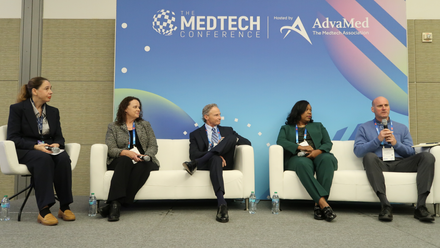
MONTREAL – The regulatory professional of the future will need to embrace change and deeper collaboration at a faster pace and on a greater scale than previously seen, according to panelists at the opening plenary session of RAPS Convergence 2023.“Change in regulations is the whole reason why we all exist here,” said session moderator Megha Iyer, MS, RAC, director of global scientific regulatory affairs at Thermo Fisher Scientific and vice chair of the Convergence Planning Committee.
Regulatory professionals will also need to develop a broader range of skills while leaving old ones behind, adopt new technologies like artificial intelligence (AI), and consider the environmental impact of regulatory decisions, the panelists said.
Empowered by technology
Key to this new regulatory future is adaptability, “not in the sense of being flexible, but in the sense of being able to develop new skills,” said Iordanis Gravanis, MD, PhD, head of scientific advice at the European Medicines Agency.
With the advent of AI and machine learning, the ability to develop new skills will be a challenge, Gravanis noted. “We’re going to need to change our jobs considerably in the future,” he said.
Critical thinking will also be an important tool in the regulatory professional’s armamentarium, according to Amin Osmani, MSc, chief executive officer of Cedience Inc. “Critical thinking is, in our belief, the piece that will be important in everything that you do when technology is involved,” he said.
Osmani said he envisions a future “where every single one of you will be empowered by technology to play more valuable roles within your organizations.”
“You're going to be more central instead of peripheral. You're going to be equipped with information that allows you to impact very specific decisions and critical decisions at the right time and the right place and quickly. Critical thinking is the tool for you to be able to evaluate what matters, what doesn't matter, what's important, what's not important,” he said.
Influence will also play a role in the regulatory professional’s future, Amrit Ray, MD, MBA, chief executive officer of Principled Impact, LLC, told attendees. The most effective regulatory professionals are science-driven, empowered by technology, master connectors both inside and outside their companies, and champions for patients. “I think for futuristic regulatory professionals, this will be a wonderful skillset to develop,” he said.
‘Collaborative muscle’
Developing a “collaborative muscle” can be “one of the best skills” to have as a regulatory professional, Kelly Robinson, director general of marketed health products directorate at Health Canada, told attendees. Regulatory professionals should think not only about collaborating within a team, but also across sectors, “between government regulators and industry regulators, regulatory professionals,” as well as supporting patients.
"Are there collaborations that can happen along that way that can really support patients, that can allow you to absolutely meet your mandate, but allow you to contribute to something that's bigger that ultimately is supporting patients and getting us closer to accessing different types of products?" she asked.
Janet Woodcock, MD, principal deputy commissioner at the US Food and Drug Administration, spoke virtually to attendees. She said that awareness will be important for the regulatory professional of the future.
“I think one of the skillsets I've always brought to the table is the ability to kind of foresee what's going to come down in the future and look forward and prepare,” she said. “And to do that, you need to gather information from so many different places.”
Looking to the future
In a discussion session, Iyer posed a question about what signals are on panelists’ radars for the future. Gravanis said technology advances, patient engagement, affordability and access, environmental impact, supply challenges, and international collaboration are all on his horizon.
“I think that these are the things that will shape the future the way that we see it now,” he said.
Ray told attendees that health equity, which includes “access on the next level so that the most vulnerable in our society are given that extra attention,” should also be considered and implemented “across the value chain of the innovation process.”
“I think our ability to say, ‘I don't just own this slice of silo, but I actually have a responsibility that transcends that and extends to the whole ecosystem,’ I think that that is going to be an important variable,” he said.
How does the regulatory professional decide what is most impactful? Robinson said it’s about keeping an open mind and then considering “not so much about what it's doing to you today, but where is it likely to go tomorrow, and the day after, and what's happening next, and who else is implicated.”
Iyer also asked the panelists how a regulatory professional should decide what areas to act on or bypass.
Osmani said it’s important to leverage expertise in that situation. “So for the noise that we hear in technology, whether it is ChatGPT, generative AI and all the different technologies that come out, understanding where can they be applied within the right framework, within the right box, and create good value for you is the number one game for us, and doing that as quickly as possible,” he said.
The answer is rarely straightforward, Ray said. Spotting a trend early and influencing others to act on your intuition can be challenging.
“It's something that I've observed that there are sometimes people who are solo artists, and they often don't see the pattern. But people who are able to be a magnet for collaborators, people who are able to bring strong talent around them,” he said, “that often gives you a different way of looking at the problem.”
In terms of thinking more futuristically, Osmani said larger organizations are “investing heavily” in AI, while smaller companies are wondering how they can “play the same game that the larger pharmaceutical companies and larger medical device companies play.”
Osmani encouraged regulatory professionals to research the limitations of AI technology, including its inability to properly reason, to dive deep into subjects, or to capture pieces of information that are invisible to it. “The fear is reasonable because of how quickly things are moving. But the reality is quite disconnected from the hype that we hear,” he said.
Considering the environmental impact of AI, Osmani said it’s time for regulation to enter the AI space and examine these questions. “These questions are not being asked, but this is the room to ask these questions,” he said. “This is the room to wonder about these things. I wish I had an answer, but I think it's up to us.”
The next five years
Over the next five years, panelists said topics likely to be discussed at future meetings include regulatory convergence, harmonization and real-world evidence, trust in science and regulation, technology and the shift to globalization, and a focus on prevention versus treatment.
“I think on stage we'll definitely have more technology companies, Osmani said. “We'll be talking a lot more technology and where it's moving forward. I think we'll shift in terms of globalization and think about the remaining gaps.”